
Home › Air & Space
Boeing, Lockheed all smiles as Artemis II lifts off
By APDR
•Apr 2, 2026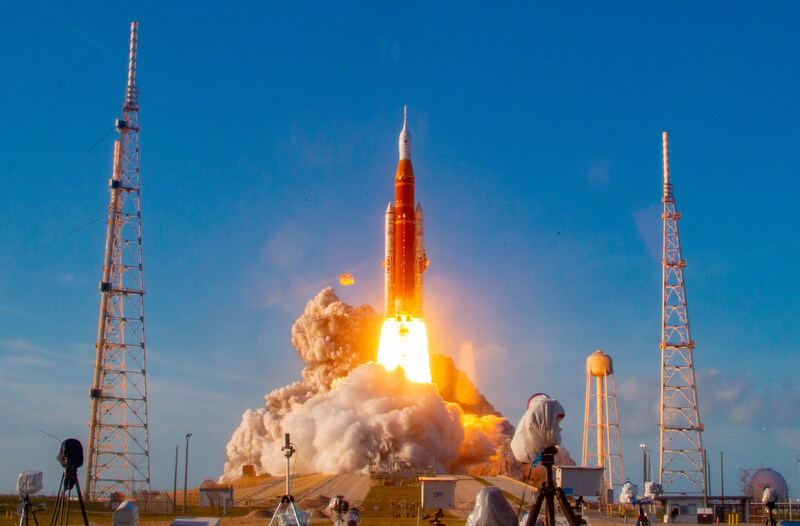
Officials at Boeing and Lockheed Martin were surely all smiles Thursday (Wednesday in the US) as NASA’s Artemis II mission lifted off on its way to the Moon, the first time mankind has visited Earth’s companion since 1972. The Artemis II mission was launched on the Space Launch System rocket, powered by the Boeing-built core stage. It lifted off at 6:35 p.m. ET on 1 April. Eight and a half minutes into flight, the core stage successfully completed its mission and separated from the upper stage of the rocket, enabling NASA’s Orion spacecraft, Integrity, to carry humankind around the Moon. NASA’s Orion spacecraft was built by Lockheed Martin. For this first crewed test flight of the Artemis program, Orion is carrying four crew members – NASA astronauts Reid Wiseman, Victor Glover and Christina Koch, and Canadian Space Agency astronaut Jeremy Hansen. During the 10-day mission, the astronauts will complete two orbits around Earth before traveling nearly 5,000 miles beyond the far side of the Moon and almost 250,000 miles from Earth. “We’re honoured to support NASA in restoring a capability vital to our nation’s interests and future,” said Steve Parker, president and chief executive officer of Boeing Defense, Space & Security. “Boeing and our Space Launch System partners are committed to NASA’s mission to return astronauts to the moon, to establish a sustained lunar presence, and continue our exploration of deep space.” The core stage built by Boeing demonstrated several important operations, including the pre-launch fuelling of both tanks, actuating the hydraulic system, igniting the engines, running thrust vector control programs in flight, depleting the fuel tanks, shutting down the engines, and conducting successful separation and disposal manoeuvres. “Today we witnessed our friends embark on a historic mission aboard our rocket,” said John Shannon, vice president, Boeing’s Exploration Systems business. “Our focus has been on prioritising the quality of the vehicle and the safety of the crew as they begin their journey. This rocket is designed to withstand incredible forces while speeding through the atmosphere, and it performed exactly as intended. I want to extend my heartfelt thanks to our dedicated team and partners for their hard work in making this part of the mission a success.” The core stage of the rocket stands at 212 feet (almost 65 meters) and consists of a 196,000-gallon liquid oxygen tank and a 537,000-gallon liquid hydrogen tank. It also includes an intertank section that joins the two fuel reservoirs, a forward skirt that connects to the upper stage, and an engine section at the bottom with four RS-25 engines, which together produce 2.2 million pounds of thrust. A Boeing team manufactures the core stage at NASA’s Michoud Assembly Facility in New Orleans, Louisiana, and uses components made by suppliers in more than 38 states. The Boeing team is preparing the next core stages for the Artemis III to V missions, which are already in production at Michoud and Kennedy. The mood at Lockheed Martin was as upbeat as Boeing’s. “Today’s launch is just the beginning of this mission, where we look forward to testing the Orion systems and proving it will be capable of transporting crews to the lunar surface and return them home,” said Robert Lightfoot, president, Lockheed Martin Space. “This historic moment marks a renewed journey to the Moon and a critical step toward future crewed landings.” The Orion spacecraft for this mission – named Integrity by its astronaut crew – features several new systems to help keep humans safe in deep space. These include: Environmental control and life support systems, critical to keep the crew safe and comfortable Updated displays and controls for the crew to fly Orion Audio communications including an experimental laser communication system to communicate with NASA mission control in Houston Fully functional Launch Abort System to pull Orion and the crew to safety in the event of an emergency during launch Exercise machine, potable water and galley to maintain strength, hydration and nutrition Waste management system and hygiene bay, a first for a deep space mission Over the 10-day mission, the crew will perform a multitude of critical system checkouts, including a proximity maneuvering demo, to verify the vehicle’s readiness for deep space operations. They will travel on a free-return trajectory around the Moon – conducting observations and imaging of the far side lunar surface – that will generate essential data on spacecraft performance and human health in deep space to enable future landing missions. On April 10, after completing its 10-day mission around the Moon, Orion and its crew will re-enter the Earth’s atmosphere at 30 times the speed of sound and then slow down to just under 20 mph, splashing down in the Pacific Ocean off the coast of San Diego, California. “Our team has poured years of precision, problem solving and passion into building Orion and seeing it on its way to taking astronauts around the Moon in this test flight is incredible,” said Kirk Shireman, VP and Orion program manager at Lockheed Martin Space. “We are excited for this mission to prepare for future crewed flights, seeing humans go farther than we’ve gone before and proving the Moon is once again within our reach.” The public can track Orion and its crew in real time during the mission, including distances from the Earth and Moon, mission duration, and more. NASA’s Artemis Real-time Orbit Website (AROW) will create visuals from Orion data. Updates will also be sent out in real-time over Lockheed Martin Space’s X channel. For Editorial Inquiries Contact: Editor Kym Bergmann at [email protected] For Advertising Inquiries Contact: Group Sales Director Simon Hadfield at [email protected]
TAGSArtemis IIBoeingLockheed Martin
Previous article
Saab opens key test site for Australia’s Hobart class destroyers