




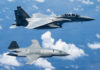
One of the happiest companies at the LIMA exhibition in Malaysia is KIA, which is seeing increasing demand for its T-50 / FA-50 family of trainer and light combat jets. The production line in Sacheon, South Korea, is turning them out at a rate of up to four per month and that number might be boosted by further orders.
Announced earlier in the year, the contract For Malaysia will be signed today for the purchase of an initial 18 FA/50 Block 20 aircraft, the most advanced of the available variants. This is also the same version ordered by Poland in September last year, which will receive 48 of them. There is a good chance that both countries will increase their orders, along with some other T-50/FA-50 users.
In the case of Poland, urgent delivery with an important issue given the need to deter Russian aggression and the RoK Air Force very generously gave up 12 of their own production slots to allow expedited delivery. Combined with a highly automated production line – for example a robotic paint shop that runs 24 hours per day – KAI is an exemplar of a company able to build aircraft at both speed and scale.
Probably the most important improvement in the Block 20 aircraft is the incorporation of Raytheon’s PhantomStrike active electronically scanned array (AESA) radar. Weighing less than 70kg it is about half the weight of previous systems and with digital beam forming can be used for targeting ground and air threats simultaneously. It is expected to be retrofitted onto earlier model FA-50s, including those flown by the RoKAF.
Other customers of the T-50 / FA-50 are Thailand, Indonesia, Iraq and the Philippines. Co-designed with Lockheed Martin, the aircraft have the same appearance as a slightly smaller F-16 ‘Fighting Falcon’.
In parallel, the company’s flight test program for their advanced, supersonic, twin engine combat jet the KF-21 is on schedule – or in some areas ahead of it. The fifth aircraft in the series has now commenced flying and the combined fleet has now carried out almost all of required tests for combat, including weapons release. In the nomenclature of DAPA – the purchasing body – the F-21 has now achieved stability in its combat configuration.
It is remarkable to reflect that even a decade ago defence technology companies from South Korea were relatively unknown, but now KAI and a number of other entities are globally competitive.
(APDR would like to thank Adam Thomas for his assistance at the LIMA exhibition)

For Editorial Inquiries Contact:
Editor Kym Bergmann at [email protected]
For Advertising Inquiries Contact:
Director of Sales Graham Joss at [email protected]



Why isn’t Australia getting closer to Korea in terms of defence equipment?
Cheaper, quicker deliveries, technology transfers.
Seems we’re going from being able to operate alongside the US to being part of and subservient to the US
I absolutely agree. Also Korean companies are happy to look at technology transfer and local manufacture.