Next-Gen Jammer Mid-Band pod completes developmental testing
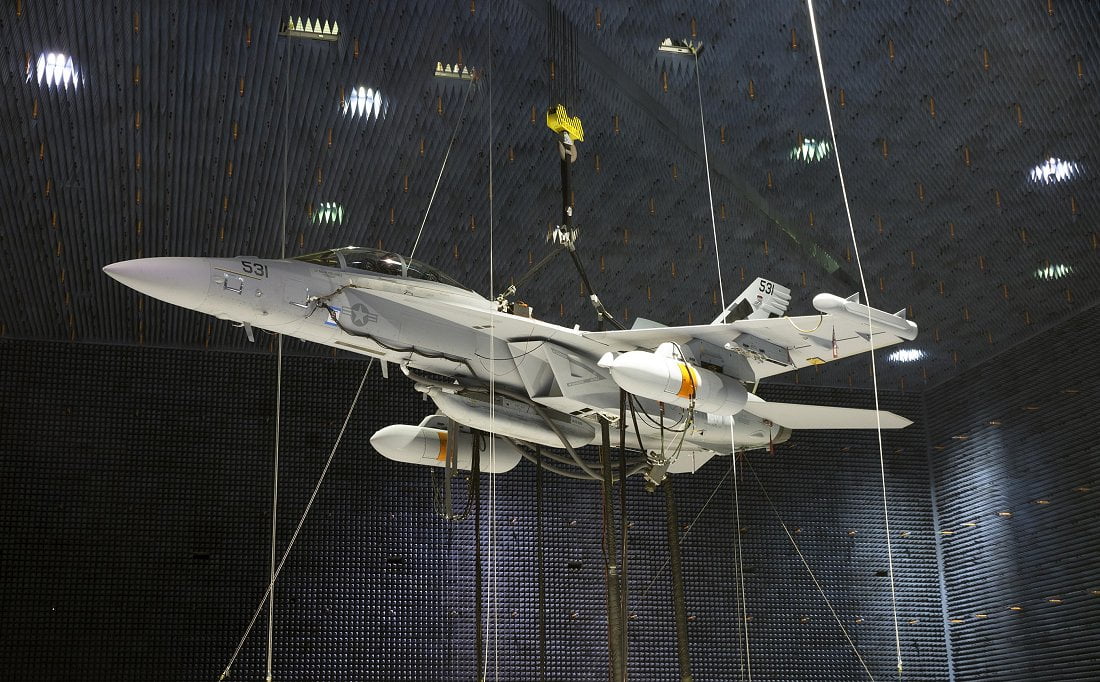
The U.S. Navy has recently completed a portion of developmental testing on the Next Generation Jammer Mid-Band (NGJ-MB) developmental pod in the Air Combat Environmental Test and Evaluation Facility anechoic chamber at Naval Air Station Patuxent River, Maryland in the U.S.
The Raytheon-developed pod completed more than 400 hours of of basic functionality, Electromagnetic Environmental Effects (E3) data collection and performance testing over a period of three months, according to the U.S. Navy’s Naval Air Systems Command (NAVAIR).
“This chamber test period was instrumental to the NGJ-MB Developmental Test program, and its success was the direct result of outstanding teamwork among the Program Office, Integrated Test Team, and Raytheon stakeholders,” said Capt. Michael Orr, Airborne Electronic Attack Systems program manager. “Data captured during this period not only supports our initial flight clearance, but also provided lessons learned that will benefit the entire NGJ-MB test program moving forward.”
This follows the award of a US$403 million ($703.8million) contract to Raytheon in January this year to deliver NGJ-MB, which has been designated the designated ALQ-249(V)1 by the American military, System Demonstration Test Articles (SDTA) pods to the fleet once developmental and operational testing is complete.
The NGJ-MB system consists of two pods, referred to as a shipset, which will be loaded onto EA-18G Growler aircraft. The system will provide significantly improved Airborne Electronic Attack (AEA) capabilities against advanced threats in the mid-band frequency range through enhanced agility and precision within jamming assignments, increased interoperability and expanded broadband capacity for greater threat coverage against a wide variety of radio frequency emitters.
The NGJ-MB systems will initially augment the legacy ALQ-99 Tactical Jamming System until the low- and high-band components of the NGJ program are ready. NGJ-MB pods are also scheduled to enter flight testing on board American Growlers during the first half of this year, with the program scheduled for Initial Operating Capability (IOC) in 2022.
Australia is participating in the NGJ program to equip the RAAF’s own Growlers, having signed a Memorandum of Understanding to be a cooperative partner in the NGJ-MB program in 2017. Australia’s Growler fleet declared IOC in April 2019 and is planned to attain Full Operating Capability in 2022.