
Australia stands up to China – by delaying submarine project for a decade
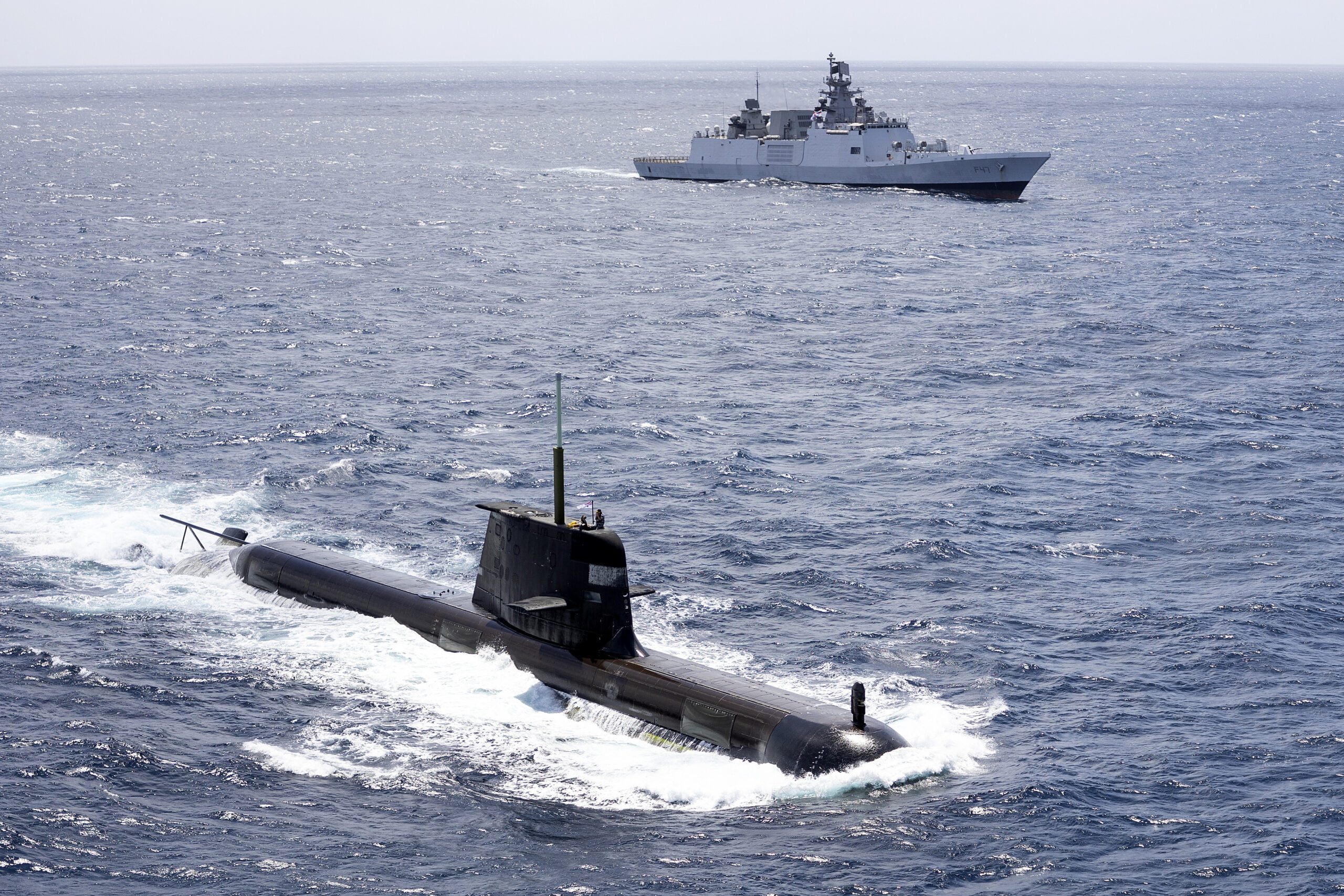
At least the plan to develop 12 Attack class submarines with French technology – as flawed as it was – had some chance of delivering a capability to the RAN around 2032. The idea of now completely switching direction and aiming for nuclear propulsion supplied by either the US or the UK has set that back by 10 years. As more details become known – or rather as the lack of detail becomes increasingly apparent – this deal is looking more like a back of a beer coaster list of ideas compiled by some senior political advisors rather than a coherent plan. With a startling change of direction, Australia has managed to enrage France, with unknown long term diplomatic and trade repercussions. This goes on top of earlier efforts that similarly enraged Japan when then Prime Minister Tony Abbott assured his counterpart in 2014 that they had the future submarine project in the bag. At least the Japanese were put out of their misery in about one year, unlike the five years of effort put in by Paris and Cherbourg. Having said that, Naval Group has been paid a lot of money – with even more to come – so their hurt feelings have already been generously compensated for by rivers of Australian cash. To the list of countries offended by Australia regarding submarines, Sweden can be added to the list. As the designer of the Collins class and shareholder in the Australian Submarine Corporation, the Swedes were mightily annoyed in the year 2000 when Defence nationalised the company, kicking them out with the message that they were no longer welcome and that the US would step in and fix all remaining technical problems. Of course, that never happened – and then in 2014 to add insult to injury a New Generation Collins class was absurdly excluded from the mix, mainly because a few senior bureaucrats had developed a personal dislike of dealing with Sweden. To be in this position of changing direction again and “stabbing in the back” the French, after already doing so to the Japanese and the Swedes is a collective display of incompetence by successive governments, the Defence bureaucracy and the RAN. If it were not so serious, this lack of process and the squandering of billions of dollars resembles a family of orangutans trying to water a garden with a high-pressure hose. To the extent that a justification has been provided, it is that strategic circumstances have deteriorated to such an extent that nuclear powered submarines are needed to secure Australia’s security. This is fine, with such submarines having several advantages over conventional diesel-electric boats, including range, speed and endurance. However, the time frame for their introduction is laughable, with best case estimates being at the end of next decade. In the meantime, Australia will only have six Collins submarines, the life extension program of which is only scheduled to begin in 2026, rather than immediately. If the government is actually serious about having nuclear powered submarines, why not have structured a FAUSUK treaty – France, Australia, US and UK – that could have produced a nuclear powered Attack class and taken advantage of all the work done for the last five years rather than throwing everything in the rubbish bin? In one of many ironies, the parent Barracuda class is indeed a nuclear-powered attack submarine – and an extremely good one of that, being more stealthy than counterparts from the US and UK. Redesigning it as a conventionally powered boat was always problematic, to put it mildly. The Attack class were already a hybrid US-French product with the combat system to be supplied by Lockheed Martin. At its heart is the AN-BYG1 tactical data handling system that equips Virginia class attack submarines – and a great deal of work has already taken place Australianising that system, which is already also in the Collins class. Why not extend this principle of cooperation to the submarine’s power source and replace a French nuclear reactor in the Barracuda/Attack class with one from the US or the UK? The importance of doing so is that French naval reactors use relatively low-grade commercial uranium fuel. This design choice means that they need to be refuelled about every ten years – a hazardous process that can only take place with the assistance of the country’s commercial nuclear industry, which does not exist in Australia. US and UK reactors use much higher-grade fuel and have enough energy to last for the lifetime of the submarine itself – in excess of 30 years – so no refuelling is required, negating the need for local support. One can be almost certain that this rather obvious avenue has never been explored with the French. Ultimately France might have said no to such an arrangement – though it seems to have benefits for everyone – at which point Australia would have been perfectly entitled to have gone down the AUKUS path. However, what has taken place is a highly secret deal designed to exclude the French and, in the process, write off more than $4 billion – and counting. The reason why this looks like a political backroom deal is that the way forward will be studied by the bureaucracy for the next 18 months. Here’s a strange thought: why not study the idea first before announcing it? What happens if the study concludes that Australia does not have the infrastructure to build nuclear submarines? Or that the timetable and the level of risk are unacceptable? If Labor is in power then, what will they do? We were all told repeatedly that the deal with France was not about buying submarines, it was developing a sovereign industrial capability that would make Australia independent forever. This huge effort costing billions was to replace the sovereign capability built up in the late 1980s and 90s to build and support the Collins fleet. All of that has now been ditched and by the look of it we will try for a third time with input from the US and the UK – both countries that are extremely protectionist when it comes to their own defence sectors – to again recreate an industry. This is beyond ridiculous. There seems to be something particularly cursed about Australia’s floundering attempts to replace Collins. It’s actually fairly straightforward – most other countries manage it in a smooth, transparent and seamless way. Here we have had six years of unconscionable neglect by the Rudd-Gillard governments, followed multiple changes of direction, damage to Australia’s reputation, huge financial losses – and still no new submarines even remotely on the acquisition horizon. This is what happens when Defence policy – particularly for submarines – becomes politicised. If only work on a Nextgen Collins had started in 2010 when it should have the first of a new class of ultra-modern conventional submarines would be going into the water now, massively boosting our deterrent capabilities. Australia would have had the design expertise to be working on our own nuclear submarines that, in conjunction with the US, UK and even France, could start to enter service at the start of the next decade rather than at the end of it. Because of this mess either this government or the next one will have to look at interim solutions. Is it possible that the US would lease two or three Virginia class to us as gap fillers? The RN only has three Astute class out of a maximum of seven to be built, so the chances of getting any of them seem less than zero. A case can be made for a gap-filler to be provided with the purchase of German or Swedish conventional submarines given that France is now unlikely to want to have anything more to do with Australia, even if we begged. A more imaginative approach would be to speak with South Korea about their KSS-III batch 2 submarines. These are about the right size for Australia at 4,000 tonnes and as well as torpedo tubes have a 6-cell vertical launch missile system, making them arguably the most potent diesel-electric submarines in the world. South Korea is also considering building nuclear submarines and discussing a way forward with them might be very worthwhile. However, given the lack of imagination, direction, and leadership that has become the norm in Australia, don’t expect anything to happen while we thrash around trying to figure out what to do. For Editorial Inquiries Contact: Editor Kym Bergmann at [email protected] For Advertising Inquiries Contact: Director of Sales Graham Joss at [email protected]
Previous article
Leonardo joins UK MoD for aircraft program
Kym Bergmann has more than 35 years of experience in journalism and Australian and international defence industry. After graduating with Honors from the Australian National University, he joined Capital 7 television, holding several positions including foreign news editor and chief political correspondent.
After 2 years on the staff of a Federal Minister, he moved to the defence sector and held senior positions in several companies, including Blohm+Voss, Thales, Celsius and Saab. In 1997 he was one of 2 Australians selected for the Thomson CSF 'Preparation for Senior Management' MBA course, the other being Chris Jenkins - formerly the CEO of Thales Australia.
He has also worked as a consultant for a number of companies, including Raytheon, Tenix (now part of BAES) and Martin Marrietta (now part of Lockheed Martin). He had several board appointments, including Thomson Sintra Pacific (1994 - 96) and Saab Pacific (1998 - 2003).
He retains good personal links with senior figures in Government, as well as in industry and the media. He decided to return to journalism in May 2008, and holds the position of editor for Asia Pacific Defence Reporter (APDR) and Defence Review Asia (DRA). He is also a podcaster and commentator on defence and national security issues.
Comments
Loading comments...