
Home › Sea
Australian hopes for Virginia class sink as Columbia SSBNs gets priority
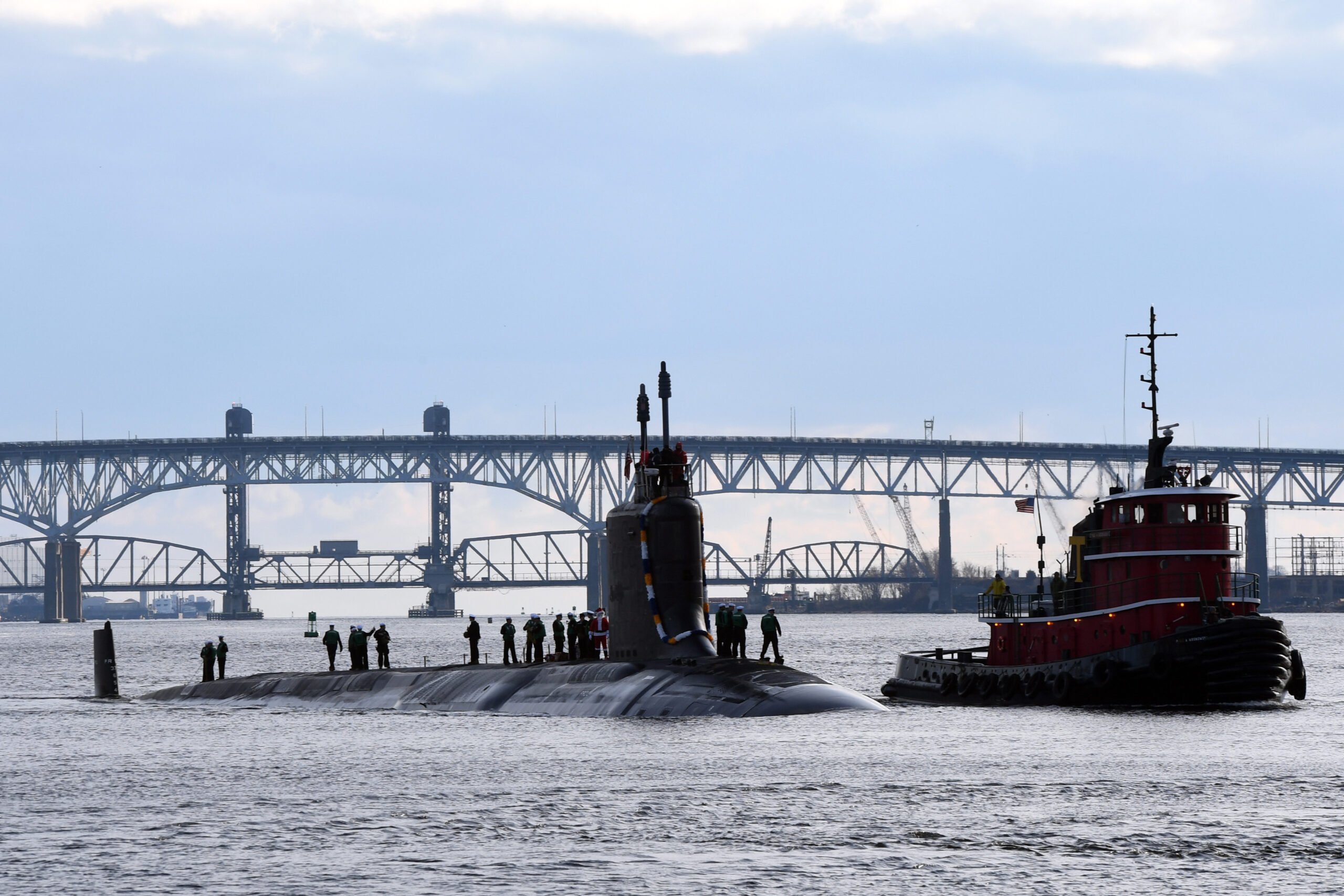
The US Government Accountability Office (GAO) has concluded that the country’s already overstretched industrial base faces increasing difficulties constructing Columbia nuclear missile firing SSBNs and this is already causing delays on the Virginia program. As the third component of the nuclear deterrence triangle – along with crewed bombers and ICBMs – the Columbia class are the USN’s highest priority acquisition. In a report released on January 24, the GAO – the equivalent of the ANAO – made it clear that the Columbia program is in early trouble, saying: “After more than a year of full-scale construction of the lead Columbia submarine, the shipbuilders are facing delays because of challenges with design, materials and quality. The shipbuilders are working to mitigate delays using additional shipyard resources, such as more staff to complete work more quickly. “Because of the Columbia class program’s essential role in strategic deterrence, it has priority status over most national defense related programs, including the Virginia class program. The shipbuilder added staff to the Columbia class program who were originally planned for the Virginia class program, contributing to delays for that program. “However, long-term planning does not account for shared risks between these programs that are likely to present production challenges and could result in additional costs. Without updated long-term planning, the Navy cannot be certain that the fiscal year 2024 budget request will be sufficient to meet the production schedule it has planned for these submarine classes.” In other words, for the foreseeable future it will be impossible to ramp up the speed of the construction of the Virginia class – a further indication that if Australia will receive any, it will be at some very distant future point. Seemingly oblivious to this reality, Defence Minister Richard Marles has pre-empted both the Defence Strategic Review and the AUKUS announcement by ruling out the acquisition of a new class of conventionally powered submarines constructed in Adelaide. In doing so, he is toeing the RAN line – which after the cancellation of the “regionally superior” Attack class is fixated entirely on nuclear powered submarines, irrespective of the cost or schedule. Whether the nuclear-powered task force led by VADM Jonathan Mead – which is costing about $500,000 per day – is taking this reality about US production difficulties into account is unknown. However, if his report on the way ahead – due to be made public at the end of March – does not fully deal with these issues it will be just so much waffle to be dumped on the pile of good intentions. Washington is committed to spending $132 billion (a whopping AU $187 billion) on 12 Columbia SSBNs and they are the largest and most complex submarines the US has ever built. These leviathans of the deep weigh around 21,000 tonnes – almost three times the displacement of a Virginia – and are 171 metres in length. Designed to replace the ageing Ohio class, they will be able to launch 16 Trident D5 nuclear-tipped missiles with a range believed to be around 12,000km. SSBNs are considered the most secure part of a country’s nuclear arsenal because they can remain undetected deep beneath the waves and therefore are far less susceptible to being wiped out in an enemy first strike. One of the main purposes of smaller, faster, SSNs such as the Virginia class is to hunt enemy ballistic missile firing submarines – and to protect one’s own fleet of them. Since Australia has no SSBNs to protect, this removes one justification for the need for SSNs. The GAO report says two U.S. shipbuilders—General Dynamics Electric Boat (Electric Boat) and Huntington Ingalls Industries Newport News Shipbuilding (Newport News)—design and build nuclear submarines. Electric Boat is the prime contractor for design and construction of the Columbia class, with Newport News serving as its major subcontractor. Newport News also builds Ford class aircraft carriers. Electric Boat and Newport News are preparing for the most significant increase in ship construction in over 30 years. The shipyards are constructing both submarine programs while also completing various activities necessary to sustain existing submarines, and in the case of Newport News, building Ford class aircraft carriers. The shipyards are basing their plans for shipbuilding on the Navy’s plans to procure two Virginia class submarines per year through 2033 and one Columbia class submarine per year starting in 2026. To make a bad situation worse in terms of resources, the USN wants to speed up the construction of the Columbias from the current 84 months to 78 months, putting even more pressure on the shipyards. The GAO worries that it is doing this by cutting some regulatory corners by reducing the level of risk analysis associated with the build, writing: “The Navy and DOD lack essential schedule insight because the shipbuilder has not 1) conducted a schedule risk analysis of the lead submarine’s construction schedule or 2) provided schedule data in a format that the Navy can easily use to validate the schedule’s quality.” This situation is already flowing through to Virginia class production: “After more than a year of full construction for the lead submarine, overall construction progress was behind where Electric Boat planned to be under its accelerated schedule. In response, the shipbuilders prioritized Columbia class construction over Virginia class construction. The Navy needs additional long-term planning to identify risks that are shared between both submarine programs.” The GAO says because of the Columbia class program’s essential role in strategic deterrence, it has priority status over most national-defense-related programs, including the Virginia class program. To mitigate growing schedule delays, the shipbuilder is adding staff to the Columbia class program by using workers that were originally planned for the Virginia program. The report quotes the USN as saying the shipbuilders plan to add more workers beyond its original staffing plan for Columbia class construction work until it recovers from schedule delays. This will likely result in additional delays to the Virginia class program. For Editorial Inquiries Contact: Editor Kym Bergmann at [email protected] For Advertising Inquiries Contact: Director of Sales Graham Joss at [email protected]
TAGSColumbia ClasssubmarinesVirginia class
Previous article
Airbus launches defence fund R&D projects
Kym Bergmannhttps://asiapacificdefencereporter.com/
Kym Bergmann has more than 35 years of experience in journalism and Australian and international defence industry. After graduating with Honors from the Australian National University, he joined Capital 7 television, holding several positions including foreign news editor and chief political correspondent.
After 2 years on the staff of a Federal Minister, he moved to the defence sector and held senior positions in several companies, including Blohm+Voss, Thales, Celsius and Saab. In 1997 he was one of 2 Australians selected for the Thomson CSF 'Preparation for Senior Management' MBA course, the other being Chris Jenkins - formerly the CEO of Thales Australia.
He has also worked as a consultant for a number of companies, including Raytheon, Tenix (now part of BAES) and Martin Marrietta (now part of Lockheed Martin). He had several board appointments, including Thomson Sintra Pacific (1994 - 96) and Saab Pacific (1998 - 2003).
He retains good personal links with senior figures in Government, as well as in industry and the media. He decided to return to journalism in May 2008, and holds the position of editor for Asia Pacific Defence Reporter (APDR) and Defence Review Asia (DRA). He is also a podcaster and commentator on defence and national security issues.