
Home › Air & Space
UPDATED: Ukraine requests unwanted Army Taipan helicopters
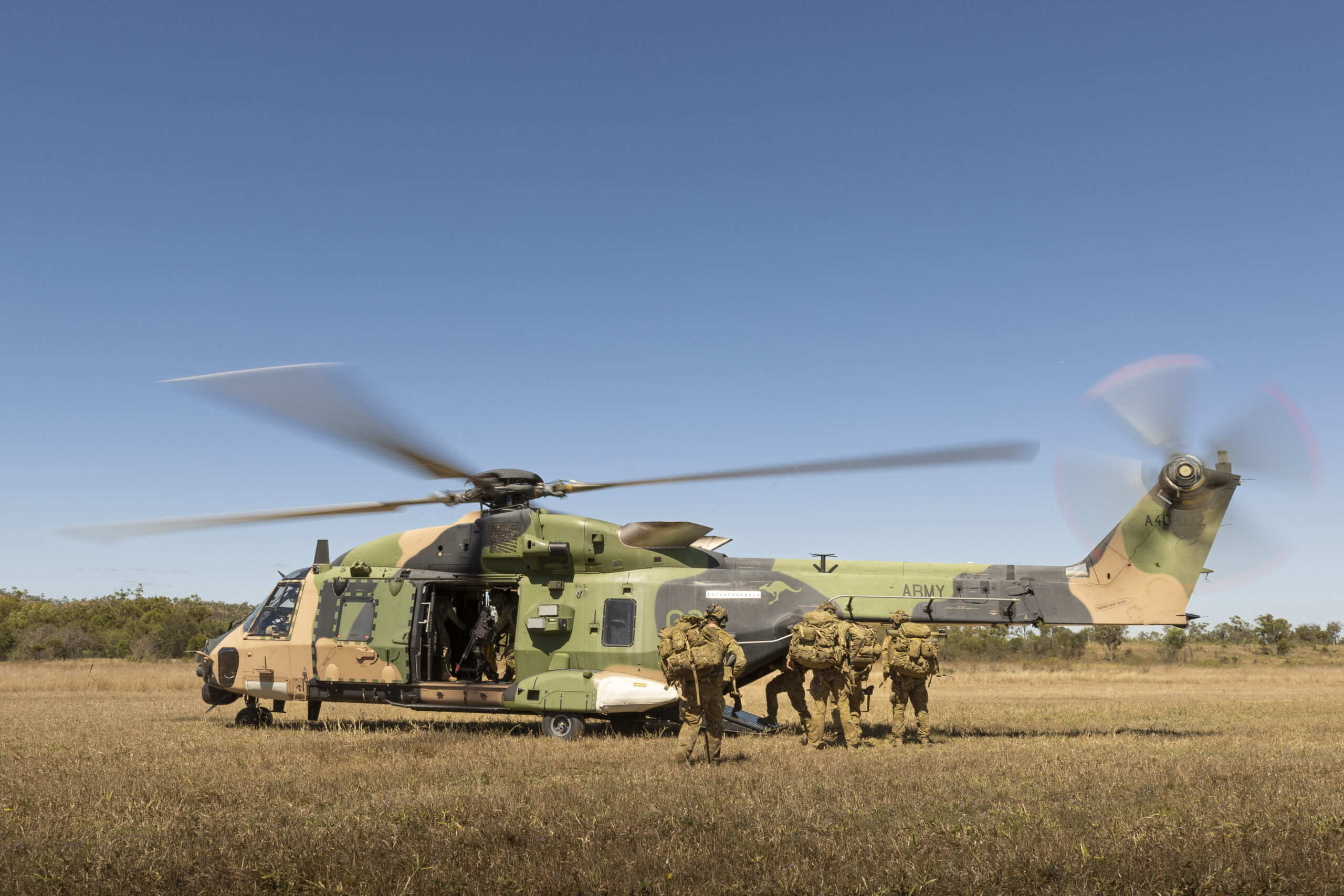
Technicians are currently – and in secret – disassembling all 45 Army Taipan Multi Role Helicopters and will bury the components on a Defence site. Worth around $20 million each on the second-hand market, the decision has been taken to instead destroy them on the quiet in the hope that no one notices. Ironically the 10-tonne, twin-engine Taipans are being pulled apart rather than cut up because their carbon fibre construction is so robust. After the publication of the original story – and the shocked reaction to it – Defence Minister Richard Marles now says that the helicopters will be disposed of in a manner that maximises their value, whatever that means. APDR understands that the Federal government has recently received a request for the retired and unwanted Taipans from Ukraine. The decision to dismantle and bury the Taipans was taken at the same time as an announcement was made on September 29 that they would not return to service following a crash during Exercise Talisman Sabre that claimed the lives of four service personnel. Defence has informally ruled out the helicopter itself as being the cause of the accident. The Taipans are in excellent condition – and if the Army had been capable of maintaining them, they would be doing valuable work in Far North Queensland right now. As it happens, all that can be deployed are two CH-47 Chinooks that are unsuited to low level rescue work because of the huge down draft from their twin rotors – though they have undertaken huge numbers of disaster relief missions – and some AW139s that operate from fixed airfields. With the withdrawal from service – and now destruction – a huge capability gap exists for both the Army and Special Forces. Only three replacement UH-60M Blackhawk helicopters have arrived in Australia and none of them are currently operational. Rather than an expedited delivery – as claimed by the government – they were four weeks late. Army is paying almost $3 billion for 40 Blackhawks. More than 500 helicopters in the Taipan family have been sold to 14 countries. They outperform Blackhawk in all key metrics – speed, range, payload and cabin volume. Taipan is an extremely modern, fully digital fly-by-wire machine with features such a four-axis flight control system, advanced avionics and world-leading night vision equipment. By comparison, an Army insider described Blackhawk as the aviation equivalent of a “farm tractor.” Another vital feature for amphibious operations from a safety viewpoint is that Taipan is fitted with flotation devices while Blackhawk is not. This was on display in March when due to pilot error a Taipan ditched in Jervis Bay with everyone exiting the aircraft safely. It is understood that the accident was due to a senior, but inexperienced, officer at the controls – and because of his rank no one attempted to correct the mistaken emergency procedure being implemented after an engine overheated. If proper protocol had been followed there is enough reserve power on a single engine to get out of trouble. In similar circumstances a Blackhawk helicopter would have sunk, possibly within seconds. The cause of the Talisman Sabre crash is still being investigated – and the results will probably remain secret because it is already clear that the cause was operator error. That is not necessarily to blame the pilot – who might also have been involved in the Nowra incident – because the weather was bad and the training mission was conducted at low level. Why senior levels of Defence – and Ministers Richard Marles and Pat Conroy – have gone along with this multi-billion-dollar travesty is unknown. It has been an open secret that the enthusiasm for Blackhawk comes from a small cadre of officers who formed an overly sentimental attachment to them during deployments in Afghanistan. Rather than sell the Taipans to a competent user, such as Indonesia, Defence instead has offered New Zealand some pieces of hardware – for free. These are likely to include some expensive items such as main, intermediate and rear-rotor gearboxes. For Editorial Inquiries Contact: Editor Kym Bergmann at [email protected] For Advertising Inquiries Contact: Director of Sales Graham Joss at [email protected]
TAGSTaipan helicopters
Previous article
GCAP to keep aircraft development costs down for Japan
Kym Bergmannhttps://asiapacificdefencereporter.com/
Kym Bergmann has more than 35 years of experience in journalism and Australian and international defence industry. After graduating with Honors from the Australian National University, he joined Capital 7 television, holding several positions including foreign news editor and chief political correspondent.
After 2 years on the staff of a Federal Minister, he moved to the defence sector and held senior positions in several companies, including Blohm+Voss, Thales, Celsius and Saab. In 1997 he was one of 2 Australians selected for the Thomson CSF 'Preparation for Senior Management' MBA course, the other being Chris Jenkins - formerly the CEO of Thales Australia.
He has also worked as a consultant for a number of companies, including Raytheon, Tenix (now part of BAES) and Martin Marrietta (now part of Lockheed Martin). He had several board appointments, including Thomson Sintra Pacific (1994 - 96) and Saab Pacific (1998 - 2003).
He retains good personal links with senior figures in Government, as well as in industry and the media. He decided to return to journalism in May 2008, and holds the position of editor for Asia Pacific Defence Reporter (APDR) and Defence Review Asia (DRA). He is also a podcaster and commentator on defence and national security issues.