
Home › Sea
From the Magazine: THE SOLUTION TO THE SURFACE COMBATANT SHORTFALL – NEW GENERATION ANZAC FRIGATES
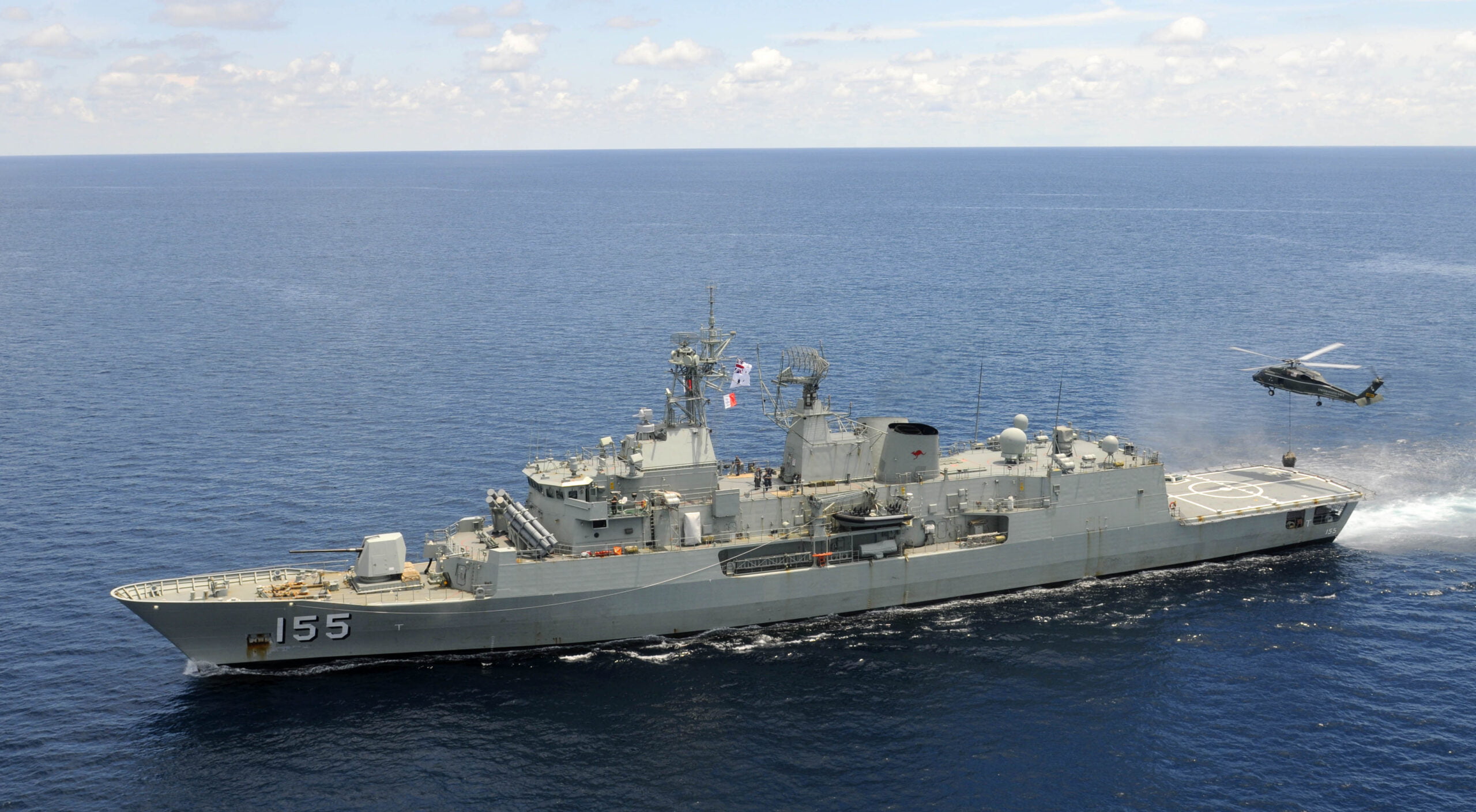
Australia’s most successful naval surface combatant project – by far – was the one that produced ten 3,500 tonne locally built ANZAC frigates. These were constructed on time and on budget – unheard of for other projects – and were commissioned between 1996 and 2006. Eight were for the RAN and two for the RNZN. Since then, they have remain the workhorses of both navies. It is one of the abiding mysteries why such a successful less successful template for project delivery was then ditched by Defence, who subsequently used different designers and primes for subsequent contracts, with far results. The Hobart class Air Warfare Destroyers were at least four years late and $1.4 billion over budget. The emerging Hunter class are behind schedule – though exactly by how much is a topic of dispute – and the eventual price tag for nine hulls is unclear, though it will certainly exceed $40 billion. Both the 9,000 tonne Hunter and 7,000 Hobart classes are much larger than the Anzacs and are more complex, though following their Anti-Ship Missile Defence upgrades incorporating a CEA active phased array radar suite the latter are at the leading edge of capability. Also, the Anzacs achieved in excess of 80% Australian content – an almost unbelievable figure today and one which included a lot of the complex electronics. This was because the German designer Blohm+Voss – subsequently absorbed by its parent company thyssenkrupp Marine Systems (also known as tk MS) actually tweaked the parent design with the objective of maximising Australian and New Zealand content. This came about for several reasons. In a fierce competition against a Dutch design, it was made clear by both the Australian and especially New Zealand governments, the Defence Department – and even the RAN – that local industry content was an essential requirement. To win, B+V and their Australian industry partner AMECON – basically the heavy engineering company Transfield, which morphed into Tenix – set about doing as much here as they could. In achieving this objective they were also helped by a large production run of 10 ships, with the further advantage that these were to a highly modular design well-suited to distributing work packages far and wide. This is an excerpt from APDR. To read the full story, click here. For Editorial Inquiries Contact: Editor Kym Bergmann at [email protected] For Advertising Inquiries Contact: Director of Sales Graham Joss at [email protected]
TAGSFrigatesHhunter Class Frigate ProgramHobart Class Destroyer
Previous article
UPDATE: Operation Flood Assist 23-1
Kym Bergmannhttps://asiapacificdefencereporter.com/
Kym Bergmann has more than 35 years of experience in journalism and Australian and international defence industry. After graduating with Honors from the Australian National University, he joined Capital 7 television, holding several positions including foreign news editor and chief political correspondent.
After 2 years on the staff of a Federal Minister, he moved to the defence sector and held senior positions in several companies, including Blohm+Voss, Thales, Celsius and Saab. In 1997 he was one of 2 Australians selected for the Thomson CSF 'Preparation for Senior Management' MBA course, the other being Chris Jenkins - formerly the CEO of Thales Australia.
He has also worked as a consultant for a number of companies, including Raytheon, Tenix (now part of BAES) and Martin Marrietta (now part of Lockheed Martin). He had several board appointments, including Thomson Sintra Pacific (1994 - 96) and Saab Pacific (1998 - 2003).
He retains good personal links with senior figures in Government, as well as in industry and the media. He decided to return to journalism in May 2008, and holds the position of editor for Asia Pacific Defence Reporter (APDR) and Defence Review Asia (DRA). He is also a podcaster and commentator on defence and national security issues.