
Home › Featured
South Korea interested in boosting defence ties with Australia
KF-21 supersonic, twin engine fighter (KAI photo)
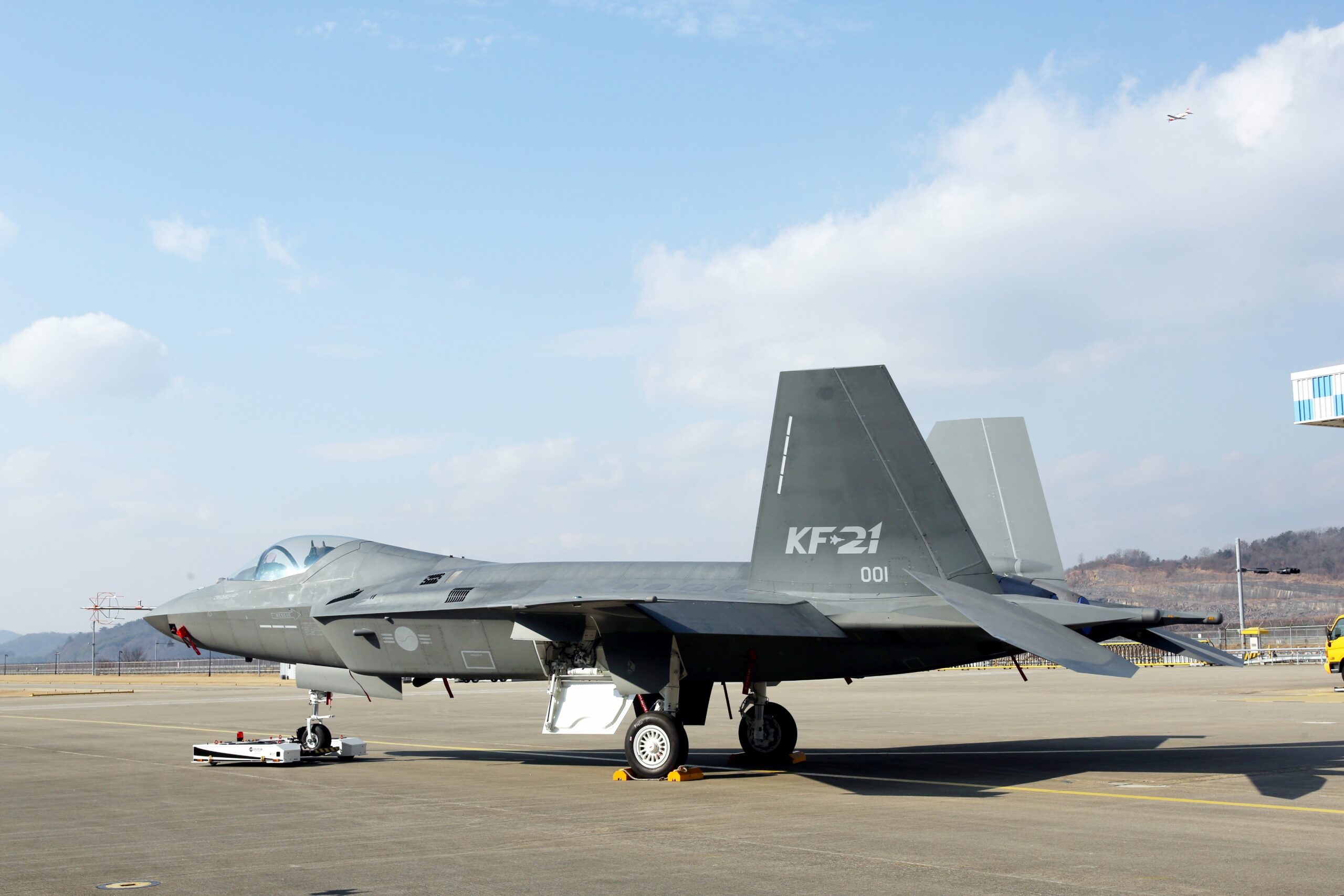
In a remarkably short time, South Korea has emerged as a major exporter of high-technology weapon systems, including submarines, armoured vehicles and high-performance jet aircraft. On July 19 the country joined an elite club with the first flight of the KF-21 supersonic jet fighter – yet another system with considerable sales potential. On top of this come an array of advanced guided weapons, sensors and defence electronics. Australia is also an emerging customer, having signed a $1 billion contract for 30 Huntsman 155mm self-propelled howitzers from Hanwha – and we are possible purchasers of several hundred Redback infantry fighting vehicles from the same company with a decision expected in September. It seems likely that the more Australia learns about the capabilities of South Korean defence industry the greater the likelihood of further sales from that country. Historically, Australia and the Republic of Korea (RoK) budgeted roughly similar amounts on defence, though in recent years Seoul has pulled away and currently spends the equivalent of $66 billion a year compared with our $49 billion. This budget supports a massive military of 550,000 full-time personnel and almost 3 million reservists, compared with 60,000 and 30,000 respectively for Australia, even though South Korea’s population is barely twice ours at 52 million people. The disparity is even greater when one looks at equipment. To choose a single metric can be misleading, but while Australia has 59 Main Battle Tanks, the RoK has more than 2,500 –including the indigenously designed K2 Black Panther currently in production and almost certainly the most modern MBT in the western world. It seems likely that this tank will soon be purchased by Poland, while Australia has a strategy of buying 75 refurbished Abrams M1A2s from the US that went out of production in 1996. One of the secrets of the RoK’s success is that its military procurements are all run by the powerful Defense Acquisition Program Administration, established in 2006. In a highly significant move, the new head of that organisation, Minister Dongwhan Eom, visited Canberra on July 21 for discussions with agencies including CASG and DSTG. Minister Eom – a former Brigadier General – was only appointed to his post the previous month by new President Suk-yeol Yoon, which gives some idea of the priority that he is giving to Australia. Discussing the massive recent growth in capability of South Korea’s defence industry, he explained that building to scale helps. Because of the overall size of the military – in turn a product of the constant threat of invasion from North Korea – large production runs of almost everything is needed. As well as the MBTs, the Air Force has almost 500 combat aircraft, including 40 F-35s, and the Navy 24 submarines – and growing – compared with Australia’s six ageing Collins class. Speaking of submarines, Korea’s leading builder is DSME – located at Okpo in the south of the country – and the company believes that they could supply Australia with their ultra-modern KSS-III Batch 2 vessels with a lead time of just seven years. Of course, this raw number seems only to refer to submarines exactly as configured for the RoK Navy – but Australia would almost certainly require US weapons and combat system, which would presumably extend the timeline. However, Korea is used to working closely with the USN – all new surface combatants use Aegis – and so the task might not be as difficult as people at first think. Okpo certainly has the capacity to design and build platforms for multiple customers. When the author visited in 2017 the yard – one of the largest and most advanced in the world – DSME was simultaneously building or upgrading 30 different vessels – everything from warships and submarines to offshore platforms and LNG tankers. At any rate, it might be of comfort for Australian defence planners to know that should AUKUS fall apart – say, by the election of a Republican as the next US President – there are alternatives to just throwing up our hands in despair. It’s also worth keeping in mind that South Korean industry is genuinely interested in working in Australia, so a strategy of building the first one or two submarines in Okpo while in parallel a production line is being set up in Osbourne could be worth considering. The KSS-III Batch 2 submarines are long-range 3,800-tonne boats incorporating lithium-ion batteries in two banks and a vertical launch missile system, in addition to bow-mounted torpedo tubes. It features a conformal sonar array, non-penetrating masts and air-independent propulsion based on fuel cell technology. In the logical minds of Koreans, if Australia wants an interim submarine, they have a suitable design available – and could start delivering well before 2030. Our economies are comparable in size with South Korea being the world’s 12th largest and Australia one place behind. The RoK is Australia’s fourth largest trading partner after China, Japan and the United States. Australia lost 339 lives defending South Korea during the 1950-53 war following the invasion from the North. Despite these strong economic and historical links, South Korea is relatively unknown for most Australians. Hopefully that will start to change soon. (An expanded version of this story will appear in the next edition of APDR) For Editorial Inquiries Contact: Editor Kym Bergmann at [email protected] For Advertising Inquiries Contact: Director of Sales Graham Joss at [email protected]
TAGSHanwhaSouth Korea
Previous article
BIOTECH ALLIANCE ANNOUNCED AT ADSTAR 2022
Kym Bergmannhttps://asiapacificdefencereporter.com/
Kym Bergmann has more than 35 years of experience in journalism and Australian and international defence industry. After graduating with Honors from the Australian National University, he joined Capital 7 television, holding several positions including foreign news editor and chief political correspondent.
After 2 years on the staff of a Federal Minister, he moved to the defence sector and held senior positions in several companies, including Blohm+Voss, Thales, Celsius and Saab. In 1997 he was one of 2 Australians selected for the Thomson CSF 'Preparation for Senior Management' MBA course, the other being Chris Jenkins - formerly the CEO of Thales Australia.
He has also worked as a consultant for a number of companies, including Raytheon, Tenix (now part of BAES) and Martin Marrietta (now part of Lockheed Martin). He had several board appointments, including Thomson Sintra Pacific (1994 - 96) and Saab Pacific (1998 - 2003).
He retains good personal links with senior figures in Government, as well as in industry and the media. He decided to return to journalism in May 2008, and holds the position of editor for Asia Pacific Defence Reporter (APDR) and Defence Review Asia (DRA). He is also a podcaster and commentator on defence and national security issues.