
Home › Sea
The sale of Virginia class submarines to Australia is not guaranteed
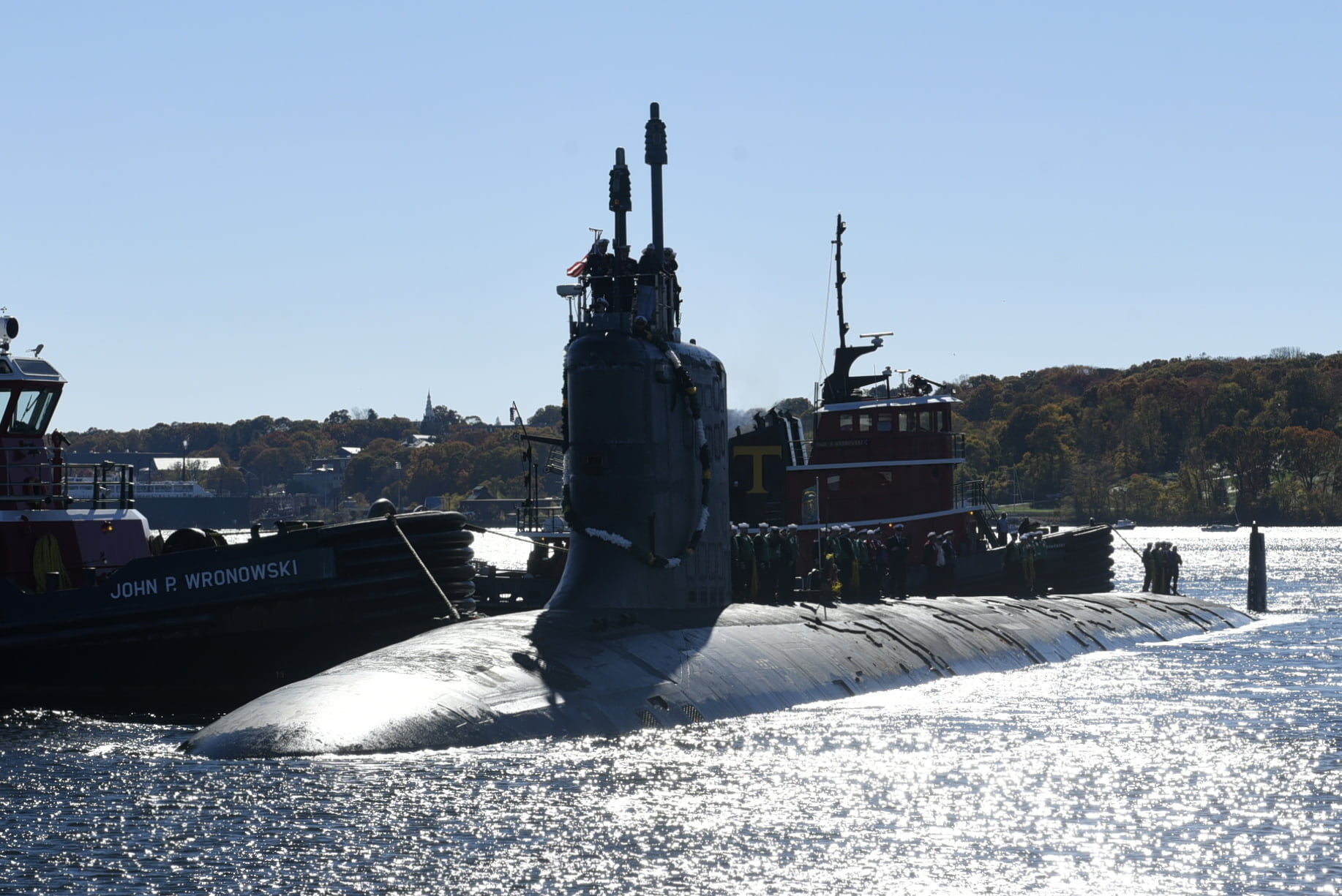
The words of any U.S. President are hugely consequential and when Joe Biden said that Virginia class submarines will be sold to Australia, many people seem to assume that the deal has been done. However, this overlooks the reality of how Washington operates. It is also a statement based on two important assumptions, both of which could change in the decade or so before the submarines are due to be delivered. President Biden said of the Virginia class: “They feature cutting-edge propulsion technology, provide unmatched stealth and manoeuvrability. And with the support and approval of Congress, beginning in the early 2030s, the United States will sell three Virginia-class submarines to Australia with the potential to sell up to two more if needed, jumpstarting their undersea capability a decade earlier than many predicted.” The first thing to focus on is the timing – why the early 2030s? The Americans say that Australia needs time to prepare for their arrival with the need to build facilities and train crews. This is true – but it ignores the most important part of the equation: the need for the U.S. to ramp up the construction tempo of the Virginia class. At the moment, they are being launched at a rate of one or two per year, averaging out at 1.5 every twelve months, or to put it more realistically – because no one wants half a submarine – three Virginia class are completed every two years. We don’t know what has been said behind closed doors, but it is highly likely that Australia will be sold submarines when the U.S. has excess capacity to build them – and reaching that goal is still some time away. Nothing else makes sense – and certainly the USN will not deprive itself of submarines deemed vital to the national interest just to be nice to Australia. There seems to be general agreement in Washington that just to maintain a healthy edge over China and other rivals such as Russia, the drumbeat for Virginia class production will need to increase to at least two per year. This ramp-up is indeed currently taking place. There are only two companies in the U.S. able to produce nuclear-powered submarines: General Dynamics Electric Boat (EB) and Huntington Ingalls Industries (HII). In the case of the Virginia class, Electric Boat undertakes final assembly and integration, with construction of hull modules evenly distributed between the two builders. Both companies are investing in people and facilities to support increased submarine production, which also needs to factor in the Columbia class SSBNs that are the highest priority of all. The wording of the AUKUS statements indicates that Australia will now also pour money into this expansion process. Nuclear-powered SSNs are complex beasts, with each one comprising an estimated ten million components – so that’s an enormous supply chain that needs to be mobilised. Gearing up for more nuts and bolts is easy – but stepping up the construction of naval reactors are orders of magnitude more challenging. If all goes well, the U.S. industrial base might have enough excess capacity by the early 2030s to sell Virginia class submarines to Australia – although a far more likely scenario will be to keep the USN happy by giving them the new boats, allowing them to offload older ones in the series. This might also suit the RAN since the first in the series, being slightly less complex, might be preferred for training purposes. They will still presumably have plenty of life left in them – the very first Virginia was commissioned in 2004 – because otherwise that would defeat the point of the exercise. Even a few oldish submarines will have considerable deterrent capability, though at a truly eye-watering cost. The second factor is the rate of growth of the Chinese navy – the PLA(N). The current expansion of the U.S. industrial base is predicated on the linear growth in China’s submarine numbers. However, if Beijing really presses the accelerator pedal – using the AUKUS submarine announcement as justification – then the production of the Virginia class will need to match that, meaning that there will be no spare submarines for Australia until way in the future. China’s industrial base is larger than that of the U.S. – which has been shrinking for three decades – though still lagging in some areas of very advanced electronics. In another ten years this dynamic might have changed, putting Washington under even greater pressure to prioritise the needs of the USN. If in the early 2030s the U.S.N. Chief of Naval Operations advises Congress that there is a dangerous shortfall in SSN numbers because a) the ramp up has not been as successful as planned; or b) China has more submarines than expected; or c) a combination of both; what will Congress do? Will it honour the words of a President spoken 10 years previously, or will it prioritise the interests of the U.S.? This is even without the possibility of the re-election of an isolationist figure such as Donald Trump – or the future election of a Trump-like figure. For Editorial Inquiries Contact: Editor Kym Bergmann at [email protected] For Advertising Inquiries Contact: Director of Sales Graham Joss at [email protected]
TAGSAUKUSAustralianuclear submarinesUKUS
Previous article
BMT granted patent for ‘SPARROW’ autonomous drone system
Kym Bergmannhttps://asiapacificdefencereporter.com/
Kym Bergmann has more than 35 years of experience in journalism and Australian and international defence industry. After graduating with Honors from the Australian National University, he joined Capital 7 television, holding several positions including foreign news editor and chief political correspondent.
After 2 years on the staff of a Federal Minister, he moved to the defence sector and held senior positions in several companies, including Blohm+Voss, Thales, Celsius and Saab. In 1997 he was one of 2 Australians selected for the Thomson CSF 'Preparation for Senior Management' MBA course, the other being Chris Jenkins - formerly the CEO of Thales Australia.
He has also worked as a consultant for a number of companies, including Raytheon, Tenix (now part of BAES) and Martin Marrietta (now part of Lockheed Martin). He had several board appointments, including Thomson Sintra Pacific (1994 - 96) and Saab Pacific (1998 - 2003).
He retains good personal links with senior figures in Government, as well as in industry and the media. He decided to return to journalism in May 2008, and holds the position of editor for Asia Pacific Defence Reporter (APDR) and Defence Review Asia (DRA). He is also a podcaster and commentator on defence and national security issues.