
1st Person: Former Prime Minister Malcolm Turnbull speaks with APDR editor Kym Bergmann
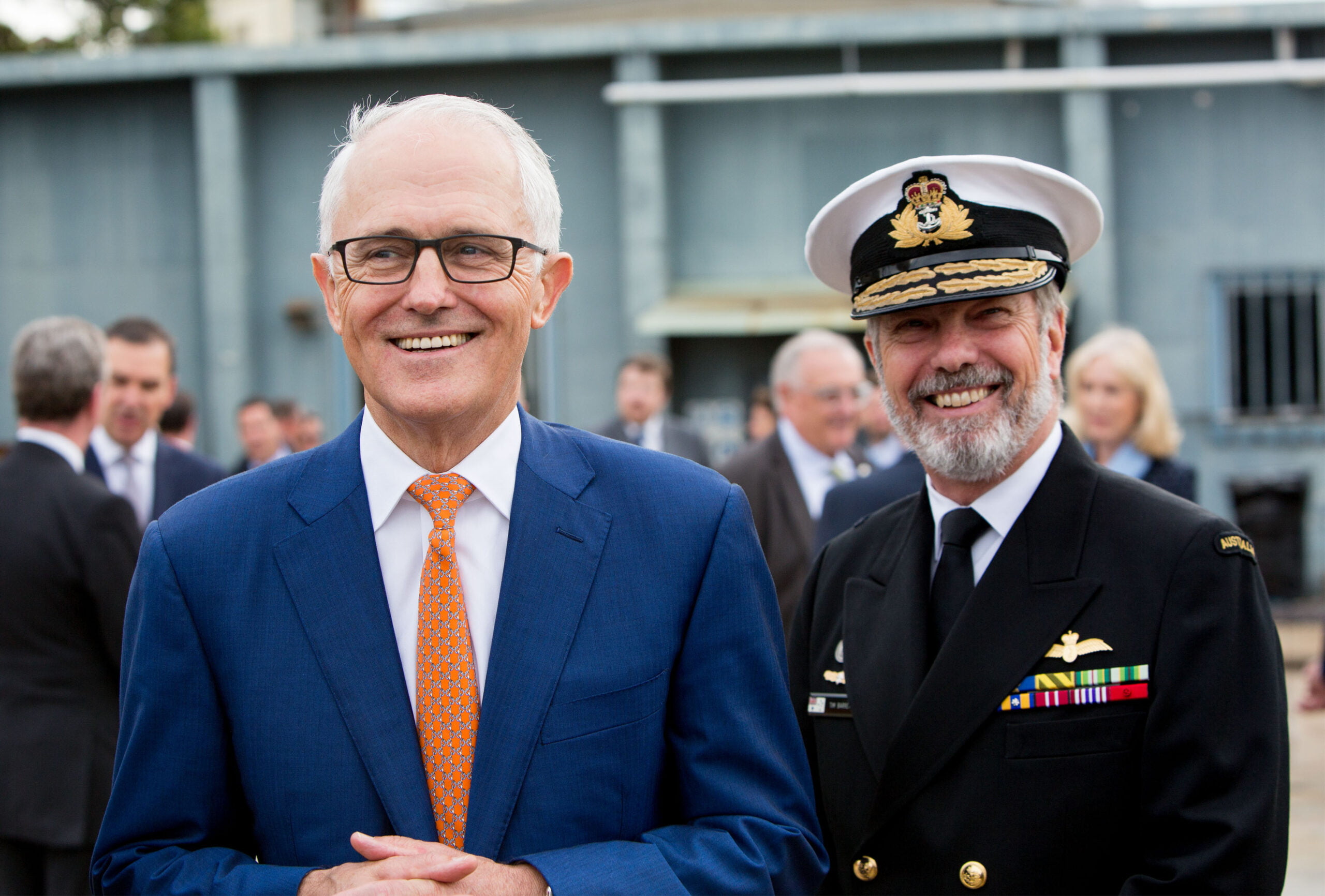
Kym: During your speech to the National Press Club you mentioned that in 2018 you asked the Department of Defence whether nuclear powered submarines would be appropriate for Australia. Did they give you a one word answer or did it have a bit of substance? Malcolm Turnbull: The response from Defence was quite detailed – as is usually the case for them. The main point they made is that all other countries that operate nuclear powered submarines have large domestic nuclear power industries, many of which have been in existence for decades – and Australia does not. Supporting nuclear powered submarines is quite complex when you factor in the extreme safety standards that are needed for regular checks and inspections of their entire propulsion system, not just the radioactive core. You can’t take the risk of leaks of radiation. They also made the point that all the countries – the US; UK; Russia; China and India – are nuclear weapon states. Other countries that are considering nuclear propulsion, such as Brazil, have large supporting industries. So a shift to nuclear propulsion would take 15 years or more to acquire the skills and infrastructure to support and maintain nuclear power submarines. If the maintenance and support of such vessels was outsourced to another country they would not, of course, be a sovereign capability. Kym: OK – the government has referred to strategic circumstances changing. But the last time I looked, the South China Sea is the same distance as it was from Australia 10 million years ago due to the slow speed of plate tectonics. Malcolm: Plate tectonics are the only thing slower than Australia’s submarine program! Kym: And even though the size of the Chinese navy is increasing dramatically, this is exactly in line with projections that were made back in 2018 and even earlier than that. I’m inviting you to speculate – what do you think might have changed? Malcolm: It seems that for whatever reason Morrison just lost interest in continuing with the French. It’s appalling that a decision of this magnitude appears to have been taken with so little research – and in such a duplicitous way. Australia’s international trustworthiness has been trashed. France has a major presence in the Pacific and is a long-term regional player. Morrison has single handedly wrecked our relationship with them by pretending all was well with the submarine program while simultaneously working to get rid of them. Even if there were legitimate concerns about how things were progressing, it should have been sorted out with the inclusion of the French.. It would have been possible to say to Macron something like “we are going to pause the Attack class for 18 months while we investigate other options – but don’t worry, French companies will be paid whatever they are owed, and we will keep you informed”. The French might not have liked it, but that would have been a far better way to proceed than the unmitigated disaster we now have on our hands which will result in an additional delay of at least a decade before Australia receives nuclear submarines around 2040 – if then. Kym: I have picked up a bit of scepticism even in government ranks about the nuclear idea, but some people already have a scapegoat – you. I’ve heard it said that if you hadn’t picked the French in the first place we wouldn’t be in this mess. Malcolm: I inherited a competitive evaluation process that was extremely detailed and complex. As a lawyer I understood the need for the process to be rigorously conducted with the utmost probity. Prior to setting up the CEP, Abbott had been planning to engage the Japanese to build submarines for us in Japan. I can assure you that the proposal from France’s Naval Group was assessed as being superior to the other two, by far. I have to be careful about what I say, but there was a clear preference for the French – and that decision was also supported by some of our US advisors such as former US Secretary for the Navy Dr Don Winter and the advisory board he chaired whose members included three retired US Navy admirals with extensive experience in submarine construction and operation. The French Barracuda design had the advantage of being based on a nuclear submarine, which left open the possibility of building, say, three conventional boats out of twelve and then switching back to nuclear at some stage if that became a necessity. This would have had major savings in things like training if all submarines had the same hull, combat system and electronics but different propulsion. Kym: At the time many of us assumed that this must have been at the back of your mind in selecting the French. Malcolm: At the back of my mind – yes. It wasn’t part of the evaluation, but it was something that we were aware of. Nuclear propulsion has many advantages, such as the ability to get out of trouble very quickly. A conventional submarine might be able to manage a burst of 20 knots and eventually you have to come to the surface and snort to run the diesel engines. Nuclear power gives you the ability to travel a lot faster than that and for much longer. On the other hand conventional submarines are quieter and better suited for shallow waters in the archipelagic waters around Australia’s north – which is where we operate in the vast majority of cases. So the idea of starting with conventional submarines and having the ability to transition to nuclear seemed an attractive option. We were on track to have the first Attack class in the water in the early 2030s. That has now all been thrown away and replaced with – nothing. Kym: It would seem sensible to first study the idea of nuclear of nuclear propulsion before making the announcement rather than the other way around. Malcolm: It’s an extraordinary decision that has also destroyed the sovereign submarine building capability that was central to all of this. The idea was that Australia would be independent and have a permanent submarine construction schedule. That has all been thrown away. As I said at the Press Club, the idea that a submarine nuclear reactor is like a battery that you plug into a power tool from Bunnings is ridiculous. It seems highly likely that if we buy from either the US or Britain the first ones will be built in their yards and then there will be little incentive to move that work to Australia. Kym: If, when you were Prime Minister, the Air Force came to you with a suggestion that Australia needed to build our own long range aircraft to bomb Moscow I guess you would ask them to have a rethink. Malcom: That’s probably correct. Kym: But the RAN somehow convinces everyone that they need something that is at the very extreme of the range and endurance that you can get from a conventional submarine. But there are plenty of choke points to the north of Australia far closer than the South China Sea – and also technology is changing rapidly. Malcom: You have touched on something that I’ve been thinking about a lot but haven’t yet had the chance to put into writing – and that the development of Autonomous Underwater Vehicles. A huge amount of work is going on in that area, including by Australian companies. As an aside, I’m involved with Advanced Navigation – a local company that has developed inertial navigation systems based on a digital fibre optic gyroscope. They are receiving a lot of interest and investment, including from the US. This technology means that in the future you could have large numbers of battery powered AUVs able to travel huge distances and navigate autonomously. They could be programmed to come to the surface at various places and raise an antenna to gather electronic information and then quickly transmit that to a satellite. Or they could undertake their mission in complete radio silence. They can wait on the seabed for months on end. The development of AUVs, underwater drones, will revolutionise the world of submarines especially in terms of surveillance. The main reason why submarines are so complex and expensive is because they have a lot of people in them who have to live and work underwater for weeks at a time. If you can replace humans with electronic systems then the equation looks quite different. If you happen to lose one or two it doesn’t really matter because there are no people on them. They can be designed to fry their own hard drives or physically self destruct if captured or tampered with. Kym: Do you see any way out of the submarine mess? I can think of two. The first is for the RAN to radically rethink their range and endurance requirements. The second is to bring the French back into the equation. Malcolm: It’s going to be very difficult. The French have been so insulted by Morrison and treated so badly that I’m not sure about their attitude. People seem to have forgotten that France and Australia had formed a strategic partnership around submarines that was in both our interests. Macron actually announced his country’s Indo-Pacific strategy in 2018 at the Garden Island naval base in Sydney. This was hugely significant and committed France to this region in a way that the UK never could. France has two million citizens in the Indo Pacific. France is our close neighbour in New Caledonia and French Polynesia. France is here to stay. With the UK, would anyone be surprised if in a few years from now someone asked “why are we sending our warships all the way out there?” Boris Johnson’s enthusiasm for our region may not outlast his government. I struggle to understand how the US has gone along with AUKUS given the damage it has done to relations with France. If you look at the recent Biden-Macron statement it is as close to a public apology from Washington as you are ever likely to see. It emphasised the importance of open consultations between strategic partners – which is the opposite of what occurred in the lead up to the AUKUS announcement. Kym: The Attack class was already a trilateral program with a US combat system and US weapons. Why not build on that? Malcolm: Exactly. The way this should have been handled was through a process of discussion and dialog – not some sort of secret back room deal. The French have every reason to feel stabbed in the back. You might have noticed that after my Press Club speech, no one objected to my assessment. Even News Limited journalists like Greg Sheridan and Cameron Stewart thought that basically I was correct. Greg’s only reservation about my critique was that I had exaggerated the diplomatic consequences of Morrison’s duplicity. Well, I am in a better position to judge that than most people. You can’t find many commentators who support this move after they have looked at the details. Kym: I guess it would be like if Australia announced we were going to put a man on the moon. Malcolm: Hooray – until people start looking at actual details like cost and schedule. Kym: I’m surprised that more research hasn’t been done by the government on the matter of using Highly Enriched Uranium as the fuel, which is nuclear weapons grade material. Malcolm: I think this is going to be a huge problem that hasn’t been thought through at all regarding nuclear proliferation – and that alone might be enough to stop the acquisition. Already Indonesia and Malaysia have expressed concern about the precedent this sets and what it might mean for a regional arms race. Because Australia doesn’t have a nuclear industry – and because we seem to have ruled out French technology which uses Low Enriched Uranium – we are going to be fully dependent on the US. What does that say about sovereign capability? Can you imagine the situation when Iran says it wants to enrich uranium to weapons grade standards and says this is for the purpose of naval nuclear propulsion. How does the US argue Australia can be trusted with weapons grade naval reactors but nobody else? How does the US mount an argument that Iran should use low enriched uranium for its naval nuclear propulsion when it has decided to equip Australia with highly enriched uranium reactors? And this is why so many people concerned with nuclear non proliferation, including the IAEA, have objected to the plan. For Editorial Inquiries Contact: Editor Kym Bergmann at [email protected] For Advertising Inquiries Contact: Director of Sales Graham Joss at [email protected]
Previous article
Serco Australia, GHD partner on defence precinct work
Kym Bergmann has more than 35 years of experience in journalism and Australian and international defence industry. After graduating with Honors from the Australian National University, he joined Capital 7 television, holding several positions including foreign news editor and chief political correspondent.
After 2 years on the staff of a Federal Minister, he moved to the defence sector and held senior positions in several companies, including Blohm+Voss, Thales, Celsius and Saab. In 1997 he was one of 2 Australians selected for the Thomson CSF 'Preparation for Senior Management' MBA course, the other being Chris Jenkins - formerly the CEO of Thales Australia.
He has also worked as a consultant for a number of companies, including Raytheon, Tenix (now part of BAES) and Martin Marrietta (now part of Lockheed Martin). He had several board appointments, including Thomson Sintra Pacific (1994 - 96) and Saab Pacific (1998 - 2003).
He retains good personal links with senior figures in Government, as well as in industry and the media. He decided to return to journalism in May 2008, and holds the position of editor for Asia Pacific Defence Reporter (APDR) and Defence Review Asia (DRA). He is also a podcaster and commentator on defence and national security issues.
Comments
Loading comments...