
Home › Sea
Latest AUKUS outrage – buying towed array sonars from the U.S. that harm marine mammals
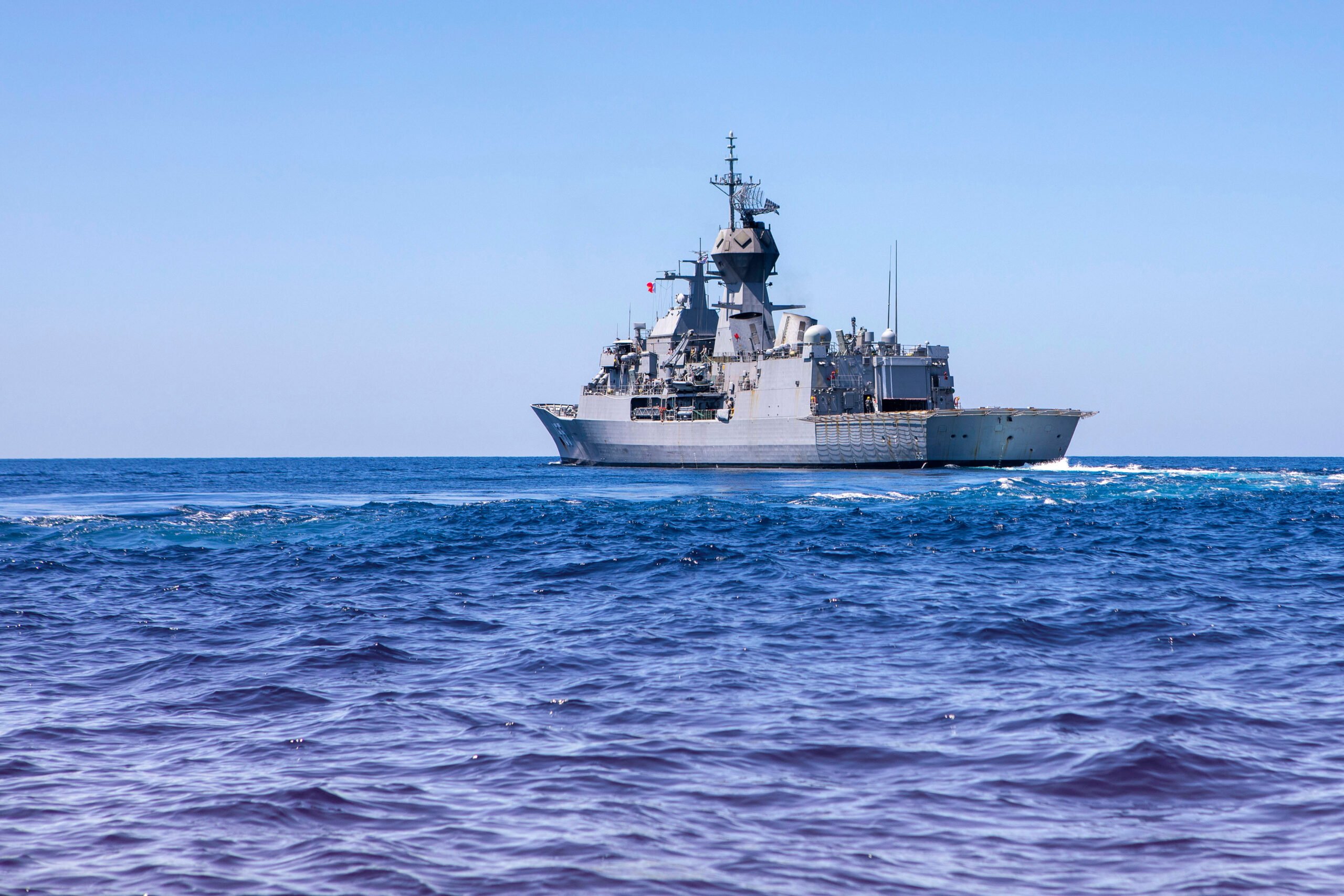
In the latest manifestation of AUKUS mania warping thinking inside Defence and government, Australia will hand over $307 million (U.S. $207 million) to buy towed array sonar systems that could – and should – be made locally. There are some areas where we have world leading technologies – and sonar is one of them. As well as decades worth of research and development undertaken by the old Defence Science and Technology Organisation, an enormous amount of expertise has accumulated in local companies such as Thales Underwater; Sonartech Atlas; Acacia; and Ultra – just to name the major players. In the 1970s and 1980s two slim line towed array sonar systems were developed in parallel, code named Kariwara and Narama, which were better than anything previously attempted. In the 1990s under project SEA 1100 (Australian Surface Ship Towed Array System – ASSTASS) we built an indigenous low frequency active-passive towed array sonar system, originally sponsored by the legendary Commander Daffy Donald and subsequently managed by the almost equally legendary Jim Manson. Australia exports sonar hardware and software for use on the nuclear-powered and armed submarines of the U.S., U.K. and France. Thales sonars equip ANZAC frigates; those from Ultra are on the Air Warfare Destroyers – and both are working on the underwater warfare systems of the future Hunter class frigates. The impending purchase of SURTASS-E has left local industry totally gobsmacked – and for the moment no one is commenting publicly until they find out what is going on. Apparently, people only heard about this when the U.S. Defense and Security Cooperation Agency sent the following obligatory notification to Congress on May 4: “The State Department has made a determination approving a possible Foreign Military Sale to the Government of Australia of Surveillance Towed Array Sensor System Expeditionary (SURTASS-E) mission systems for Vessels of Opportunity (VOO) and related equipment for an estimated cost of $207 million. The Defense Security Cooperation Agency delivered the required certification notifying Congress of this possible sale today. “The Government of Australia has requested to buy Surveillance Towed Array Sensor System Expeditionary (SURTASS-E) mission systems for Vessels of Opportunity (VOO); a shore processing mission system, a spare SURTASS passive acoustic array; containers; communications parts and support equipment (Classified and Unclassified); software (Classified and Unclassified); publications (Classified and Unclassified); training; U.S. Government and contractor engineering support; and other related elements of logistics and program support. The estimated total cost is $207 million.” APDR understands that this system is to equip a second commercial offshore vessel that Defence acquired on the sly a few months ago – only confirming the multi-million dollar purchase after being busted by the media. This second hand ship will apparently be used for underwater warfare research activities – though why the feasibility of building something similar in Australia was not considered is a total mystery. Why Defence Minister Richard Marles and especially Defence Industry Minister Pat Conroy could think that this is a good idea is unknown. When this recommendation came over from the Department it should have sent alarm bells ringing because it’s probably more about lavish postings to Washington than it is about capability. What makes the situation even worse is that the RAN made an attempt to purchase SURTASS about two decades ago – but was blocked from doing so on environmental grounds. It transmits on a frequency known to disturb marine mammals – unlike the French-Australian CASSTASS Low Frequency Active Variable Depth Sonar then in use. Does the RAN and the Federal government no longer care about environmental issues? In 2002, Liberal Defence Minister Robert Hill provided the following information to Parliament: “Low frequency active sonar (LFAS) is a generic term. It is generally used to identify a sonar system that emits sound at a frequency of 1 kilohertz (kHz) or less. The particular type of LFAS that has been linked in the media to environmental impacts on whales and dolphins is the Surveillance Towed Array Sensor System (SURTASS LFA sonar) used by the United States Navy (USN). SURTASS LFA is not a system used by the RAN and it has not been deployed in Australian waters. “It is understood that the source level of SURTASS LFA is such that the intensity received by a whale, diver etc. at a distance of 10 meters from the source is approximately 215 decibels, relative to one micro Pascal (215 dB re 1 Pa). At a distance of 100 meters, the received sound intensity would be one one-hundredth, or 20 dB less, of the received sound intensity at 10 meters, i.e. 195 dB re 1 Pa. The received sound intensity will continue to decrease as distance to the source increases. To help place these numbers in context, it should be noted that common occurrences such as lightning strikes on the ocean produce received sound intensities approximately three hundred times this level (approximately 240 dB re 1 Pa at 10 meters) and sperm whales, in communicating, regularly produce total received sound intensities of 215 dB re 1 Pa at a distance of 10 metres. “The distance any sound can travel (be detected) in the marine environment is highly variable and depends on numerous, changeable ocean characteristics such as salinity and temperature profiles. With respect to the impacts that arise from underwater sound propagation it is considered that the most relevant distance is that at which the received sound intensity is safe for the sensitive hearing possessed by marine mammals etc. “For marine mammals (whales, dolphins, dugongs and seals), it is generally accepted by scientists that a received level of 178 dB re 1 Pa for intermittent or pulsed sounds is considered to be the best estimate of a safe exposure level. In the deep water in which the USN SURTASS LFA system would operate, a conservative estimate of the distance corresponding to this received sound level would be approximately one kilometre.” The expenditure of more than $300 million would go a long way towards keeping local industry at the forefront of sonar technology. The SURTASS-E purchase is sheer madness. If the government wants to retain any credibility for its claims of supporting Australian industry, this decision needs to be reversed – now. For Editorial Inquiries Contact: Editor Kym Bergmann at [email protected] For Advertising Inquiries Contact: Director of Sales Graham Joss at [email protected]
TAGSAUKUStowed sonar
Previous article
New agency and new regulator to deliver Australia’s nuclear-powered submarine program
Kym Bergmannhttps://asiapacificdefencereporter.com/
Kym Bergmann has more than 35 years of experience in journalism and Australian and international defence industry. After graduating with Honors from the Australian National University, he joined Capital 7 television, holding several positions including foreign news editor and chief political correspondent.
After 2 years on the staff of a Federal Minister, he moved to the defence sector and held senior positions in several companies, including Blohm+Voss, Thales, Celsius and Saab. In 1997 he was one of 2 Australians selected for the Thomson CSF 'Preparation for Senior Management' MBA course, the other being Chris Jenkins - formerly the CEO of Thales Australia.
He has also worked as a consultant for a number of companies, including Raytheon, Tenix (now part of BAES) and Martin Marrietta (now part of Lockheed Martin). He had several board appointments, including Thomson Sintra Pacific (1994 - 96) and Saab Pacific (1998 - 2003).
He retains good personal links with senior figures in Government, as well as in industry and the media. He decided to return to journalism in May 2008, and holds the position of editor for Asia Pacific Defence Reporter (APDR) and Defence Review Asia (DRA). He is also a podcaster and commentator on defence and national security issues.