
Home › Govt Policy & News
US tried to compel Australia to spend extra billions on an unwanted SSN
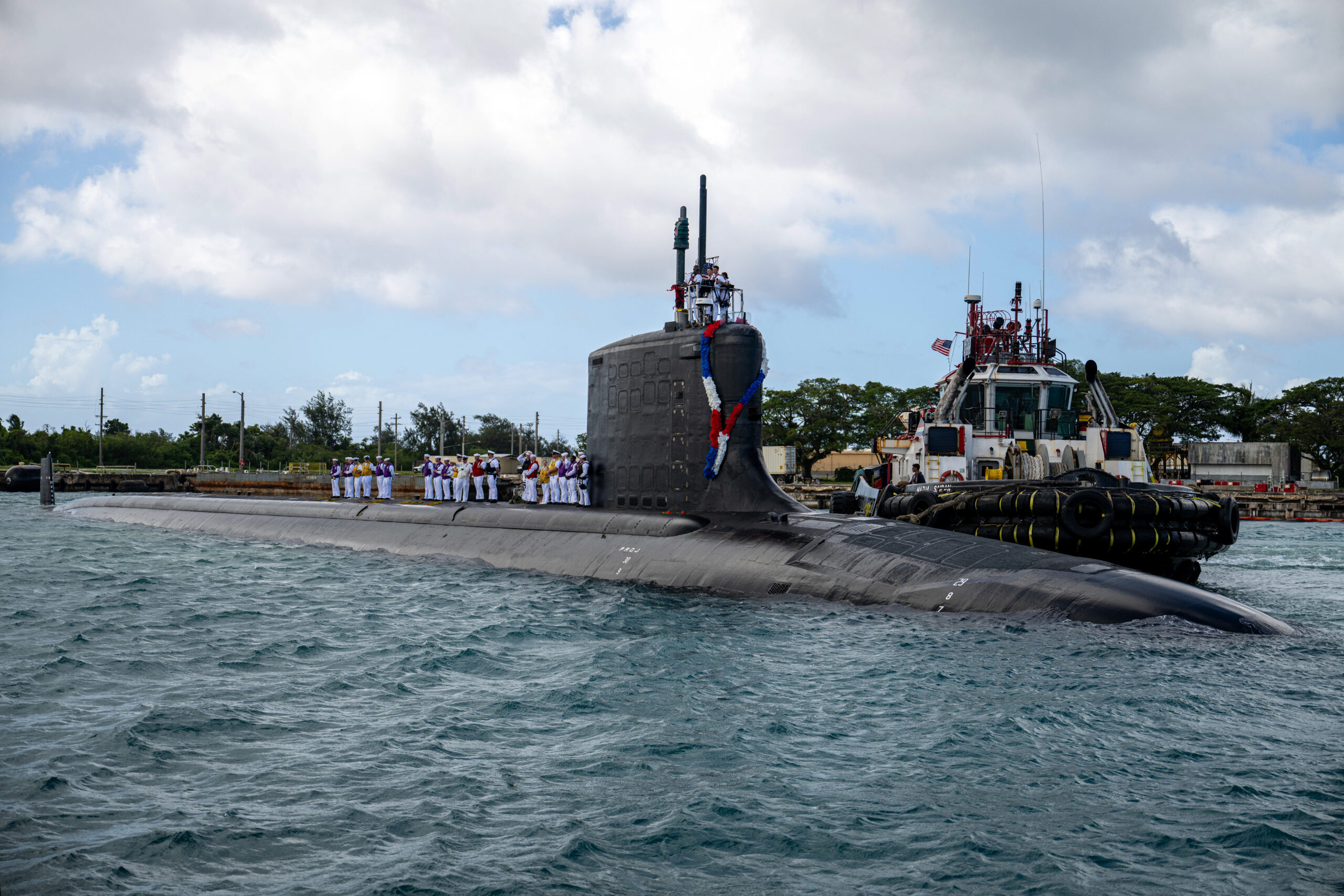
This is the extraordinary position of the Australian government in explaining why the plan to acquire 8,000 tonne nuclear powered Virginia class attack submarines was changed on May 30. Previously, Australia had been working towards the purchase of two second hand Virginias in about 2032 and 2035 followed by a new one around 2038. There is – or was – also scope for the purchase of another two new SSNs after that. This has even been codified in US legislation in the form of the 2024 National Defense Authorisation Act. On 15 December of that year, a joint media release from Defence Minister Richard Marles and Defence Industry Minister Pat Conroy said the US Act: “Authorise the transfer of three Virginia class submarines to Australia, (emphasis in the original) including two in-service submarines and one off the production line. This significant contribution is vital to the pathway and will ensure there is no gap in Australia’s critical submarine capability in the lead up to delivering Australian-built SSN-AUKUS from the early 2040s. Australia will retain the option to seek congressional approval for purchase of up to two more Virginia class submarines.” However – to the surprise of many – on the fringes of the Shangri-La Dialogue in Singapore on 30 May, Defence Minister Marles and Pete Hegseth, U.S. Secretary of War (Defense), and John Healey MP, UK Secretary of State for Defence, met at the U.S. Embassy in Singapore, issuing a statement that included the paragraph: “The Deputy Prime Minister (aka Defence Minister Richard Marles) and Secretaries welcomed the proposed approach to streamline Australia’s acquisition of Virginia-class submarines (VCS), simplifying supply chain management, operational and maintenance requirements, and maximising cost efficiencies. This approach would enable Australia to acquire three in-service VCS in lieu of a mixture of new and in-service VCS variants.” In other words, this is a sudden change in direction from the well-established and frequently repeated two used and one new SSN to now three used SSNs. This looks like a total humiliation for Australia with the US abruptly changing its mind and keeping all of the new submarines for themselves. To make a bad situation worse, the government and its boosters are now arguing that Australia always wanted three used submarines, with Pat Conroy saying on 3 June: “…it was a joint decision to move from two in service submarines and one new to three in-service Virginias. We’ve made it very clear that that was our preferred position when we were negotiating this arrangement in ‘22 and ‘23.” Except this is the first anyone has heard of Australia’s apparent preferred strategy. One has to ask: why did the US ram down Australian throats a new Virginia SSN when we had made it clear two years in a row that we did not want it? This is an obvious deviation from the announced “Optimal Pathway” for the development of Australia’s nuclear-powered submarine force. During Senate Estimates on the night of 2 June, new Defence Department Secretary Meghan Quinn seemed to be making heavy weather of the issue, arguing that Australia had actually been pursuing at least two Optimal Pathways. This is a Schrödinger’s Cat approach where one can be buying a submarine that is both new and second-hand at the same time. For language purists, optimal means best or most favoured – in other words a singular approach to something. It does not mean dual or multiple pathways of equal merit. Optimal also does not mean that Australia will get only what the US wants us to get – it means the best outcome for us. All the talk has been about cooperation, shared values and joint objectives – yet we now find out that is not how the process has been working for the last four years. It augers poorly for the future if the US is now so openly prioritising their own needs – but under the Trump administration this has become normalised. A new Virginia class submarine in Australian dollars is vey roughly $8 billion. There is a not unreasonable expectation that a second-hand sub would be half that at around $4 billion – but no one knows because the US has never previously sold a nuclear powered submarine, either new or used. In other words, until May 30 the US was compelling Australia to pay about $4 billion extra for a platform we did not want. The Defence Minister, the Defence Industry Minister, and the Chief of Navy are now making a lot of noise explaining that three second hand SSNs of the same class will be easier to maintain than acquiring a mix of new and old. This is undoubtedly true – though the quantum of those savings might not be that great since all the submarines will have the same combat system and the same propulsion plants. However, if this was such a good idea, why wasn’t it the plan from Day One? What does it say about the US as an ally if they happily pocket our $5 billion contribution to their submarine industrial base – and on top of that try to compel the purchase of an unwanted new SSN for a $4 billion premium. So far it has not been possible to corroborate any aspects of this story from US sources – though we are trying. For Editorial Inquiries Contact: Editor Kym Bergmann at [email protected] For Advertising Inquiries Contact: Group Sales Director Simon Hadfield at [email protected]
TAGSAUKUS
Previous article
DroneShield wins new order for counter-drone work
Kym Bergmannhttps://asiapacificdefencereporter.com/
Kym Bergmann has more than 35 years of experience in journalism and Australian and international defence industry. After graduating with Honors from the Australian National University, he joined Capital 7 television, holding several positions including foreign news editor and chief political correspondent.
After 2 years on the staff of a Federal Minister, he moved to the defence sector and held senior positions in several companies, including Blohm+Voss, Thales, Celsius and Saab. In 1997 he was one of 2 Australians selected for the Thomson CSF 'Preparation for Senior Management' MBA course, the other being Chris Jenkins - formerly the CEO of Thales Australia.
He has also worked as a consultant for a number of companies, including Raytheon, Tenix (now part of BAES) and Martin Marrietta (now part of Lockheed Martin). He had several board appointments, including Thomson Sintra Pacific (1994 - 96) and Saab Pacific (1998 - 2003).
He retains good personal links with senior figures in Government, as well as in industry and the media. He decided to return to journalism in May 2008, and holds the position of editor for Asia Pacific Defence Reporter (APDR) and Defence Review Asia (DRA). He is also a podcaster and commentator on defence and national security issues.