
Home › Govt Policy & News
VIEWPOINT: DSR insults South Korea and hurts Australian industry
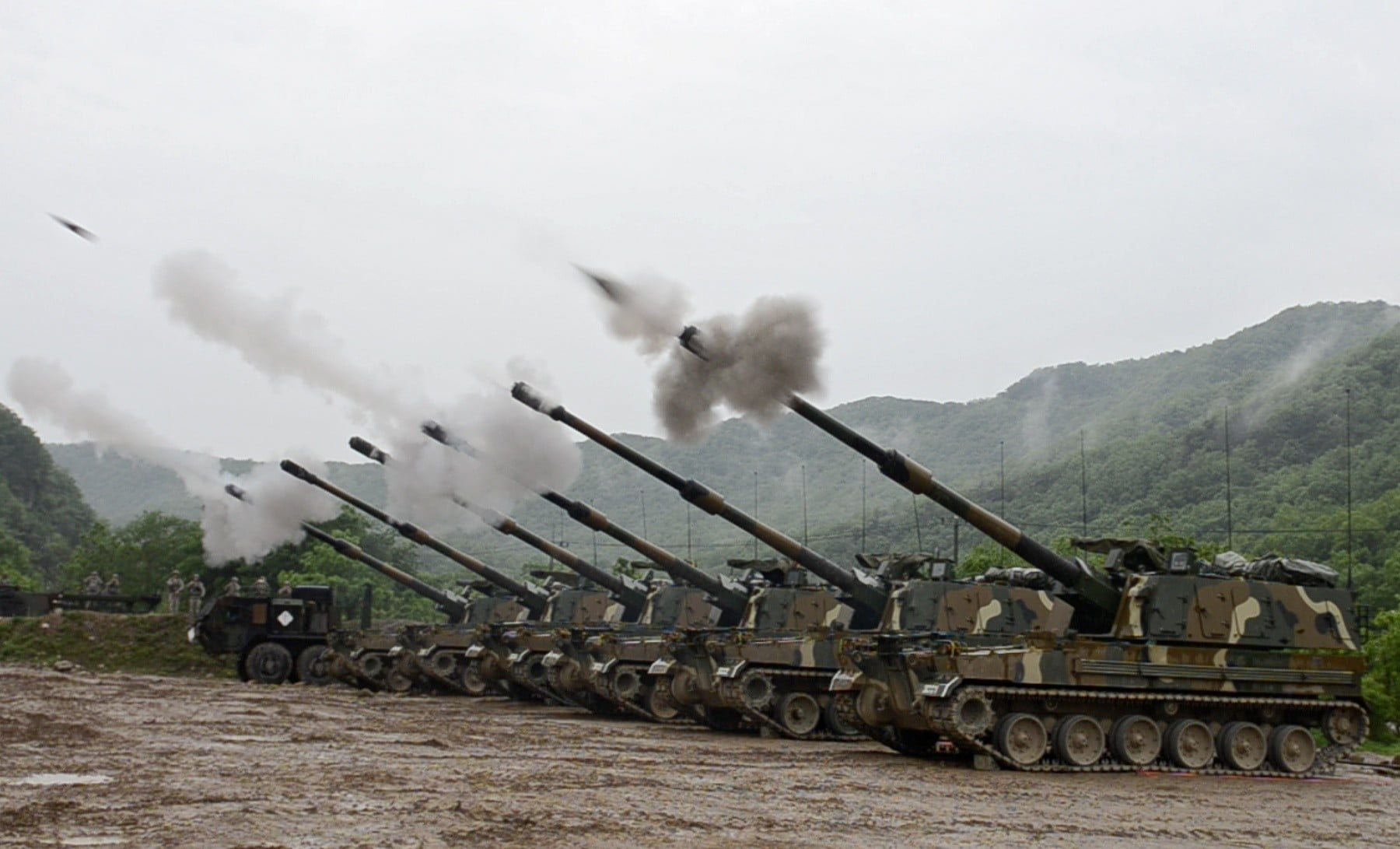
For all of its positives in calling for a whole of government approach to Defence and an increase in spending, this is a shocker for industry. Most of the analysis repeats the government’s talking points that this is the most fundamental reorientation of strategy in the last 80 years – which it is not. What has happened is that the ADF has caught up with the existence of long-range weapons and now has a sensible desire to acquire them. Before we get to local industry, spare a thought for South Korea. The most surprising decision, anticipated by no one, was the cancellation of additional 155mm Self-Propelled Howitzers, due to be ordered later this decade. Built by Hanwha, these have become the western world’s most respected and prolific SPH. Poland has just ordered 648 of them; they are in widespread NATO service; India and Egypt are users – and the RoK will field 2,000 of them. Australia decided in 2019 to acquire an initial 30 ‘Huntsman’ systems plus 15 armoured in-theatre resupply vehicles, built near Geelong. The 2020 White Paper called for a second batch to further boost Army’s mobile, protected firepower. As events in Ukraine are showing – and there’s not a single mention of this conflict in the DSR – mobile 155mm artillery has been a key ingredient in Ukraine’s resistance to massively superior Russian numbers. All the publicity has gone to the HIMARS MRLS, but mobile artillery has done the bulk of the work, firing hundreds of thousands of rounds. If Ukraine could get their hands on the ‘Huntsman’ they would – and they are already making use of a Polish variant that uses the Hanwha chassis with a British 155mm gun. They are complimentary to MLRS and have several advantages, including a high sustained rate of fire, greater mobility due to the use of tracks rather than wheels – and greater levels of crew protection. The unfortunate history to this that in 2012 Army declined to proceed with an initial order of the same SPH. APDR has documented all of this – once being threatened with legal action by Chief of Army – because even though the Hanwha system clearly won the technical evaluation a contract was never signed, despite years of risk reduction work and trials. The reason: some very senior people were not confident that an Asian country could produce quality defence materiel. Looking for any excuse, in 2012 then Defence Minister Stephen Smith – now of the DSR team – was looking for budget savings and Army gleefully offered up the SPH purchase. The people involved covered their tracks well, but some of the nonsense they told the Minister was that they weighed 80 tonnes and therefore could not be deployed other than under their own power. This is an obvious falsehood – and at 49 tonnes they are 13 tonnes lighter than an Abrams M1A2, to which the Army is inordinately attached. Hanwha is also one of the two finalists for LAND 400 Phase 3 for Infantry Fighting Vehicles, also to be built in Australia, which the DSR has cut back from an aspirational figure of 450 to just 129. This makes one wonder if economies of scale make it worth building them here at all – and maybe that’s the idea. It is an open secret that the Korean ‘Redback’ was the better vehicle during the extensive test and trial phase of the project, being more reliable, more lethal, and more survivable. Yet here they are, compelled to go through a full, expensive rebid process that will mean the restructuring of their entire industry package. Months if not years of further delays will occur. The question for Defence is: having figured out which is the better vehicle, why not sit down with Hanwha, negotiate a price, and just get on with it? After all, the DSR emphasises the need for more rapid acquisitions. By so dramatically scaling back IFV and SPH purchasers the government is ripping $15 billion out of Australian industry. As an aside, part of the logic of the local build of these systems was to undo some of the damage caused by the end of the car industry. Instead, Army is going ahead with the purchase of 72 old Abrams MBTs made in the U.S. with zero Australian content for $4 billion. Put simply, the message to Korea is: “We don’t want your modern systems; we want U.S. missiles and 30-year-old refurbished U.S. tanks.” This will be interpreted in Seoul as a deliberate slap in the face. The DSR theme that long range missiles can do everything is wrong. If that logic applied, ships would no longer have main guns and fighter aircraft would not have cannons. Missiles – as good as they are – are relatively expensive and complex to produce. Ammunition for 155mm artillery can be manufactured in vast numbers and give accurate ranges of 60km. To add to the bleak picture, the Thales vehicle factory in Bendigo might shut within six months as orders for Bushmaster and Hawkei dry up. The future for naval shipbuilding is unclear, with a further review into the structure of the surface fleet due later this year. In one of the worst examples of cultural cringe that APDR has ever seen, this is to be conducted by a retired USN admiral – as if no Australians are qualified. Because of the 2012 budget, Labor almost destroyed the naval shipbuilding sector and progress on replacing the Collins submarine – such as it was – stalled completely. The DSR will have a similar effect on what has been a promising armoured vehicle sector – and one of the ironies is that the Hanwha factory is in the electorate of Defence Minister Richard Marles. AUKUS won’t fix everything for us. These decisions need to be reversed for the sake of future Army capability, local industry – and Australia’s reputation in Asia. For Editorial Inquiries Contact: Editor Kym Bergmann at [email protected] For Advertising Inquiries Contact: Director of Sales Graham Joss at [email protected]
TAGSDefence Strategic ReviewHanwhaSouth Korea
Previous article
BISim and blackshark.ai join forces on geospatial work
Kym Bergmannhttps://asiapacificdefencereporter.com/
Kym Bergmann has more than 35 years of experience in journalism and Australian and international defence industry. After graduating with Honors from the Australian National University, he joined Capital 7 television, holding several positions including foreign news editor and chief political correspondent.
After 2 years on the staff of a Federal Minister, he moved to the defence sector and held senior positions in several companies, including Blohm+Voss, Thales, Celsius and Saab. In 1997 he was one of 2 Australians selected for the Thomson CSF 'Preparation for Senior Management' MBA course, the other being Chris Jenkins - formerly the CEO of Thales Australia.
He has also worked as a consultant for a number of companies, including Raytheon, Tenix (now part of BAES) and Martin Marrietta (now part of Lockheed Martin). He had several board appointments, including Thomson Sintra Pacific (1994 - 96) and Saab Pacific (1998 - 2003).
He retains good personal links with senior figures in Government, as well as in industry and the media. He decided to return to journalism in May 2008, and holds the position of editor for Asia Pacific Defence Reporter (APDR) and Defence Review Asia (DRA). He is also a podcaster and commentator on defence and national security issues.