
Airbus delivers new H145M to European customer
Airbus signs MOU for Japanese anti-submarine variant of the Eurodrone
By APDR
•Jun 29, 2026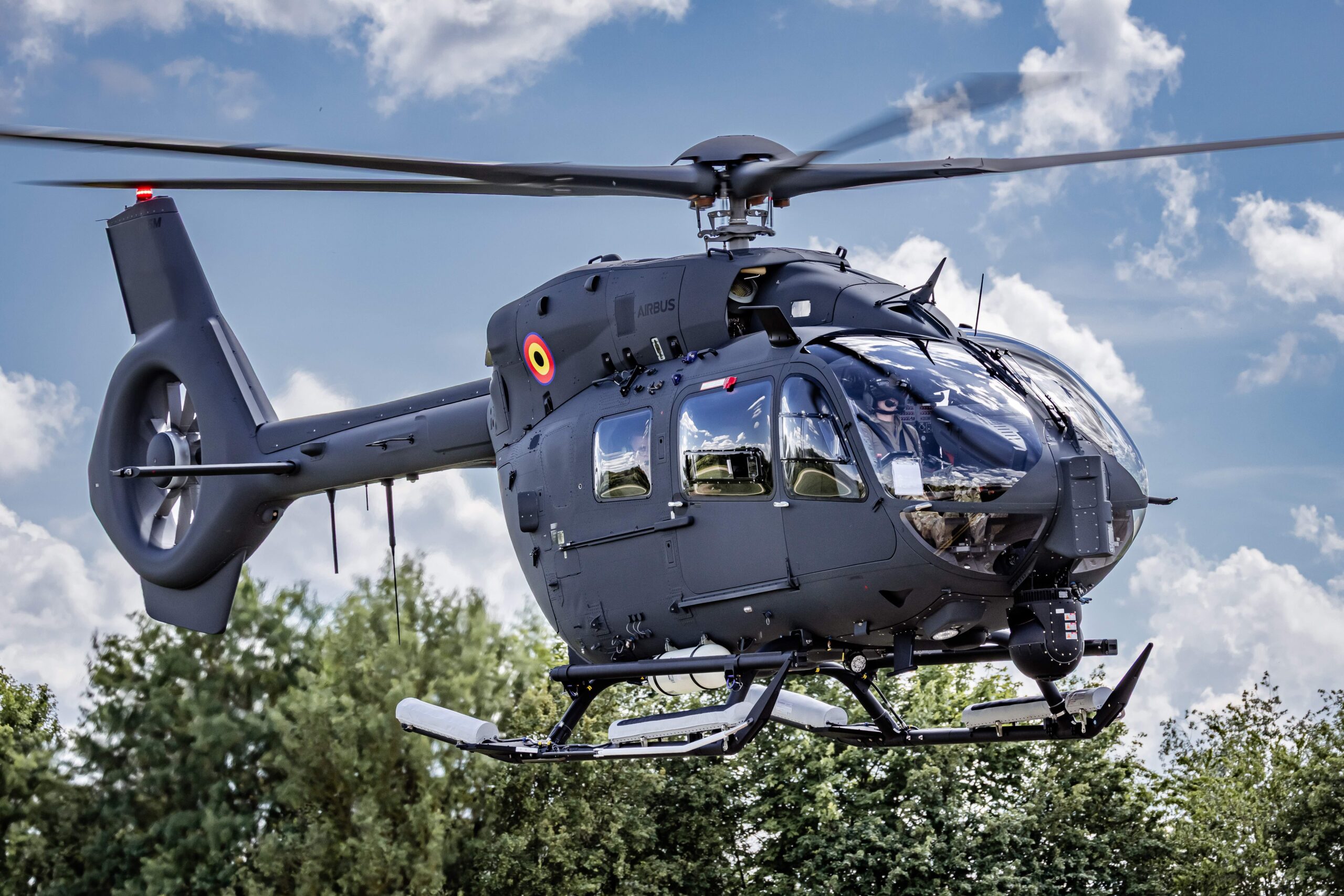
Airbus Helicopters has delivered the first H145M helicopter to the Kingdom of Belgium, marking a major milestone in the modernisation of the nation’s defence and security capabilities. The aircraft is part of a wider procurement contract signed in 2024 via the NATO Support and Procurement Agency (NSPA) to equip both the Belgian armed forces and the Federal Police. Highlighting the growing momentum of the programme, Belgium has also recently exercised its option for three additional H145M helicopters, bringing the nation’s total fleet on order to 20 aircraft. “We are proud to celebrate this first delivery to Belgium and are deeply honoured that they are joining a rapidly growing community of European nations that trust the H145M for their most critical operations,” said Thomas Hein, Head of Europe Region at Airbus Helicopters. “This platform has become the definitive European reference for military multi-mission capabilities. Belgium’s decision to extend their fleet to 20 aircraft is a powerful testament to the deep trust placed in our team and the H145M’s ability to meet today’s evolving security challenges,” he added. The H145M is a multi-role military helicopter that provides a broad range of mission capabilities. Within minutes, the helicopter can be reconfigured from a light attack role with axial ballistic and guided weapons and a state-of-the-art self-protection system into a special operations version with fast-rappelling equipment. The comprehensive mission packages include hoisting and external cargo capabilities. Its ability to seamlessly integrate into networked combat and team with uncrewed aerial systems, backed by advanced digital connectivity, makes it the most capable helicopter in its class. The H145M is the military version of the tried-and-tested, light twin-engine H145 helicopter. The global fleet of the H145 family has accumulated more than 8.5 million flight hours. It is used by armed forces and law enforcement agencies around the world for the most demanding missions. The US Army employs almost 500 helicopters from the H145 family under the name UH-72 Lakota. Germany has ordered up to 82 H145M helicopters, with deliveries currently ongoing. Other military operators of the H145 family include Hungary, Serbia, Luxembourg, Thailand, Ecuador, and Honduras. Powered by two Safran Arriel 2E engines, the H145M is fitted with a full authority digital engine control (FADEC). In addition, the helicopter is equipped with the Helionix digital avionics suite which, alongside innovative flight data management, includes a high-performance 4-axis autopilot, reducing pilot workload during missions. Its particularly low acoustic footprint makes the H145M the quietest helicopter in its class. Airbus signs MOU for Japanese anti-submarine variant of the Eurodrone Airbus has signed a Memorandum of Understanding (MoU) with Kawasaki Heavy Industries. Under the MoU, Airbus, in cooperation with Kawasaki Heavy Industries, will analyse opportunities to work on a Japanese anti-submarine warfare variant of the U950 Eurodrone, Europe’s first Large Long Endurance Remotely Piloted Aircraft System (RPAS). Japan has held observer status in the Eurodrone programme since 2023. The Eurodrone is ideally suited for countries like Japan that need to monitor large maritime areas. Compared to its nearest competitor, Eurodrone has very long flight endurances and can fly with much more mission payload, including sonobuoys and torpedoes for anti-submarine warfare. With Eurodrone, Japan could complement its current crewed anti-submarine warfare fleet with a very efficient uncrewed platform and strengthen its maritime security in a sovereign and sustainable manner. In the next step, Airbus will engage in discussions with Kawasaki Heavy Industries to develop options for the design, development, and commercialisation for a future Japanese maritime version of Eurodrone, including the definition of possible configurations, integration of Japanese sensors and effectors, and other potential workshare for Japanese industry during production and sustainment. All this is intended to ensure that Japan can operate the Eurodrone sovereignly and without restrictions, should the country decide to acquire the RPAS. This targeted collaboration with Japan is set to bolster the Eurodrone programme while deepening the strategic framework of European-Japanese defense initiatives. Furthermore, insights gained from developing Japan’s specific variant are expected to provide substantial operational and logistical advantages for future European naval versions of Eurodrone. The Eurodrone, a four-nation programme of Germany, France, Italy and Spain, led by the Organisation for Joint Armament Cooperation (OCCAR), is currently under development and is scheduled to take its first flight in 2029. India is also an observer in the programme. The Eurodorne can cover a wide range of missions – from airborne intelligence, surveillance, target acquisition, and reconnaissance to early warning and signals intelligence, as well as maritime patrol and anti-submarine warfare. With a mission payload (excluding fuel) of up to 2.3 tonnes it can stay airborne for up to 40 hours. It will be fully integrated in civil airspace and thanks to its high levels of safety and redundancy, it will be ideal to operate over the open sea. For Editorial Inquiries Contact: Editor Kym Bergmann at [email protected] For Advertising Inquiries Contact: Group Sales Director Simon Hadfield at [email protected]
Previous article
Team Boxer UK delivers 100th Boxer for British Army
Comments
Loading comments...