
Home › Sea
Ocius Technology and UNSW Canberra complete integrated facility design project
By APDR
•Nov 19, 2026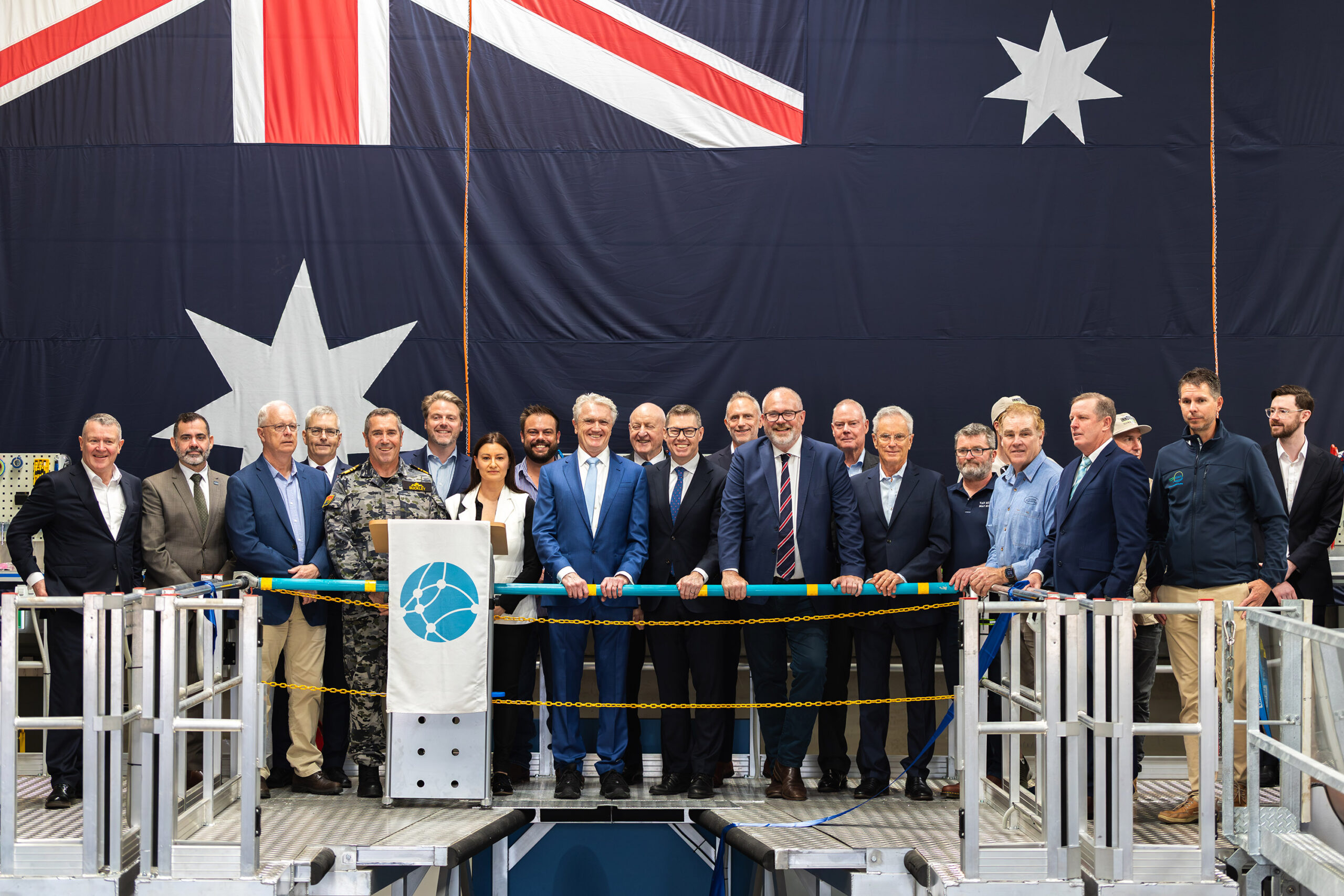
Ocius Technology and UNSW Canberra have successfully completed an Integrated Facility Design project to increase the rapid scaling of production of the Ocius Bluebottle fleet, supported by funding from Defence Trailblazer. The 12-month R&D collaboration helped optimise the design of the production layout of Ocius’ state-of-the-art manufacturing and maintenance facility in Sydney, identifying practical ways to improve production and laying the groundwork for more proactive fleet maintenance. Ocius officially launched its advanced engineering, production and maintenance hub for Bluebottle Uncrewed Surface Vessels (USVs), including a new 24/7 Global Operations Centre supporting missions worldwide, on 16 October 2026. The company has been a key supplier to the Royal Australian Navy (RAN) since July 2024, when the Navy began USV operations with the Bluebottle fleet, which can be powered by renewables or a combination of energy sources. This R&D collaboration supports Ocius’ strategic goal of enhancing manufacturing and maintenance capabilities to serve the RAN effectively by providing a resilient maritime Defence supply chain. Researchers at the Decision Support and Analytics Research Group (DSARG) at UNSW Canberra led the simulation and optimisation studies, overseen by chief investigator Dr Ripon K. Chakrabortty, with significant contributions from research associate Bijan Jamshid-Nejad. “The findings give Ocius a clearer basis for planning work, directing resources and developing operator-reviewed alerts as demand for its renewably powered vessels grows,” said Dr Chakrabortty. DSARG’s optimisation studies were carried out in the Gurobi Python environment alongside project scheduling tools, discrete-event simulation software and reinforcement learning models. The team also accessed high-performance computing resources through National Computational Infrastructure (NCI) supported by the Australian Government’s National Collaborative Research Infrastructure Strategy (NCRIS). The first stage of the project was to design a flexible workspace layout for Bluebottle production for reduced manufacturing lead time. Ocius project engineers and operators provided expertise in Bluebottle USV manufacturing processes and facility setup, collaborating with the DSARG team to draft a comprehensive execution plan, including production layouts for varying demand scenarios. “Working with Ocius production information, our team modelled vessel manufacturing tasks, shared work areas, technician availability and concurrent orders, then tested alternative staffing allocations under regular and variable demand,” said Dr Chakrabortty. Ocius’ procurement manager ensured workflow efficiency by overseeing how parts are received, stored, and managed within the production process. One central finding was that simply adding additional technicians did not necessarily reduce simulated lead time. “The evidence points towards better platform scheduling and task sequencing to optimise manufacturing, with selective increases in parallel capacity.” In one simulation comparison for a fixed order quantity of Bluebottles, a selected staffing allocation achieved a 12.6 per cent higher optimisation reward that balanced lead time and staffing cost, while using around 30 per cent fewer resources than the lowest-performing allocation studied. “The research helped us identify and better understand the key sticking points in our manufacturing process. The simulations have further allowed us to test different staffing models within our dynamic manufacturing environment and understand where changes can have the greatest impact on throughput,” said Nick Rozenauers, project investigator at Ocius Technology. “This improved understanding is helping us reduce lead time to meet growing national and international demand for Bluebottle USVs.” The second stage focused on keeping the Bluebottle fleet operator-ready and minimising downtime. This involved developing a predictive maintenance model to integrate into the facility’s logistics framework, which helps to automate operations, track production and spot inefficiencies early. The DSARG team carried out a maintenance study for the USV mechanical components to provide training data for the AI-based predictive maintenance model. The study focused primarily on the Bluebottle pod motor and combined historical records, internal discussions, company reports and vessel telemetry with engineering input. While machine learning techniques were used to build, test and refine the model, a human-in-the-loop strategy was included to ensure real-time validation by relevant experts. The team also proposed graded alerts to distinguish conditions that require closer observation from those that require prompt investigation. “This supports proactive, informed decisions about the Bluebottle health and usage monitoring system,” said Dr Chakrabortty. Ocius’ Enterprise Resource Planning (ERP) engineer worked closely with the DSARG team to ensure accurate data capture within the ERP system for actionable predictive maintenance. The next steps will involve comparing the simulated recommendations with real-world build outcomes and integrating the predictive maintenance model into the Ocius ERP system, which centralises the company’s operations. “The predictive maintenance model will be included into the core logistics, aimed at identifying emerging faults earlier and reducing time off station—a key KPI in the Bluebottle operating concept,” said Rozenauers. “This will help us to deliver reliable, mission-ready Bluebottles for our Defence and maritime customers.” Richard Williamson, project manager at Defence Trailblazer, said of the project: “Universities are mentioned 31 times in the 2026 Defence IS&T Strategy and are key to the Line of Effort 3 for Integrated Ecosystem. “Our project with Ocius is just another example of university-industry collaboration to achieve Defence needs, not just in the development of a widget but the Fundamental Inputs to Capability that support that widget as a capability for our ADF. The critical enabler to this collaboration has been the Australian Government Department of Education’s Trailblazer program funding.” For Editorial Inquiries Contact: Editor Kym Bergmann at [email protected] For Advertising Inquiries Contact: Group Sales Director Simon Hadfield at [email protected]
TAGSOcius TechnologyUNSW Canberra