
Boeing to build 96 AH-64E Apaches for Poland
South Korea to strengthen presence in Poland’s defence market
By APDR
•Dec 1, 2025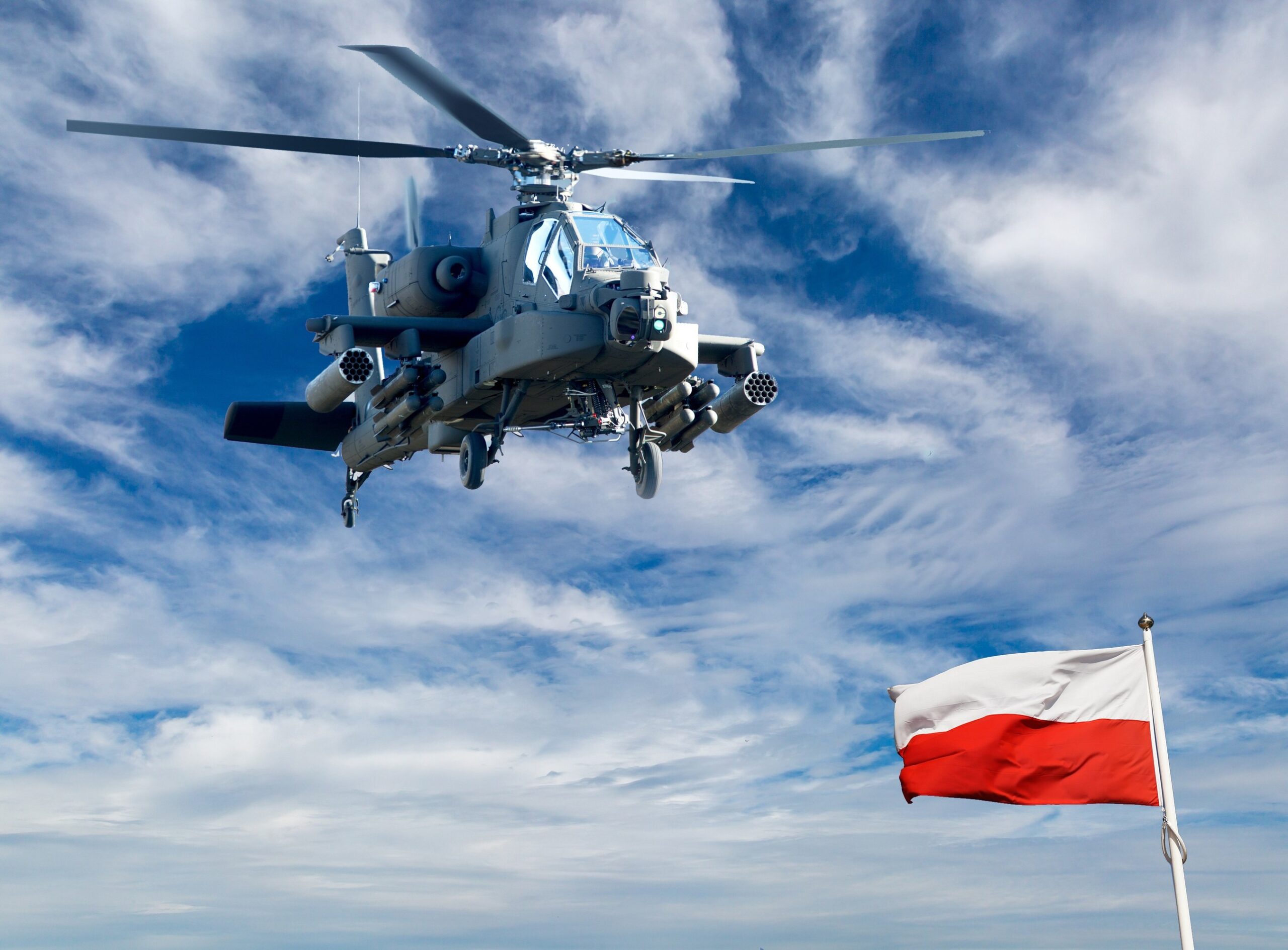
Boeing will produce AH-64E Apache attack helicopters for international customers including 96 for the Polish Armed Forces, under a Foreign Military Sales contract awarded by the U.S. Army valued at nearly $4.7 billion. Poland’s order represents the largest number of Apache aircraft ordered outside of the United States in the program’s history. With deliveries expected to begin in 2028, the Polish Ministry of National Defence (MND) is already training pilots and maintainers on the attack helicopter. The MND currently leases eight aircraft from the U.S. Army. “This important agreement allows us to begin building one of the largest and most formidable Apache fleets that the world has ever seen,” said Christina Upah, vice president of Boeing’s Attack Helicopter Programs. “Working closely with the Polish Armed Forces, we’re focused on disciplined execution to help enhance Poland’s defense capabilities and keep up with the strong demand for the most advanced attack helicopter.” Through an offset agreement announced last year between Boeing and the Polish MND, local industry will play a key role in performing maintenance and support of the Apache fleet. Boeing will also establish training programs and help develop a composite laboratory. Boeing recently celebrated the 50th anniversary of the Apache’s first flight at its Mesa production facility. Today’s E-model Apache has evolved to become the most proven, advanced configuration that brings unmatched lethality, survivability, connectivity and interoperability to the battlefield. In recent months, Boeing has delivered new Apaches to customers around the world, including the Australian Army, Indian Army and Royal Moroccan Air Force. Poland is the 19th global operator. There are currently more than 1,300 Apaches operating worldwide, with sustainment and training support provided by Boeing Global Services. South Korea to strengthen presence in Poland’s defence market Following the news that South Korea has reportedly proposed transferring one of its decommissioned submarines to Poland, Abhijit Apsingikar, Aerospace & Defense Analyst at GlobalData, a data and analytics company, offers his view: “Despite the selection of the Swedish A26 submarine for the Orka contract by Poland, South Korea’s proposal to transfer the decommissioned ROKS Jang Bogo, an HDW Type 209 submarine, to Poland at no cost after its retirement is expected to help the European nation to address its immediate capability shortfalls. It is also expected enable the country to restructure its crew training regime and support the transition from Kilo-class submarines to Western submarine technology standards. This, in turn, will enable Polish crews to swiftly adapt to the new A26 submarines when they enter service in the future. “As per GlobalData’s dataset Global Submarine Market Forecast 2025-2035, the Polish submarine market is valued at around $2.4 billion, and the country plans to acquire four submarines under the Orka-class program. South Korea has already established a strong foothold in Poland’s defence market, with its defence export deals to the country exceeding $10 billion in 2022 alone and totalling an estimated $13–14 billion overall till date. The proposed transfer of the Jang Bogo is likely to further strengthen South Korea’s presence in Poland’s defence market and pave the way for expanded sales to the country. “Poland has already concluded major defence contracts with South Korea, including 180 K2 Black Panther main battle tanks, 48 FA-50 jet trainers, 212 K239 Chunmoo MLRS systems, and 212 K9 self-propelled howitzers, with an additional 162 K9 howitzers announced. The Polish Krab self-propelled howitzer is also based on the South Korean K9 chassis, and Poland has signed a licensing agreement to produce the K9A1 variant domestically. Against this backdrop, South Korean defence companies have strong prospects for successfully promoting their other defence equipment, as they are already well acquainted with Poland’s defense procurement framework. “If realised, the transfer is therefore also expected to pave the way for expanded future acquisitions of South Korean defence equipment by Poland and to support follow-on orders. The move also demonstrates South Korea’s intent to go the extra mile to empower its allies and strategic partners, especially at a time when Poland expressed concerns about possible spillover of the Russia-Ukraine conflict at its borders.” For Editorial Inquiries Contact: Editor Kym Bergmann at [email protected] For Advertising Inquiries Contact: Group Sales Director Simon Hadfield at [email protected]
Previous article
Heckler & Koch, Rheinmetall Nordic sign partnership
Comments
Loading comments...