
Chief of Navy, Vice Admiral Michael Noonan speaks to APDR
By Marilyn Tangye Butler
•Oct 9, 2019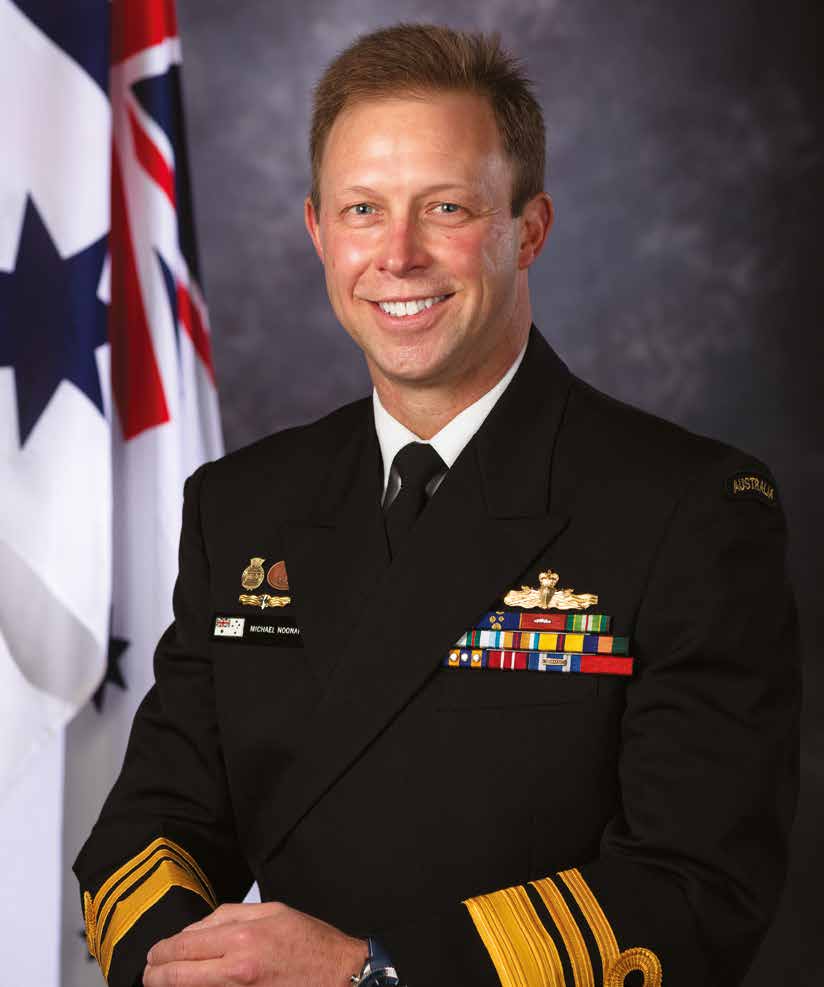
AUSTRALIA’S NAVAL BUILD UP EXPLAINED The current Chief of Navy, Vice Admiral Michael Noonan, AO, took up his position on 6 July, 2018. With previous postings as the Deputy Chief and also head of Border Force, he is now not only in the job at a time of enormous activity, but also while one of the largest peacetime increases in Australian naval capability is taking place. He was kind enough to bring APDR up to date on a variety of topics. Kym: Looking at the year that’s gone, what have been the major activities for Navy? And what do you anticipate happening in 2020? Admiral Noonan: I think it would be fair to say 2019 has been yet another busy year for us overall – with a lot of that activity going very well. A quick run around the bazaars: we’ve had our ongoing commitment to Operation Resolute, the standing operation for maritime border security. We’ve had consistently five to six boats in that program all year. Then there is our ongoing commitment to Middle East operations through Operation Manitou. We saw HMAS Ballarat up there for a good part of the back end of last year and into this year. They had some very significant activity with respect to drug interdiction – including a couple of record drug hauls. Closer to home, we saw the Indo-Pacific Endeavour 2019 activity with a significant presence of five ships and almost 1200 Defence personnel visit seven countries in the region – which was a great activity. This is now the third time that we’ve done the Indo- Pacific Endeavour. However, the most significant change, Kym, has been the Government shift in terms of focus to the region, especially since October last year when the Government committed to the Pacific Step Up. The ramifications for Navy are that we have now had an almost continuous presence in the Southwest Pacific. Since February this year I’ve had a vessel in Papua New Guinea waters – and I’ve had at least a second vessel, if not more, operating through the Southwest Pacific. I think that’s going to be part of the new normal going forward. So, 2019 started busy, and it got busier. With respect to next year, I would expect that we will build upon all of those activities. I believe some highlights of that will be that the Pacific step-up will be maintained and we will do another Indo-Pacific Endeavour. Regarding other major exercises, 2020 will be a RIMPAC year so we will deploy a number of ships to Exercise RIMPAC. At home, we will host exercise Kakadu off Northern Australia in the July – August timeframe next year. Most significantly, Kym, we’ve seen the Prime Minister’s announcement last month, with respect to Australia’s involvement in the US led International Maritime Security Construct. What this means for our Navy is that HMAS Toowoomba will deploy to the Persian Gulf in January next year. We’re likely to see her employed in that maritime security role, which will be defined over the coming months. But it will be a shift in the focus in employment of that frigate from what would have been activities with Combined Task Force 150, which has been focussed around the counter narcotic and counter illicit material and arms trade to what is going to be a new focused operation around providing security and escort duties around shipping – namely fuel tankers transiting the Strait of Hormuz. Kym: I assume that Navy will continue to support Australian border security operations as well, just as part of your normal activities? Admiral Noonan: Yes, absolutely Kym. There’s no foreseeable change to that occurring – and our commitment to that remains enduring. Of course as we look to introducing future capabilities – particularly the offshore patrol vessels – we want to ensure they are designed with that enduring commitment in mind. Kym: Just that quick overview indicates that you have a lot happening – and I assume that you have to keep something in reserve to deal with unplanned events? Admiral Noonan: Yes, that’s very astute, Kym – what I just described to you is largely what has been our off-the-Australian-station commitment. On top of this, we have other national commitments in terms of not just responding to crises or exercises, but the day-to-day raise, train and sustain commitments we have, which have typically seen between 20 and 27 ships at sea at any one time through 2019. Kym: That’s impressive. Admiral Noonan: Which means every day, we’ve had somewhere between 2,000 and 2,700 Australian men and women at sea from our Navy. This represents a significant proportion of our overall force in terms of our sustained commitment. So yes, we’re pretty busy at the moment. Kym: It certainly sounds like it. Turning to acquisitions, you have at least three major programs underway: OPVs, future submarines and future frigates. It is a long time since so many large projects were running in parallel. Does this give rise to particular challenges? Admiral Noonan: I think in terms of the magnitude of what we’re doing, you’re spot on, it is unprecedented. In terms of overall capability, clearly this is the single biggest capitalisation of the Navy since the Second World War. But even back then, we weren’t doing things like building submarines in parallel with frigates and other vessels. So in terms of challenge, absolutely it’s a huge challenge. But it’s a challenge that I share with my colleagues in the Capability and Sustainment Group. I share that challenge with the Australian ship building industry. I share that challenge with the Estate and Infrastructure Group who are responsible for providing the shore support services. And to a large degree I also share that challenge with my colleagues in the Air Force and Army as many of these capabilities will have tri-service usage as we develop them. In some cases the Acceptance Authorities, the Test and Evaluation Authorities, come from other parts of Defence as well. So while I’m certainly not at all trivialising the challenge that we have, I do feel both excited by it – and I’m also well supported across the enterprise. As we look at Governments’ commitment to it, and the amount of the resource that they are putting into not just the Navy but the entire Defence enterprise at this very important time, I think it really does underpin the Governments’ commitment to the ADF, and also their understanding of what is the evolving strategic context Australia finds itself in. Kym: All three of these major acquisitions are in the relatively early stages. Are there any headaches or standouts? Admiral Noonan: I think that in terms of the three major programs, look they’re in great shape. With the OPVs, the first two are being built in South Australia, and we’ll see the third through to the 12th vessel commence production in Western Australia next year. So that’s a great news story. I think in absolute terms, there is very little risk to that program. The Hunter class frigates – I’m very comfortable with where we’re at with the build of those. Obviously, part of developing that capability is building the shipyard where the frigates will be constructed. That yard will be up and running early next year. And also later next year we’ll start the prototyping of the first hull for the Hunter class and then we’ll split the build with the first ship commencing in 2022. So in terms of de-risking activities and industry’s engagement, we’re very well advanced. And of course we have the ability to learn lessons through BAE Systems construction of HMS Glasgow, happening in Scotland as we speak. We’ve had regular contact there – I visited that dockyard late last year. I certainly took away some great insights in terms of things that we need to be planning for in our Navy.Rear Admiral Pete Quinn, my Head of Navy Capability, was there only last week. And so we’re asking tough questions, but we’re asking the right questions of BAE – and that’s all designed around ensuring that we are a very informed customer and we are taking a hands-on approach. Turning to the Attack class: there is not a day that goes by that I don’t think or talk about submarines. That project is pretty exciting too, in terms of what it represents for our Navy and the nation. Certainly it’s complex. It’s ambitious, but it’s absolutely vital. The process that we’ve gone to, to get to where we are now has been very, very robust indeed. Design work for that submarine is proceeding very well. I expect that we will see construction of NUSHIP Attack commencing in 2023. And we’ll take delivery of that first submarine in the early 2030s. In parallel with that, we’ve now got both of the two new supply ships in the water. They’re being built in Spain, with the second of those vessels launched just a few weeks ago. The first ship will be HMAS Supply, and we’ll take delivery of the capability in the first half of next year. Kym: I guess sometimes we forget about the supply ships because they’re not bristling with weapons, but they’re a pretty important part of the overall mix. Admiral Noonan: Absolutely. In terms of being able to achieve and maintain the mission that I’ve set for our Navy in 2022, it’s all about being able to conduct sustained operations as part of the joint force. And that sustained increase absolutely is underpinned by not just our national logistics mechanisms, but also our ability to replenish our ships at sea from things like our tanking ships. Kym: As an aside, I was lucky enough to spend a few days on board ESPS Cantabria for a NATO electronic warfare exercise a couple of years ago. Admiral Noonan: Well that’s great Kym, and given your firsthand experience, which is even more current than mine, I look forward to reading your very impressive summary of the capabilities of our new oilers! The Spanish have been terrific in terms of their support for the realisation of our own capability. In 2013, Cantabria spent three or four months in Australia and we received a great understanding of the capability of the ship and in the lead up to taking delivery of Supply we’ll have a small team over there learning how to operate her as well. Kym: I understand you are particularly interested in the Air Warfare Destroyers? Admiral Noonan: Yes, and I hope it’s something your readers are interested in! I’m absolutely thrilled with the progress that we’ve made with the Hobart class destroyers. I was able to declare initial operating capabilities for HMAS Hobart earlier this year. And that was after she deployed to the West Coast of the US late last year and conducted her combat system sea qualification trials. I would go as far as saying the results of those trials exceeded our expectations in a number of areas. Hobart’s now back in Australia, and she’s just completed her first maintenance cycle, following her IOC declaration. What that’s allowed her to do is to conduct some complex missile firings off the East Coast of Australia. What that now allows me to do is certify her to deploy off the Australian station. She will do that as part of a task group in the September – October period. I’m really proud that Hobart will lead the Australian task group into the South China Sea and will also participate in the Japanese Fleet Review soon after that. In terms of the second ship – Brisbane – she commissioned last year. She sailed out a month ago on her way to the US to do a similar set of certification trials to Hobart. Ultimately she will be ready to deploy operationally from about the start of next year. The third ship NUSHIP Sydney, she’s well advanced, she’s about 90% crewed and complete, so we’re looking to accept her later this year and commissioned her into Navy service early next year. They’ve been a tremendous success in terms of the delivery of those programs – and their operational performance has been absolutely first class. Kym: I had a look at Sydney earlier this year when the decision had been taken to incorporate the MH-60R helicopter modifications while she was still there. Admiral Noonan: Yes – I took a deliberate decision to recommend to Government to leave her there a little bit longer, and get those mods in, which really ramps up the overall final operational capability of the class by about nine months. Kym: Next on my list is the Collins life extension program. There seems to be some uncertainty about numbers: whether it will be five or six. Can you clear that up? Admiral Noonan: It’s not my decision to make, Kym. Ultimately it’s a decision for Government – and my recommendation has been that we upgrade at least five of the six. I’ll let analysts and reporters continue to debate that. Ultimately the point that I’d underline around the Life Extension Program is that it’s fully funded. The capabilities that we will put into that boat are two fold. One is ensuring that the capability of the Collins class remains at the cutting edge, and also that we’re de-risking capabilities that we will build into the Attack class. Now, at some point there a funding envelope will dictate the number of boats that we upgrade, but also the nature of the systems that we put into that life of type extension. I’m very confident that those boats will continue to serve us at the high end of submarine capability until we see the introduction of the Attack class. But clearly some of the details around what systems, and how many boats we extend are yet to be decided by Government. The current plan is that the first boat will commence the life extension program as part of its full cycle docking in 2024. Kym: Now, to personnel. How are things looking there? I recall reading a report recently of an Anzac frigate being tied up because of a crew shortage. Can you clarify what is going on there? Admiral Noonan: Sure – it’s absolutely my single most important focus is our people and our workforce. In terms of the ship that you’ve described, that’s HMAS Perth. She’s not tied up, she’s out of the water. She’s actually sitting on the hardstand at the Henderson facility in Western Australia and she’s been there for two years. She’s now part of the Anzac capability upgrade program – so in terms of absolute manning, she wouldn’t be manned at this point anyway. But my predecessor took the decision to put Perth into extended availability on the requirement that we simply didn’t have the complete workforce to man her in a sustainable way. We could’ve put that ship to sea, and it would’ve been probably at around about a 70% manning level – and that would have seen good people overworked, and a capability not fully realised. So part of a very deliberate strategy that we have been enacting now for the last two years is about rebuilding our workforce. I’m delighted to say that the inroads that we’ve made over the last 12 months have been significant in terms of our workforce regeneration. I monitor the health of our workforce daily – and each fortnight as we pay our people, I track our numbers. Last Thursday, we paid 14,682 people. Which highlights the steady growth that we’ve enjoyed over the last 12 months, which has been about a nett increase of 700 people overall. But there’s two things to add: as you’ve alluded to, we’ve had workforce shortages and part of my biggest challenge is that we’ve got a Navy workforce that’s been critically hollow in the mid ranks. I’m about a 1,000 people short the ranks of Leading Seaman to Petty Officer, Lieutenant Commander. So while recruiting is going gangbusters at the moment, overall, it will still take time to rebuild the experience off the Navy to get us to the full, currently authorised strength. I expect that we will hit the authorised strength of our Navy, which is currently 14,774. We’ll hit that pretty soon. But in terms of being sustainable, and being able to deploy capability, we need to get experience and depth back in the workforce. That’s going to require two things. I need to continue to grow the workforce. And I need to work very hard at retaining the men and women whose skills we rely upon every day. So we’ve undertaken a number of very targeted retention initiatives to ensure that we provide a great opportunity for people to continue to serve beyond what has become an average length of service of around about seven years. That seven year average is not sustainable in terms of the future capabilities that we’ve got coming towards us. As part of the force structure planning activity that’s currently under way through the Department, one of the biggest things that I’ve put on the table, is to grow the Navy workforce. And how I’ve gone about that is through careful analysis of what our future fleet looks like. We have to plan for how we will look in 2035 – and we’ve got a very clear understanding of what the fleet is going to look like. We’ve probably got a less certain view of what we’ll be doing. But some of those things that we spoke about at the start of the interview, gives you a sense of where I think we’re going. And so my belief, and my advice to Government is that we need to significantly increase the number of people in our Navy. I’ve stood up a new directorate within Navy that’s absolutely committed to understanding what our future workforce needs to look like. And developing those strategies to ensure that we can achieve it once we get approval from government to grow. Kym: A supplementary question on that, because it’s obviously a vital topic. Do you have an ultimate figure in mind of how much larger you’ll need to be in terms of personnel say at the end of the decade when platforms like the future frigate and the future submarines start to come online? Admiral Noonan: The Director General Future Navy Workforce and his team have commenced detailed analysis of this very question, and I will be seeking to provide input to the force structure planning process currently being led by the Vice Chief of Defence Force in the coming months. But it would be fair to say that I expect that the Navy will need to grow in the coming years in order to fully exploit the capabilities which will be delivered, which I expect Navy to be directed by Government to undertake. Kym: There has been a bit of publicity about networking Air Force and Army assets – is that just as important for the RAN? Admiral Noonan: Bottom line, absolutely! In as much, Kym, as that we don’t deploy as a Navy, we deploy as part of a joint force. This is certainly the case if you’re looking at it through experiences such as the recent Exercise Talisman Sabre. If you peel back what we achieved out of that exercise, it was all about being part of a networked enabled force. We were actually operating the two LHDs together for the very first time – and that has allowed me now to progress towards the final operating capability of the LHD platform. But moreover, we’re talking about the amphibious ready group – and that’s all about command and control and networks. It’s all about being able to plan in an aggregated way. Sharing information between land systems, air systems and maritime systems. That really is now the way that we do business. The end state for me, as I reflected earlier, in terms of Plan Pelorus 2022 is about being able to conduct those sustained operations in the joint force. The things that we are looking at in terms of future Navy and maritime capabilities, are well beyond even networking. The opportunities around cyber; around advanced ICT systems; around space; around satellite protocols. We’re thinking about those every day. Even some of the trials that HMAS Brisbane will conduct during her time in the US, will be a step up from what Hobart’s done previously in terms of their networked abilities. In terms of sharing targeting information from the third party and real-time activities that absolutely make full use of the electro-magnetic spectrum. Kym: Any final messages? I assume you will be looking forward to discussing this at the Pacific Conference? Admiral Noonan: Yes – and my only final comment would be to say thanks for this opportunity – and certainly going forward in the context of the Sea Power Conference and Exhibition, I’m delighted that we’ve got this opportunity to engage with industry and engage with our academic colleagues – who I now see as being not just part of the commentary, but they’re truly integrated partners in the capability that the Navy is fielding. I see this relationship developing in the future – and certainly my hopes and expectations for this upcoming Sea Power Conference is that everybody leaves feeling that they are part of a very important time of our Navy’s history. And I certainly look forward to receiving advice – I get plenty of that! Kym: Thank you for your time – and see you there.

Kym Bergmann has more than 35 years of experience in journalism and Australian and international defence industry. After graduating with Honors from the Australian National University, he joined Capital 7 television, holding several positions including foreign news editor and chief political correspondent. After 2 years on the staff of a Federal Minister, he moved to the defence sector and held senior positions in several companies, including Blohm+Voss, Thales, Celsius and Saab. In 1997 he was one of 2 Australians selected for the Thomson CSF 'Preparation for Senior Management' MBA course, the other being Chris Jenkins - formerly the CEO of Thales Australia. He has also worked as a consultant for a number of companies, including Raytheon, Tenix (now part of BAES) and Martin Marrietta (now part of Lockheed Martin). He had several board appointments, including Thomson Sintra Pacific (1994 - 96) and Saab Pacific (1998 - 2003). He retains good personal links with senior figures in Government, as well as in industry and the media. He decided to return to journalism in May 2008, and holds the position of editor for Asia Pacific Defence Reporter (APDR) and Defence Review Asia (DRA). He is also a podcaster and commentator on defence and national security issues.
Comments
Loading comments...