
Home › Industry News
Government covers up failure to deliver capability by re-announcing HIMARS and NSM decisions
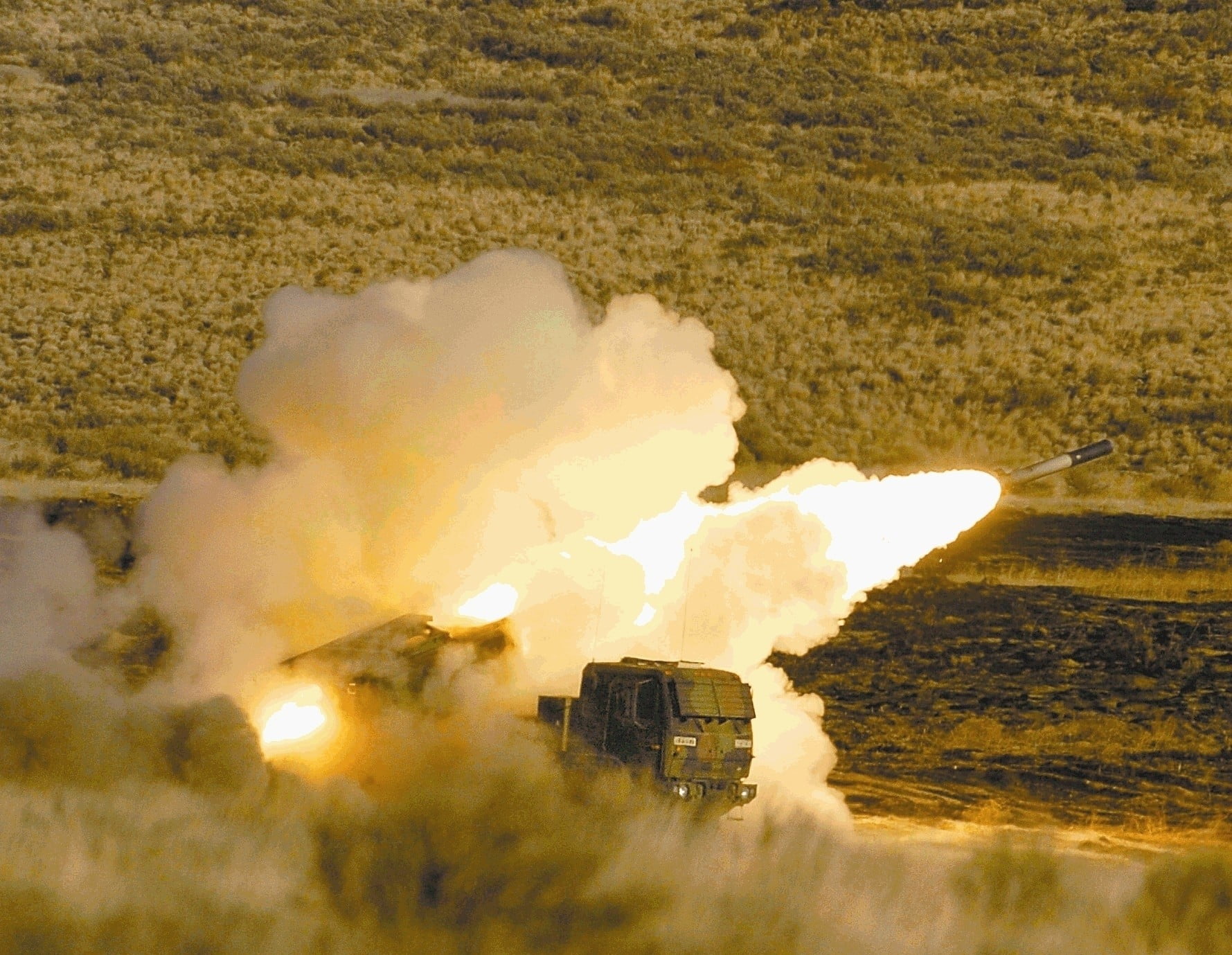
Breathlessly repeated by large sections of the Australian media, the January 5 joint statement by Defence Minister Richard Marles and Defence Industry Minister Pat Conroy is old news – literally. Prime contractor for the Naval Strike Missile – Norway’s Kongsberg – announced on April 5, 2022, that they had been selected to equip the RAN’s Anzac and Hobart class warships. On May 25, 2022, the US Congress was notified publicly, in writing, of an Australian request to purchase Lockheed Martin’s High Mobility Artillery Rocket System. What would have constituted news was an announcement that the Government had selected the coastal defence version of the NSM, paired with a Bushmaster vehicle from Thales Australia, in a system known as the Strikemaster. Or that it will equip the hopelessly outgunned Arafura class offshore patrol vessels. Or that local industry will develop a HIMARS-compatible long-range guided rocket. To shift everything into the realm of the Theatre Of The Absurd, was a claim by Minister Conroy that precise costing information could not be disclosed for reasons of national security. This is presumably a line delivered by an over-zealous security obsessed official from the secretive Department of Defence, because all relevant information is publicly available: The complete cost of the HIMARS package for Australia is a “not to exceed” figure of US $385 million (AU $563). This is for twenty (20) M142 High Mobility Artillery Rocket Systems (HIMARS); thirty (30) M30A2 Guided Multiple Launch Rocket Systems (GMLRS); thirty (30) Alternative Warhead (AW) Pods with Insensitive Munitions Propulsion Systems (IMPS); thirty (30) M31A2 GMLRS Unitary (GMLRS-U) High Explosive Pods with IMPS; thirty (30) XM403 Extended Range (ER)-GMLRS AW Pods; thirty (30) EM404 ER GMLRS Unitary Pods; and ten (10) M57 Army Tactical Missile System (ATACMS). Also included are Reduced Range Practice Rocket Pods (RRPRP); Vehicular Intercom System (AN/VIC-3) 3-Station; radio communication mounts; machine gun mounts; battle management system vehicle integration kits; wheel guards; ruggedized laptops; training equipment publications; spare and repair parts; support equipment; tools; test equipment; technical data; U.S. Government and Contractor support; technical and logistical support services; and other related elements of program and logistic support. The cost of a basic GMLRS rocket is AU $60,000. The cost in 2012 of an ATACMS was US $2 million; with inflation taken into account an ATACMS today is around AU $4.5 million. The unit cost of a Naval Strike Missile is US $2.194 million / AU $3.21 million. To suggest that revealing these numbers is a threat to national security is ridiculous. The US procurement system is quite transparent and the view is taken in Washington that taxpayers are fully entitled to know the cost of equipment – the complete opposite of Australia. Even without the benefit of publicly available information, security analysts in Beijing, Moscow and Pyongyang are more than capable of figuring out the cost of things for themselves. In the case of the GMLRS, for example, it’s hardly rocket science. Each one is made up of a rocket motor, a navigation unit, a basic flight control system, and a warhead. There are costs for assembly, handling and storage – but these are easy to calculate. This government was rightly critical of the failure of the Coalition to deliver improvements in Defence capability, despite plenty of announcements. On present indications they are no better. Minister Conroy in particular does no one any favours by going along with the obsessive and pointless secrecy that has become the hallmark of how the Defence Department deals with everything. With procurement on hold and causing damage to Australian industry while we wait for the outcome of the Defence Strategic Review, some people must have thought it would be smart to re-announce stuff during the summer holidays in the hope of fooling the public. That might work at first, but it’s not a viable long-term strategy – as the previous government discovered. For Editorial Inquiries Contact: Editor Kym Bergmann at [email protected] For Advertising Inquiries Contact: Director of Sales Graham Joss at [email protected]
TAGSAustraliaHIMARSKONGSBERG Naval Strike Missile
Previous article
Rheinmetall wins contract for explosives factory in Hungary
Kym Bergmannhttps://asiapacificdefencereporter.com/
Kym Bergmann has more than 35 years of experience in journalism and Australian and international defence industry. After graduating with Honors from the Australian National University, he joined Capital 7 television, holding several positions including foreign news editor and chief political correspondent.
After 2 years on the staff of a Federal Minister, he moved to the defence sector and held senior positions in several companies, including Blohm+Voss, Thales, Celsius and Saab. In 1997 he was one of 2 Australians selected for the Thomson CSF 'Preparation for Senior Management' MBA course, the other being Chris Jenkins - formerly the CEO of Thales Australia.
He has also worked as a consultant for a number of companies, including Raytheon, Tenix (now part of BAES) and Martin Marrietta (now part of Lockheed Martin). He had several board appointments, including Thomson Sintra Pacific (1994 - 96) and Saab Pacific (1998 - 2003).
He retains good personal links with senior figures in Government, as well as in industry and the media. He decided to return to journalism in May 2008, and holds the position of editor for Asia Pacific Defence Reporter (APDR) and Defence Review Asia (DRA). He is also a podcaster and commentator on defence and national security issues.