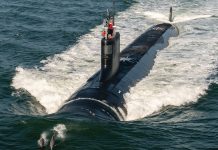
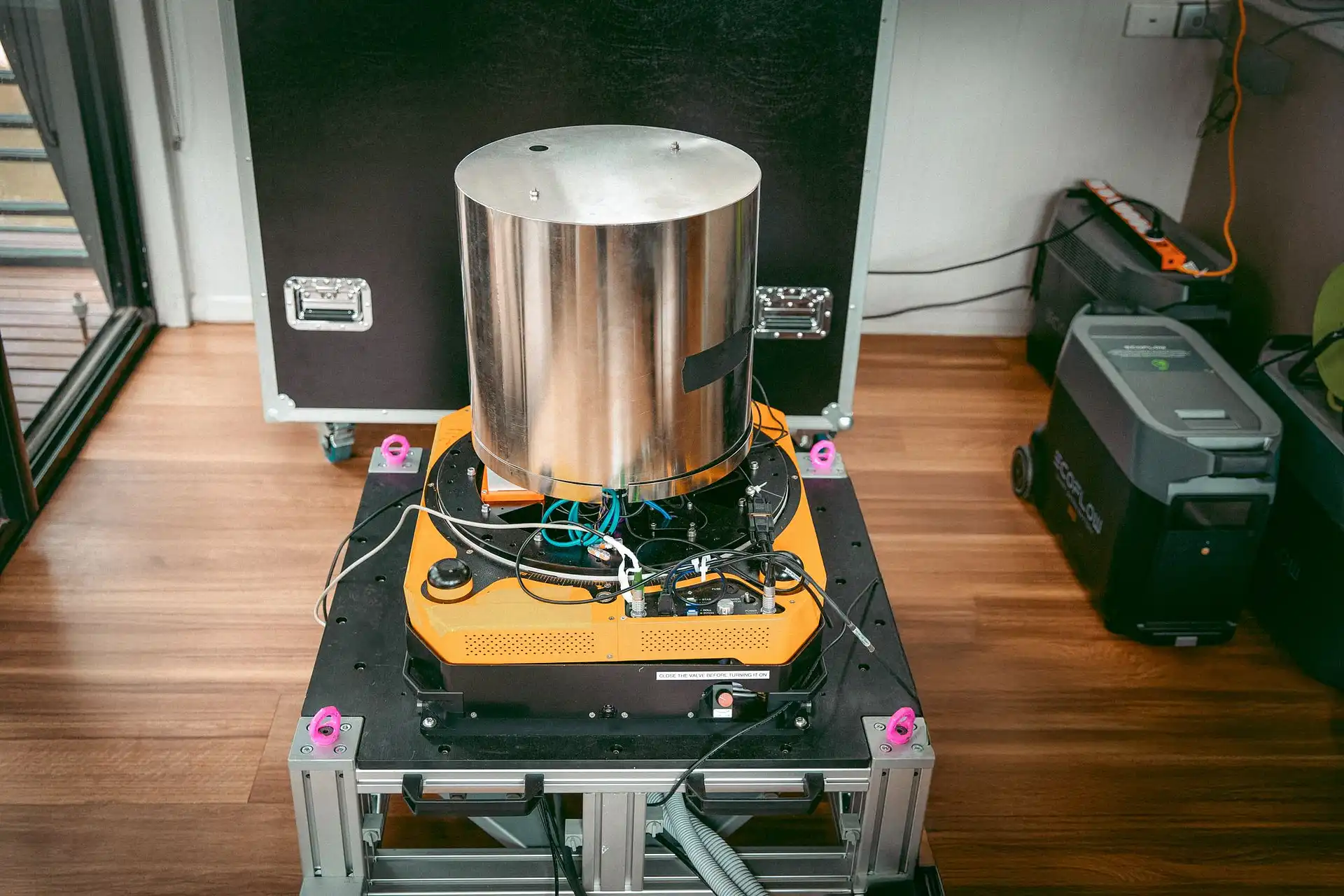
 Q-CTRL announced what it called a world-first field demonstration where it successfully navigated a maritime vessel without GPS using a new form of software-ruggedised quantum gravimeter. Through a series of trials in the Coral Sea off the East Coast of Australia, Q-CTRL performed autonomous gravity mapping and GPS-free quantum-gravimetric navigation, achieving the key metric of one nautical mile positioning accuracy.
This demonstration of Q-CTRL’s new maritime quantum navigation system comes as the race intensifies to develop secure capabilities for missions where GPS is unavailable or compromised. This year, electronic warfare took center stage as conflict in the Strait of Hormuz became a flashpoint for deliberate GPS jamming and spoofing, causing major disruption to maritime operations across the entire region. In Q1 of 2026 alone, approximately 978,000 GPS jamming events were recorded globally, with 98% concentrated in the Middle East, affecting more than 1,100 vessels.
Ironstone Opal by Q-CTRL is a new generation of quantum-assured navigation systems that delivers GPS-like positioning by “seeing” the Earth’s unique geophysical signatures. This advanced quantum sensing-powered technology is designed to operate in all domains—air, land, and sea—and serves as a robust backup for when GPS is unavailable or impaired. It functions day or night, in all visibility conditions, and does not rely on transmitting or receiving any external radio signals, making it immune to jamming and spoofing attacks.
The report demonstrates a new form of quantum “GravNav” which uses a quantum sensor to continuously “see” the tiny and otherwise invisible hills and valleys in Earth’s gravity, allowing the system to position against gravity maps. It builds on the company’s existing “MagNav” system, which operates similarly using magnetic fields. Quantum gravimetric navigation is suitable for maritime vessels for technical reasons and due to the broader availability of gravity maps at sea.
This breakthrough approach provides a correction to improve the performance of an inertial navigation system and enables precise positioning irrespective of mission duration. The concept of GravNav has been conceived for decades; a published demonstration that doesn’t rely at all on GPS signals, the need for periodic sensor recalibration, or special installation infrastructure has never been achieved in the open until now.
The key to this capability is Q-CTRL’s proprietary software-ruggedised quantum sensors, which use the very rules of nature at the atomic level to enable stable long-term navigation. Q-CTRL’s AI-powered software stabilises the quantum sensor, enabling it to work under heavy seas with no special countermeasures, such as temperature control, gyroscopic motion stabilisation (as used in a steady-cam), or frequent recalibrations. The system was simply installed in a passenger cabin and run autonomously. Compared against all prior publications, Q-CTRL’s new demonstrations significantly expand the range of real-world conditions in which quantum sensors have now proven their utility.
“The presence of malicious interference to GNSS signals via jamming and spoofing attacks means that we need reliable alternatives that cannot be manipulated by external sources,” said Jason Ralph, Professor of Electrical Engineering and Electronics at the University of Liverpool. “Whilst there are a number of ‘Alt-Nav’ technologies that can help to provide resilience, they all have limitations and their own vulnerabilities. Gravity sensing and map matching is the only passive Alt-Nav technology that is global in extent and is impossible to jam or to spoof. Q-CTRL’s recent work to develop and demonstrate a compact and high-precision gravity sensor suitable for navigation applications has the potential to be a game changer for reliable alternatives to GNSS positioning.”
In April 2025, Ironstone Opal demonstrated true commercial quantum advantage in navigation after delivering successful GNSS-free MagNav in real-world ground and airborne trials, outperforming a high-end conventional GPS alternative by up to 100 times. The technology is also Safety-of-Flight (SOF) qualified and has been recognised as one of TIME’s Best Inventions of 2025.
“Adversarial investment in electronic warfare and GPS jamming and spoofing capabilities has made assured positioning, navigation, and timing a warfighting necessity, not a convenience,” said Lieutenant General Steven A. Sklenka, USMC (Ret.), former Deputy Commandant for Installations and Logistics for the U.S. Marine Corps. “Q-CTRL’s demonstration shows a credible path to navigation that doesn’t depend on a signal we can no longer assume will be there – which is exactly what distributed maritime operations and contested logistics require to function, when, not if, GPS is denied.”
Q-CTRL is already working with allied government agencies and has major contracts with defence organisations, including DARPA, the U.S. Defense Innovation Unit (DIU), the Australian Department of Defence, the UK Royal Navy, and other AUKUS partners, to deliver new quantum sensing and quantum computing solutions in service of the warfighter.

For Editorial Inquiries Contact:
Editor Kym Bergmann at [email protected]
For Advertising Inquiries Contact:
Group Sales Director Simon Hadfield at [email protected]