Land Forces 2026

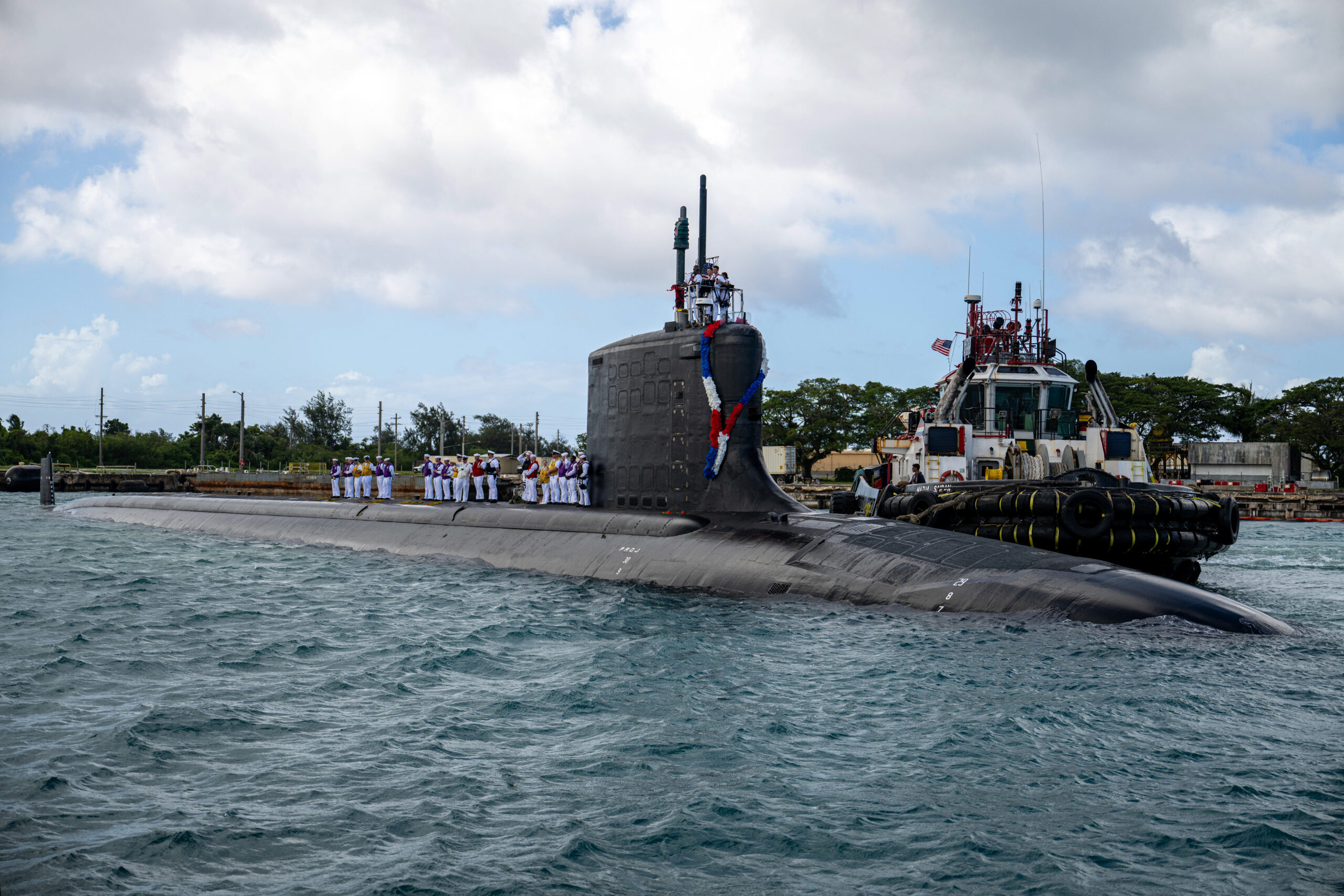
This is the extraordinary position of the Australian government in explaining why the plan to acquire 8,000 tonne nuclear powered Virginia class attack submarines was changed on May 30. Previously, Australia had been working towards the purchase of two second hand Virginias in about 2032 and 2035 followed by a new one around 2038. There is – or was – also scope for the purchase of another two new SSNs after that.

This has even been codified in US legislation in the form of the 2024 National Defense Authorisation Act. On 15 December of that year, a joint media release from Defence Minister Richard Marles and Defence Industry Minister Pat Conroy said the US Act:

Authorise the transfer of three Virginia class submarines to Australia, (emphasis in the original) including two in-service submarines and one off the production line. This significant contribution is vital to the pathway and will ensure there is no gap in Australia’s critical submarine capability in the lead up to delivering Australian-built SSN-AUKUS from the early 2040s. Australia will retain the option to seek congressional approval for purchase of up to two more Virginia class submarines.”

However – to the surprise of many – on the fringes of the Shangri-La Dialogue in Singapore on 30 May, Defence Minister Marles and Pete Hegseth, U.S. Secretary of War (Defense), and John Healey MP, UK Secretary of State for Defence, met at the U.S. Embassy in Singapore, issuing a statement that included the paragraph: “The Deputy Prime Minister (aka Defence Minister Richard Marles) and Secretaries welcomed the proposed approach to streamline Australia’s acquisition of Virginia-class submarines (VCS), simplifying supply chain management, operational and maintenance requirements, and maximising cost efficiencies. This approach would enable Australia to acquire three in-service VCS in lieu of a mixture of new and in-service VCS variants.”

In other words, this is a sudden change in direction from the well-established and frequently repeated two used and one new SSN to now three used SSNs. This looks like a total humiliation for Australia with the US abruptly changing its mind and keeping all of the new submarines for themselves.

To make a bad situation worse, the government and its boosters are now arguing that Australia always wanted three used submarines, with Pat Conroy saying on 3 June:

“…it was a joint decision to move from two in service submarines and one new to three in-service Virginias. We’ve made it very clear that that was our preferred position when we were negotiating this arrangement in ‘22 and ‘23.”

Except this is the first anyone has heard of Australia’s apparent preferred strategy. One has to ask: why did the US ram down Australian throats a new Virginia SSN when we had made it clear two years in a row that we did not want it?

This is an obvious deviation from the announced “Optimal Pathway” for the development of Australia’s nuclear-powered submarine force. During Senate Estimates on the night of 2 June, new Defence Department Secretary Meghan Quinn seemed to be making heavy weather of the issue, arguing that Australia had actually been pursuing at least two Optimal Pathways.

This is a Schrödinger’s Cat approach where one can be buying a submarine that is both new and second-hand at the same time. For language purists, optimal means best or most favoured – in other words a singular approach to something. It does not mean dual or multiple pathways of equal merit.

Optimal also does not mean that Australia will get only what the US wants us to get – it means the best outcome for us.  All the talk has been about cooperation, shared values and joint objectives – yet we now find out that is not how the process has been working for the last four years.  It augers poorly for the future if the US is now so openly prioritising their own needs – but under the Trump administration this has become normalised.

A new Virginia class submarine in Australian dollars is vey roughly $8 billion. There is a not unreasonable expectation that a second-hand sub would be half that at around $4 billion – but no one knows because the US has never previously sold a nuclear powered submarine, either new or used.  In other words, until May 30 the US was compelling Australia to pay about $4 billion extra for a platform we did not want.

The Defence Minister, the Defence Industry Minister, and the Chief of Navy are now making a lot of noise explaining that three second hand SSNs of the same class will be easier to maintain than acquiring a mix of new and old. This is undoubtedly true – though the quantum of those savings might not be that great since all the submarines will have the same combat system and the same propulsion plants.

However, if this was such a good idea, why wasn’t it the plan from Day One? What does it say about the US as an ally if they happily pocket our $5 billion contribution to their submarine industrial base – and on top of that try to compel the purchase of an unwanted new SSN for a $4 billion premium.

So far it has not been possible to corroborate any aspects of this story from US sources – though we are trying.

APDR_Bulletin_728X90


For Editorial Inquiries Contact:
Editor Kym Bergmann at [email protected]

For Advertising Inquiries Contact:
Group Sales Director Simon Hadfield at [email protected]

Previous articleDroneShield wins new order for counter-drone work
Next articleSaab rolls out first Gripen F
Kym Bergmann
Kym Bergmann has more than 35 years of experience in journalism and Australian and international defence industry. After graduating with Honors from the Australian National University, he joined Capital 7 television, holding several positions including foreign news editor and chief political correspondent. After 2 years on the staff of a Federal Minister, he moved to the defence sector and held senior positions in several companies, including Blohm+Voss, Thales, Celsius and Saab. In 1997 he was one of 2 Australians selected for the Thomson CSF 'Preparation for Senior Management' MBA course, the other being Chris Jenkins - formerly the CEO of Thales Australia. He has also worked as a consultant for a number of companies, including Raytheon, Tenix (now part of BAES) and Martin Marrietta (now part of Lockheed Martin). He had several board appointments, including Thomson Sintra Pacific (1994 - 96) and Saab Pacific (1998 - 2003). He retains good personal links with senior figures in Government, as well as in industry and the media. He decided to return to journalism in May 2008, and holds the position of editor for Asia Pacific Defence Reporter (APDR) and Defence Review Asia (DRA). He is also a podcaster and commentator on defence and national security issues.

28 COMMENTS

  1. Buying second-hand equipment from the USA is madness. How quickly the Canberra gnomes forget.
    In the 1990s the two ex-USN rust buckets became HMAS Kanimbla and Manoora; they lasted from 1994 to 2011.
    Then there was the second-hand Seasprites; the second-hand C27 Spartans.

    These people are costing us billions! NO BRAINS; NO ACCOUNTABILITY!

  2. Anyone who thinks Australia had any part in the decision to move from 2 used/1 new with a possible further 2 new to 3 used is deluding themselves.
    The only part Australia had in this decision was to say Yes Sir when told of the decision.
    Conroy’s spin is just a desperate attempt to look relevant

  3. A great article Kym.

    It could be the Marles’ 3 aging Block II Virginias (“old gals”) capitulation was a delayed announcement of US War Department Elbridge Colby 2025 Review results. Going from the fake “full speed ahead” slogan closer to spin-doctored reality.

    Colby was/is long opposed to the US delivering ANY Virginias to Australia. Hegseth and Trump (with continuous wars to fight) are no SSN experts so would have accepted Colby’s arguments for delay until the 2040s.

    In the meantime the US is only too happy to receive A$4 to 5 Billion per year in Aussie Tax payered homage-bilateral bribery. Also the UK’s BAE and RollsRoyce are divying up their A$4 to 5 Billion per year.

    Non-delivery of Virginias has always been on the cards until the US builds 2.33 to 3 every year. The US cannot achieve such numbers until the US has completed its higher priority run of 12 already delayed Columbia SSBNs, one per year 2029 – 2041. Then the US is in a position to deliver to Australia one Virginia every 3 years from 2043, 2046 and 2049.

    Also, only by the late 2040s can the UK (in a worse state than the US) develop and deliver SSN-AUKUSs.

    • Just a minor correction – the $5 billion going to US industry and another $5 billion going to the UK are the total amounts, not annual payments. That’s bad enough.

  4. So the latest from ABC supports the long term erosion of the AUKUS deal: ABC reports 4 May 2026 https://www.lowyinstitute.org/the-interpreter/shangri-la-washington-southeast-asia-talked-past-each-other

    “Talks on changes to the AUKUS pact began around 18 months ago, according to Australian Submarine Agency [ASA] officials [answering questions at Australian Senate Estimates].

    The changes announced over the weekend will see Australia buy three second-hand submarines, rather than two second-hand and one new.

    Officials told the hearings the submarines Australia buys will be roughly six years old [RAN desperately hopes…] and have a life span of 30–33 years.”

    Pete Comment

    Still lots of spin from ASA that having a used sub is better than having a new sub. Subs, nuclear or not, need a heavy overhaul every 9 years or so.

    Its as if a car buyer opts for a used car that will need a heavy overhaul in 3 years time rather than a new car needing a heavy overhaul in 9 years.

    Also where in the troubled heavy overhaul queue will aging Australian Virginias be placed versus the USN’s own needs? The 2 or 3 US shipyards doing heavy overhauls have long queues and many problems. Can we expect ASC Osborne’s well recognised inefficiencies to do any better?

    • I would be surprised if the used subs for Australia were only 6 years old. That strikes me as ASA spin. Up until now the assumptions both in Australia and the US are that they will be at the halfway point of their lives, namely 15 years old. I note that the ASA is talking about Australia receiving Block IV subs, the last of which will be delivered to the USN next year. However, I have seen no confirmation from the US side about any of this.

  5. There are a few things that have to be considered here.
    The US, I would think when the first plan was being developed would’ve looked at their scheduling for both maintenance of existing and in build boats, and also the build schedule for the various upcoming blocks to understand what was going to available and when. From this, it’s more than likely that it was determined that 2 in service boats would be available at certain dates, but a 3rd wasn’t. Buying boats of the same block makes a lot of sense. The training, maintenance and supply chains would be simplest having to deal with only one block.
    It would probably have been seen at the time that there wouldn’t have been any in-service boats available at the required timeframe, hence the offer of a new build.
    Fast forward to today and with build/ maintenance schedules likely adjusting, a review may have found that a 3rd block IV post refit would actually be available.
    Remembering that the Virginia’s have always been intended to be a bridging capability until the AUKUS class arrived, why would you want a new build that is out of sequence with the 2 block IVs, essentially being a sub class when you could have 3 identical block IVs..? As it is, we are going to have at some point Virginia block IVs, Collins and AUKUS class boats in service at the same time. Adding a sub class. Or worse still, another interim SSK, as some commentators have suggested, would only serve to overwhelm the RAN.
    It’s important to remember that a submarine is far more complex that a service vessel and that refits/overhauls can cost a significant amount more in comparison. So, while there will be cost savings in logistics and commonality in training etc, overhauling a sub can cost a fair proportion of the original build cost.
    It’s fair to say that this announcement has received an absolute flogging in the media, most often by uninformed sources, or those quoting bias experts with other agendas.
    There have been several usually quite well informed SMEs that have agreed with the move, calling out the valid points that matter.

    • You may be correct in all your points but the government and the RAN have created a perception problem for themselves by insisting over and over – and over – that they have a Plan and The Plan must be adhered to and no one must ever question The Plan. What would have been the harm in saying from the get go that the exact mix of classes would not be decided until closer to the end of the decade when the USN had a clearer picture of which submarines would be available for sale? No harm in that. Instead, we get a constant firehouse of bullshit that it’s all going wonderfully well, when we know from US sources that it is not.

      From what little we know of the details, but listening to Pat Conroy, Australia said to the USN in 2022 and 2023 that we did not want a new submarine. The attitude of the USN – you will take what we decide you will take.

      When it comes to the difference between supporting Block IV – assuming that’s what we get (I don’t think we will) – and a new Block VII in 2038, I don’t know how great that difference is. Again, the RAN has made such a big deal of a standard CMS around AN/BYG-1, it seems that will be common across all classes. The propulsion system is the same. Sure there will be differences but I don’t know enough to understand how significant they will be.

  6. I look forward with baited breath, to the announcement that AUKUS has been further streamlined, by the U.S. magnanimously agreeing to Sell Australia three refurbished Los Angeles Class SSNs.

  7. Kym Bergman

    It’s incorrect to conclude that Aus doesn’t need SSNs. Anyone with a rudimentary understanding of time and space can see that Aus is a huge continent. Conventional subs have limited endurance. An SSN can stay at sea for unlimited time. They are also faster. They can also stay underwater without having to come up to recharge their batteries. These are critical technological advantages if you are preparing for a future conflict with China. In actual fact, Australia has been 30 years too late in getting this quantum jump in capability.

    Second hand SSN doesn’t mean that these SSNs are creaking old rust buckets. These are high performance hulls. The equipment can always be upgraded.

    It takes time for the work force to adapt to running these machines. Early inclusion will give RAN the opportunity to get to know the machines.

    • If we were given them for free, I would be in agreement with you. But you overlook a couple of points: 1) they are costing vast sums of money that are distorting the procurement budget and mean we are missing out on other things, which could be anything from additional F-35s to more XL-UAVs to extra IFVs. 2) even with this vast expense, there is no guarantee that a single SSN will be delivered. They might be – but if we get to 2040 and nothing has turned up, there will be a few embarrassed admirals and politicians in their retirement homes and a very large capability gap for the country.

      • 3) Australia has staked its entire future submarine capability on an agreement with no commercial enforceability with three ship building regions (UK, US
        and Osborne) that are quagmired in inefficiencies and whose demonstrated capacity to adhere to schedules are appalling.

      • time to return to France for SSN. I also believe we need both conventional, forward based in Asia, subject to permission of the nations concerned and SSN based in Australia

        I would you prefer we buy no more of anything with American software we need to have control of the source code and the IP.

        It is my understanding both France and Germany will head over source code and IP

  8. It is about time that the Australian Government told Trump to f****off because the UA only wants us to waste our money on rust buckets as they get old they will only start leaking under pressure.
    Our great leader will continue to bow and kiss his back side when Trump tells him to as he only wants to get our money and control of Australia for himself like all the other countries to make himself look big and he is proving it by getting his arm service’s here already, plus doing what they want.

  9. If the Hunter class frigates are anything to go by, the British subs that haven’t even been designed yet, will be a disaster. One has to ask why? Why are we buying second hand US submarines and yet to be designed British ones? The only logical answer is to maintain work forces in both countries while pouring in billions of dollars.
    When the F35 was delayed, we bought F18 Superhornets as a stop gap that have worked out to be an extremely good platform. Why can’t we buy the Japanese subs (at 500 million a pop) as a stop gap until the nuclear subs are available. We’re buying Japanese frigates and are about to spend billions on tired Collin’s Class that are just about at their use by date. It is truly Monty Pythonesque our defence acquisition and once again no one will be held accountable.
    Buy the Japanese subs as an interim, forget about the pommie subs and place an order for 8 Virginias that we will receive in the late thirties. Hang on a minute, that will only save around 100-150 billion won’t it. Sheer bloody madness.

    • You make several valid points – and I’ve tried asking the government and Defence some of the same questions, to no avail. I think people get so dazzled by AUKUS as the solution to everything that they lose the capacity for rational thought and open-minded analysis.

      • Keep the alliances using the same equipment made by the same companies American usually. So it makes their defence companies rich, and we are kept in line because they keep IP and the source code. They affectively keep us on a digital leash.

        Our government is a great believer in the nuclear umbrella protection from the United States, and they will waste all sorts of money because of the worth of that protection as they see it

    • Keep the alliances using the same equipment made by the same company’s American usually. So it makes their defence companies rich, and we are kept in line because they keep PIP and the source code they affectively keep us on a digital leash.

      Our government is a great believer in the new killer umbrella protection from the United States, and they always all sorts of money because of the worth of that protection as they see it

  10. Remember we are talking about America First Trump and Hegseth here – not known for worrying about alliance loyalties or keeping unstated “promises”. There is no contract prescribing Australia will get Block IVs – only ASA-Marles spin which has been lapped up by some thinktank, mainstream media and academic cheerleaders.

    IF we get a Virginia in 2032, who’s to say it won’t be Block II or at best a III and its just going into or within an extended maintenance (although non-reactor) cycle? We’ve already paid/paying a A$5 Billion deposit (maybe more by 2032 – there being no contract that we only have to pay A$5 Billion).

    By 2032 the deposit we’ve gifted to the US may be all that an aging 20-25yo II or III is worth.

    • Please be clear – the $5 billion is not a deposit, it is a gift. It is a no-strings-attached donation – without a refund clause – to US submarine building companies. An almost identical gift goes to the UK – though the vast majority of that is to Rolls Royce for nuclear reactor components, again with no refund clause. Is it any wonder the governments of the US and UK are so enthusiastic about AUKUS?

    • Well we can’t blame the Americans and we can’t blame Trump. It’s his job to look after his own people.

      People to blame are our own

  11. I think, through thought repetition,, we’ve convinced ourselves they are “gifts” but where’s the proof? The US and UK may see these as deposits, binding Australia to pay much, much more over the next 30+ years.

    How can we be certain of anything when AUKUS Pillar One is commercial and national security in Confidence? And AUKUS may involves changeable deals – spread over several US presidencies, every 4 to 8 years, and twice+ as many UK PMships. The Poms are changing their PMs, every 18 months (or less) on average now.

    I don’t see any Australians as the authorities on AUKUS. We get what the US and UK deign to give us, after the needs of the USN and then the UK RN are met.

    • I think your observations are accurate. If you read the “Geelong Treaty” (named to appeal to the ego of Richard Marles), it is clear that Australia only has observer status when it comes to the SSN AUKUS design. We have zero (0) input into any of the US designs.

      In breaking news, UK Defence Secretary John Healey has quit in the middle of the Marles / Wong visit, saying the UK isn’t spending enough on defence. This is exactly the point many of us have been making – it’s Australian dollars propping up SSN AUKUS – and even our gift of $5 billion to Rolls Royce isn’t enough.

  12. Hi Kym

    Yes it looks like AUKUS Pillar One is between:

    – a US rock (America First and US Admirals don’t want to deliver Virginias until the 2040s (if we’re lucky))

    – and a hard UK place.

    The UK has neither the technical ability (all UK SSNs are at present again unavailable due to repeated piping to PWR2 reactor faults).

    UK Defence Sec Healey’s embarrassing (to Marles, the RAN and Alboo) overnight resignation over UK defence money worries indicates the UK simply does not have the Defence Budget to face all of the UK’s worsening NATO/anti-Putin priorities. Trump’s withdrawal from many NATO responsibilities mean non-US NATO including the UK have to spread their forces and budgets thinner.

    The UK may be receiving less US technical/monetary support for PWR3 reactor development then the US has provided for every “UK” submarine reactor since the the US S5W reactor used for the HMS Dreadnought (S101) of the 1960s.

    The need for Australia to have already paid A$4? Billion to UK RR for the PWR3 indicates a severe UK money shortage. This puts in doubt the ability of the UK to fund SSN-AUKUS as quickly as Australia would hope or fund SSN-AUKUS at all.

    Unless Australia funds (say) 80% of SSN-AUKUS and PWR3 costs the UK may only be able to provide Astute/PRW2 variants to go into “SSN-AUKUS” in the late 2040s/early 2050s.

LEAVE A REPLY

Please enter your comment!
Please enter your name here