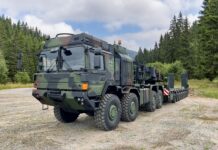

 Indra has unveiled its Deployable Modular Command, Control and Communications Shelter (DEMOCL3S). DEMOCL3S represents a shift in rapid deployment capabilities, allowing to establish a fully functional command and control centre within just 30 minutes. Engineered for agility and efficiency, the system streamlines deployment procedures, managed adeptly by a compact team of four operators. This rapid deployment capability is crucial for quickly establishing command and control centres in response to emergencies, military operations, or crises.
The Armed Forces and emergency services prepare every day to respond immediately to any threat or risk situation. And one of the decisive elements to be able to do so is having a command and control centre that meets their needs. Indra’s new centre has been designed to offer a space capable of housing the growing number of information and communications systems that enable these types of operations. The centre is modular, scalable and fully adaptable to the needs of any army or security corps.
At the heart of DEMOCL3S lies its modular architecture, designed to adapt seamlessly to diverse operational environments. Whether deployed on land, aboard vessels, or in tactical settings, its scalable configuration ensures optimal performance across varied mission requirements. The system is designed to fulfil the highest versatility and efficiency requirements to offer a 3-in-1 deployment option. It can come into operation immediately, whether it is fully extended, semi-extended or folded. Once at the destination, it can be deployed and picked up in a matter of minutes, with the help of just four operators.
Inside, the command and control centre provides a climate controlled air-conditioned workspace with autonomous power supply systems, integrated satellite links, robust servers, and a comprehensive network infrastructure facilitate real-time information exchange and enhance joint situational awareness. This technological sophistication enables seamless coordination among deployed units, enhancing operational effectiveness in dynamic and challenging scenarios.
DEMOCL3S is capable of self lifting and levelling with two configurable systems that can be fitted. During all stages of deployment the system can be self-contained for transportation within the confines of the ISO-20 Foot configuration. Signature management can be managed with Electromagnetic Spectrum (EMS) reduction, remote antenna farming and camouflage systems installed.
The work area is adaptable to the needs of each mission and, being modular, can be expanded to accommodate the number of personnel required. For enhanced security in high-risk zones, DEMOCL3S can be fortified with ballistic protection and weapon systems, safeguarding personnel against potential threats. This enhances safety for personnel operating within the command centre.
Indra thus meets the needs of increasingly advanced armies and security forces, which operate in digitised environments where the constant exchange of information is key. This requires the ability to move to any location, however remote or inhospitable it may be, an infrastructure that ensures the correct operation of a large number of systems and provides the appropriate working and protection conditions for extended periods.
While primarily designed for military and emergency response operations, DEMOCL3S can also serve as a fixed installation for industrial activities such as mining, leveraging its robust infrastructure and modular design. By leveraging DEMOCL3S capabilities, industrial operations can benefit from enhanced command, control, and communications infrastructure, supporting efficiency and safety in challenging operational environments.
“We are proud to introduce DEMOCL3S, a game-changing solution that redefines rapid deployment and operational resilience,” stated Adam Taylor, Head of Business Development at Indra in Australia. “This innovative command and control centre exemplifies Indra’s dedication to pushing the boundaries of technology, providing our global customers with the tools they need to succeed in dynamic and demanding environments.”

For Editorial Inquiries Contact:
Editor Kym Bergmann at [email protected]
For Advertising Inquiries Contact:
Group Sales Director Simon Hadfield at [email protected]