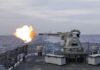

 Hanwha Aerospace announced a joint development program with the Korea AeroSpace Administration (KASA) to produce a 4,500-pound-class turbofan engine for Collaborative Combat Aircraft (CCA) and other unmanned aerial platforms. Hanwha Aerospace will lead engine development, with KASA providing fund investment. The company will also invest in engine design, core component development, test infrastructure, and production readiness.
The engine developed under this program is a high-bypass turbofan designed for fuel efficiency and for both military and civil use. It could also be adapted for small business jets and other commercial aircraft. The 4,500-pound-class turbofan is part of a UAV propulsion portfolio that Hanwha Aerospace is developing with Korean government support, including a 5,500-pound-class low-bypass turbofan for low-observable unmanned wingman aircraft, a 1,400-horsepower-class turboprop for medium-altitude UAVs, and core technologies for a 10,000-pound-class turbofan for stealth platforms.
The engine will be the first developed in Korea to integrate a starter-generator on the engine shaft, supplying up to 100kW of electrical power. CCA platforms, conceived to operate alongside manned fighters, require significant power for computing, radar, electronic warfare, and sensor operations.
Hanwha Aerospace will apply additive manufacturing and other advanced production methods to shorten development cycles and reduce cost, producing lightweight, electrified propulsion systems for global customers. Evolving geopolitical conditions continue to drive customer demand for faster delivery timelines and greater affordability. The company plans to invest approximately KRW 750 billion (USD 500 million) in UAV platforms, engine development, and related facilities.
A Hanwha Aerospace official said, “As global demand for CCA and unmanned platforms grows, propulsion will be central to fielding these systems at scale. This program puts Hanwha Aerospace in a position to deliver the performance, affordability, and delivery speed that customers need.”
Hanwha Defence Australia appoints Donghyeon Kim as new CEO
Hanwha Defence Australia (HDA) has named Donghyeon (DH) Kim as CEO, succeeding Mr. Ben Hudson. Kim most recently served as head of Hanwha Aerospace’s Land Systems Business Group, which is responsible for Hanwha Aerospace’s full land defence portfolio. Mr. Kim has spent almost 30 years at Hanwha Aerospace, leading its R&D centre, running its production operations, and heading the Land Systems Business Group, where the division grew substantially under his watch.
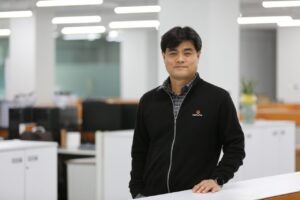
His experience in research, production, and business growth maps directly onto HDA’s needs. He will be responsible for overseeing program delivery to ensure the continued smooth delivery of both the Huntsman and Redback fleets to the Commonwealth of Australia. Kim will oversee the Hanwha Armoured vehicle Centre of Excellence (H-ACE) in Geelong, continue to build the local supply chain, and accelerate technology transfer to Australia. Kim has worked on numerous successful international programs including the K9 for Poland, Romania, Norway, Finland and India.
Kim brings established relationships across the company’s engineering, production, and supply chain functions, giving HDA efficient access to global resources and enabling faster and more responsive coordination between HDA and headquarters, Hanwha Aerospace. He will focus on building the operational foundations for HDA’s long-term growth, with a clear commitment to developing and transitioning to Australian leadership as the company’s programs mature and expand.
“We are here to deliver these programs on schedule, build R&D capability and capacity in Australia, and make H-ACE a manufacturing and MRO&U (Maintenance, Repair, Overhaul and Upgrade) centre that the local industry and economy benefit from,” said Kim. “Australia is well placed to become a defence export base, not simply a customer. My role is to lay the foundation and grow the Australian leadership team that will take this company forward. That is what success looks like for HDA.”

For Editorial Inquiries Contact:
Editor Kym Bergmann at [email protected]
For Advertising Inquiries Contact:
Group Sales Director Simon Hadfield at [email protected]