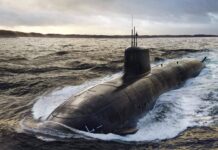

 Navantia Australia and RMIT University have been awarded a $500,000 grant through the AEA Ignite program to develop a Neuromorphic Light Field Receiver Module for covert satellite to underwater communication. The partner and collaborator investments bring the total value for this project at $800,000. The grant forms part of the more than $72.5 million that has been distributed in the latest round of Australia’s Economic Accelerator Ignite program, with 174 projects from 27 universities receiving funding.
The project will develop and demonstrate a hybrid underwater communications and navigation module designed for autonomous underwater systems. Its purpose is to allow multiple vehicles to share information with accuracy and reliability while coordinating tasks in demanding marine environments.
“The project will deliver a flexible, high-performance unit capable of supporting a broad range of underwater platforms,” said Ross Yannatos, Navantia Australia Chief Information and Technology Officer. “By improving the quality and speed of information exchange, it will strengthen coordination, provide greater situational awareness, and enable more effective underwater operations across future maritime missions.”
“The benefits of this technology will reach far beyond defence, extending to offshore energy safety, environmental monitoring, and scientific research,” said Israel Lozano, Navantia Australia Managing Director. “Research partnerships such as this play a vital role in strengthening the national defence industry. They accelerate the development of advanced technologies, build sovereign skills, and ensure Australia remains at the forefront of maritime innovation.”
“This joint project builds on an established relationship between RMIT and Navantia, highlighting our organisations’ ongoing commitment to advancing innovative projects and building capability in sectors of national importance,” said Distinguished Professor Calum Drummond AO, Deputy Vice-Chancellor, Research and Innovation. “By working together, we will strengthen research expertise and explore innovative solutions for Australia’s growing maritime sector.”
The technologies developed through this program support a broader shift toward more connected, intelligent, and autonomous maritime systems. These advancements are expected to influence the future of the maritime sector by improving underwater communication, enhancing the performance of uncrewed systems, and enabling faster, more informed decision making in complex operational environments.

For Editorial Inquiries Contact:
Editor Kym Bergmann at kym.bergmann@venturamedia.net
For Advertising Inquiries Contact:
Group Sales Director Simon Hadfield at simon.hadfield@venturamedia.net