
Home › Sea
Arkeus radar tech integrated with Ocius Bluebottle
Liquid Robotics’ Wave Gliders surpass 3 million nautical miles at sea
By APDR
•Nov 5, 2025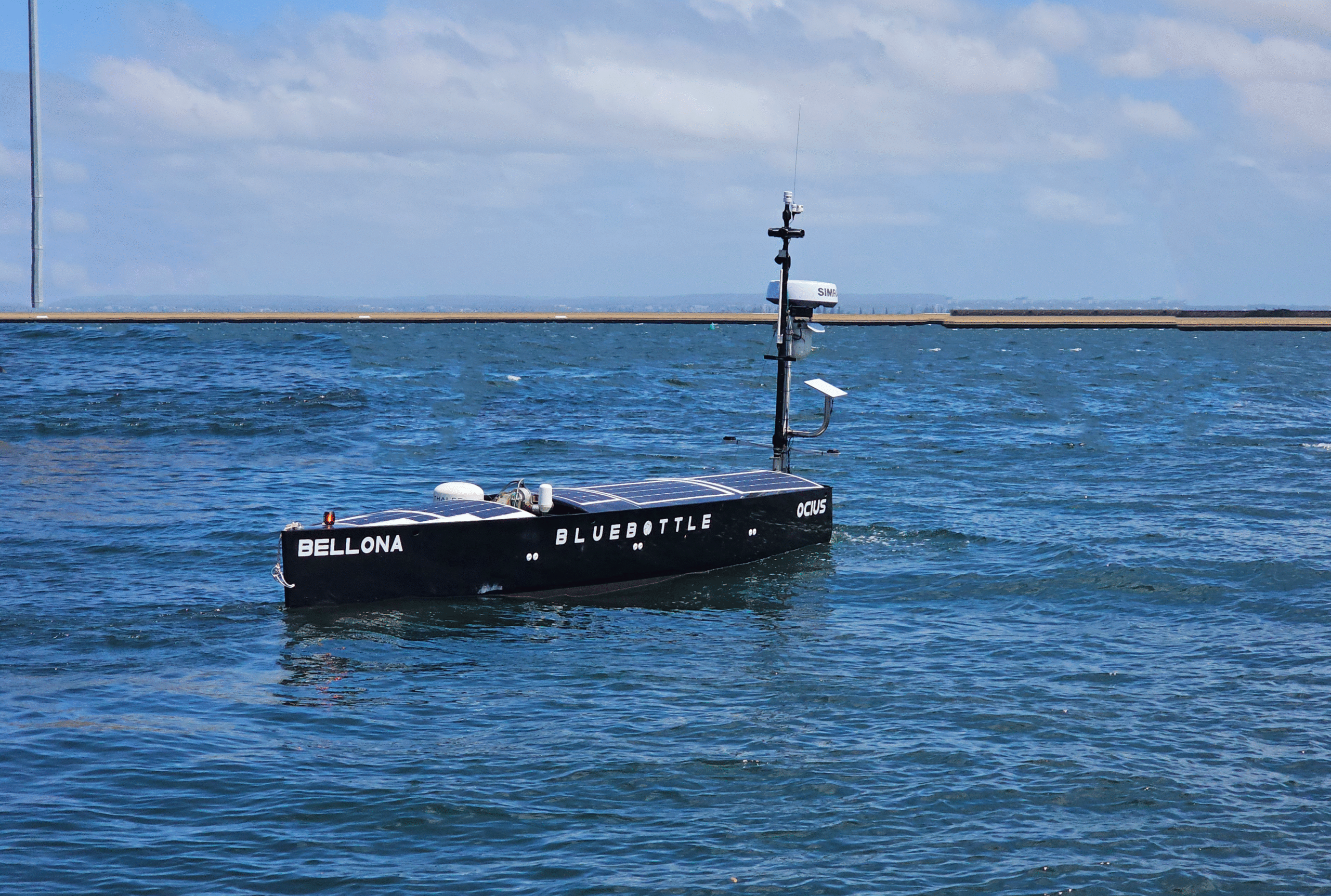
Arkeus, an Australian provider of AI-powered autonomous optical sensing systems for air, land and sea, announced its Surface Hyperspectral Optical Radar (HSOR) technology has been successfully integrated and operationally tested on the Ocius Bluebottle Uncrewed Surface Vessel (USV) to provide enhanced maritime domain awareness to customers of the platform. “We’re incredibly proud to be selected by Ocius for this important collaboration,” said Simon Olsen, CEO of Arkeus. “Integrating our Surface HSOR with Bluebottle not only reinforces our leadership in maritime surveillance, but also demonstrates the ability for our two companies to deliver greater range and coverage int the most challenging operational environments in which our customers operate. Together, we’re delivering technology that extends operational reach, enhances safety, and underpins Australia’s strategic capability at sea,” he said. The partnership strengthens Australia’s sovereign defence innovation ecosystem, supporting national objectives to enhance resilience and advance AUKUS-aligned capabilities by reducing dependency on foreign supply. Ocius Technology Chief Executive Officer, Robert Dane, said. “The integration of Arkeus’s cutting-edge surface hyperspectral optical radar with our Bluebottle platform represents a significant step forward in autonomous maritime surveillance. It also underscores our commitment to leveraging sovereign technologies to deliver unmatched operational capabilities.” Arkeus’s advanced optical radar provides continuous surface and near-surface detection, distinguishing vessels, personnel, and objects that are difficult to detect in degraded visual environments. Arkeus’s unique AI based spectral sensing enables real-time identification and tracking of objects, at considerable range with reduced false positives – even in challenging or degraded operational environments. “We believe this combination of technologies delivers a force-multiplier for naval operations,” Olsen adds. The self-sustaining USV, equipped with Surface HSOR, becomes a low-profile, long-endurance sensor node that significantly expands intelligence, surveillance, and reconnaissance coverage. It enables networked maritime awareness without risking personnel or high-value assets, even in highly denied areas. Wave Gliders surpass 3 million nautical miles at sea Marking an unprecedented milestone in the uncrewed maritime industry, Boeing-owned Liquid Robotics’ Wave Gliders have tallied more than 3,000,000 nautical miles on missions around the world. The notable cumulative distance traveled by Wave Glider Uncrewed Surface Vehicles (USVs) underscores the maturity of the platform and, once again, confirms its leadership position in the autonomous market. “Wave Glider is the first USV to reach this remarkable milestone, literally going the distance. I am so proud of our dedicated team, as we continue to be on the forefront of the development and execution of persistent uncrewed maritime capabilities and solutions,” said Shane Goodenough, CEO of Liquid Robotics. “We are at a tipping point in the deployment of autonomous systems at scale, and the team at Liquid Robotics has the unique advantage of unparalleled operational experience and expertise.” Powered exclusively by wave and solar energy, and equipped with cutting-edge sensor technologies, Wave Gliders excel in persistent ocean monitoring, continuously collecting and transmitting real-time data. For more than 15 years, Wave Gliders have shown their exceptional ability to serve on long-range, long-endurance missions, precisely navigate courses, and withstand extreme ocean and weather conditions, including hurricanes and typhoons. Missions have been conducted in all five major ocean basins supporting global maritime monitoring and protection. The distance of 3,000,000 nautical miles is equivalent to circumventing the Earth 138 times. Not included in this count are sensitive mission deployments, which are exclusively managed by Liquid Robotics’ customers to ensure Operations Security. “Surpassing 3 million nautical miles is a testimony to the platform’s maturity and proven ability to deliver data and insights from the world’s most remote and demanding oceans,” said Garth Haselden, director of business development and strategy, Boeing Defence Australia. “At a time when maritime domain awareness is critical to national security and economic prosperity, Wave Glider provides a cost effective and resilient solution for a wide array of maritime challenges.” USVs enable persistent ocean surveillance for maritime defence and security at lower cost and risk while operating in the harshest ocean environments. Wave Gliders are actively deployed in international waters providing acoustic, signal, and image intelligence for Maritime Domain Awareness (MDA), Anti-Submarine Warfare (ASW), and Intelligence, Surveillance, and Reconnaissance (ISR) missions. Meteorological, oceanographic, and seismic data collected by Wave Gliders provide valuable datasets for governments and scientists that extend the range and effectiveness of traditional observation systems. For Editorial Inquiries Contact: Editor Kym Bergmann at [email protected] For Advertising Inquiries Contact: Group Sales Director Simon Hadfield at [email protected]
TAGSArkeusLiquid RoboticsOcius BluebottleWave Glider
Previous article
Rolls-Royce signs AUKUS support deal with Victorian government