

 The Vlissingen, the second of the series of mine countermeasures vessels of the Belgian-Dutch rMCM programme, first intended for the Royal Netherlands Navy, began her first sea trials campaign from Concarneau, France, on 27 March. The aim is to implement and test at sea the vessel’s performance before its delivery at the end of 2025. The rMCM programme is being led by Belgium Naval & Robotics, a consortium formed by Naval Group and Exail, involving Kership (a joint venture between Piriou and Naval Group) as industrial prime contractor.
During this first day at sea, the ship’s performance has been put to the test, in particular her propulsion system and manoeuvrability. Several sea trials campaigns will then follow to test all the systems, before her delivery at the end of 2025.
The first vessel, Oostende, intended for the Belgian Navy is currently undergoing trials of her combat system in Naval Group Lorient shipyard. It will be delivered during the summer 2025. The first sea trials of the Tournai, third vessel of the program and second unit intended for the Belgian Navy, are planned for the end of the summer 2025. The fourth vessel, the Scheveningen, the second vessel intended for the Royal Netherlands Navy, was launched on November 2024. All 12 vessels ordered in the frame of the rMCM program will be delivered before end of 2030.
Awarded in 2019 to Belgium Naval & Robotics, the consortium formed by Naval Group and Exail, the rMCM programme is a major component of European defence cooperation. Naval Group is responsible for ship design, overall mission systems integration, testing and commissioning. The ships are built and assembled by Kership and Chantier Piriou, under the overall industrial management of Kership, a joint venture between Naval Group and Piriou. Exail is in charge of the drones mission system. Most of these drones will be produced and maintained in Exail Belgium subsidiary based in Ostend.
These specialised and cyber secured by design mine countermeasures (MCM) vessels are the first to have the capability to embark and launch a combination of surface drones (themselves 12-metre, 19- tonne vessels), underwater drones and aerial drones. The mine countermeasures vessels will use a mainly autonomous system for detection, classification, identification and neutralisation of mines This approach with an unmanned integrated system enables safe and rapid clearance of mined areas—up to ten times faster than traditional methods.
The MCM vessels can withstand underwater explosions and have very low acoustic, electrical and magnetic signatures, in line with the missions to be carried out.
Exail sells DriX O-16 USV to Oceanic Observatory of Madeira
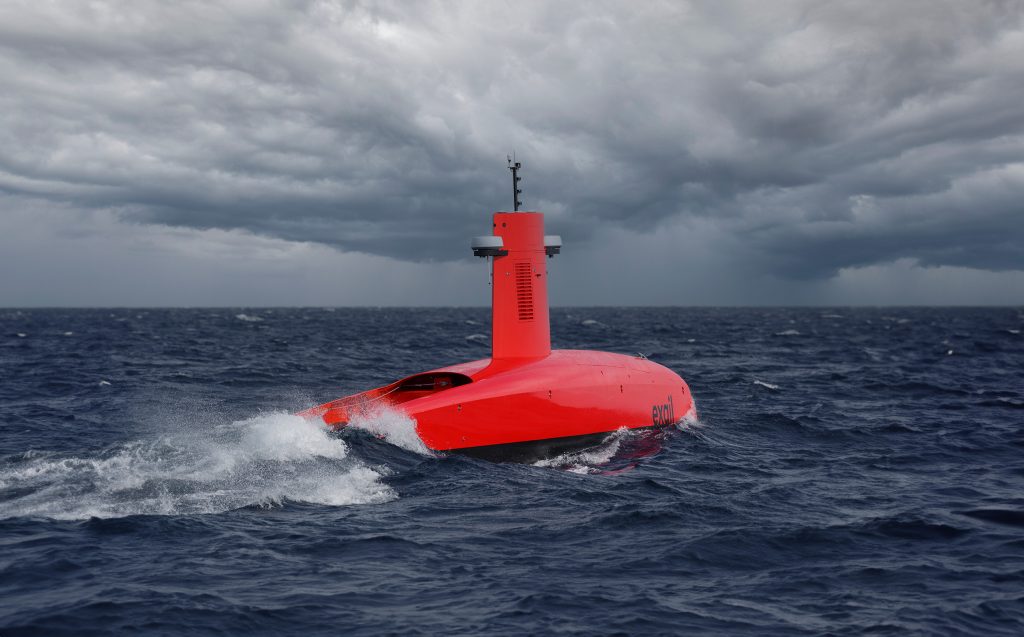
Exail announced it has been awarded a contract by the Oceanic Observatory of Madeira’s (OOM) to supply a DriX 0-16 Uncrewed Surface Vessel (USV), following an international competitive public tender. The USV will enhance OOM’s capabilities in conducting comprehensive full-ocean depth scientific and hydrographic surveys.
The DriX 0-16, equipped with a Multibeam Echosounder (MBES), Exail Gaps M7 USBL, a biomass echosounder (EK80), and oceanographic sensors, will support underwater asset tracking and INS navigation updates, and will provide high-resolution seabed mapping and precise environmental monitoring in Madeira’s complex archipelagic conditions. The USV will enable advanced multi-robot collaboration missions, allowing coordination between USVs, ROVs, and AUVs. Previously, the Institute has integrated Exail’s DriX H-8 and the R7 ROV into their research initiatives, showcasing its strategic vision for advancing robotic operations in ocean monitoring.
As the maritime operators move toward greater autonomy and sustainability, the DriX 0-16 supports this evolution by offering an efficient, low-carbon alternative to conventional crewed vessels. Its hybrid propulsion system and optimized design help reduce fuel consumption and operational costs, while its autonomy enables safer and more resource-efficient missions. This acquisition, funded under Portuguese Recovery and Resilience Plan (RRP), reinforces the commitment to innovative and sustainable solutions that support scientific and environmental advancements.
Carlos Lopes, Commercial Director at Exail, expressed his enthusiasm about this acquisition: “We are very happy to see the DriX 0-16 part of the robot fleet of OOM, it highlights the renewed trust in our technology and our shared commitment to advancing hydrographic and oceanographic research. This sale not only strengthens the relationship between Exail and OOM but also signifies the growing recognition of the DriX 0-16’s capabilities in the global maritime research community.”
Rui Caldeira, Chairman of the Board at ARDITI adds: “DriX 0-16 will position Portugal at the forefront of marine autonomous robotics. With islands spread as far as 200 nautical miles apart, DriX 0-16 will enable monitoring of Madeira’s vast Exclusive Economic Zone (EEZ), covering around 500,000 square kilometers. It has been a privilege to partner with Exail in quest to position Madeira, ARD/Tl and its Oceanic Observatory in the vanguard of marine autonomous systems.”

For Editorial Inquiries Contact:
Editor Kym Bergmann at [email protected]
For Advertising Inquiries Contact:
Group Sales Director Simon Hadfield at [email protected]