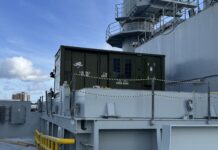

 The Vlissingen, the second mine countermeasure vessel of the rMCM programme and first one for the Royal Netherlands Navy, was delivered on 27 February.
“This is a highly symbolic and huge step in the pursue of a strong and trustful relationship between our nations. But it also tightens our bond and allows the Netherlands to benefit from an innovative and performative ship, who will deeply reinforce the naval power of their Navy. It is also a world premiere, as Belgium delivers for the first time a vessel for another nation, an ally,” said Vincent Martinot-Lagarde, Naval Group surface ships Executive Vice President.
“With the transfer and arrival of HNLMS VLISSINGEN, Belgium and the Netherlands take a historic and exceptional step within their binational programme. For the first time within our BeNeSam cooperation framework, a Royal Netherlands Navy vessel has been built under contract by the Belgian Minister of Defence — a milestone in which Belgium, acting as lead nation, helps deliver a naval ship for another country. This achievement reflects an exceptional depth of mutual trust and the maturity of our joint capability development. This transfer elevates our cooperation to a new strategic level,” said Captain (Navy) Ludo Portier, Section Head Procurement Naval Systems (DGMR)
“With the delivery of Vlissingen, Exail continues its contribution to the Belgian-Dutch rMCM programme, in close cooperation with Naval Group and industrial partners. This milestone reflects our recognised expertise in autonomous mine countermeasure systems and our commitment to supporting the Royal Netherlands Navy with advanced, fully integrated unmanned capabilities. Together, we are contributing to strengthening NATO’s maritime security and European operational readiness,” said Jérôme Bendell, Director of the Exail Maritime Business Line.
The solution acquired by the Royal Netherlands Navy represents a complete paradigm shift in mine countermeasures, with the ship and its crew remaining at a safe distance from danger (stand-off). This solution increases the speed of mine clearance tenfold compared to conventional methods.
These ships, specialised in mine warfare, are the first to have the capacity to carry, launch or fly and reconfigure a set of surface drones (ships measuring around 12 meters and weighing 19 tonnes), underwater drones and aerial drones. They are the first to implement a fully robotic system for the detection, classification, identification and neutralisation of mines. They can withstand underwater explosions and have very low acoustic, electrical and magnetic signatures, in line with the missions to be carried out.
Awarded in 2019 to Belgium Naval & Robotics, the consortium formed by Naval Group and Exail, the rMCM programme is a major component of European defence cooperation. A tripartite agreement between France, Belgium, and the Netherlands was signed in September 2023 to formalise their cooperation in the field of mine warfare.
Naval Group is responsible for the design of the vessels. Exail designs and delivers the naval drones. The overall integration, testing and commissioning of the mission system will be carried out in close collaboration with Exail, ensuring full operational coherences between the vessels and the unmanned capabilities. The vessels are being built and assembled by Piriou, under the industrial project management of Kership, a joint venture between Naval Group and Piriou.

For Editorial Inquiries Contact:
Editor Kym Bergmann at [email protected]
For Advertising Inquiries Contact:
Group Sales Director Simon Hadfield at [email protected]