


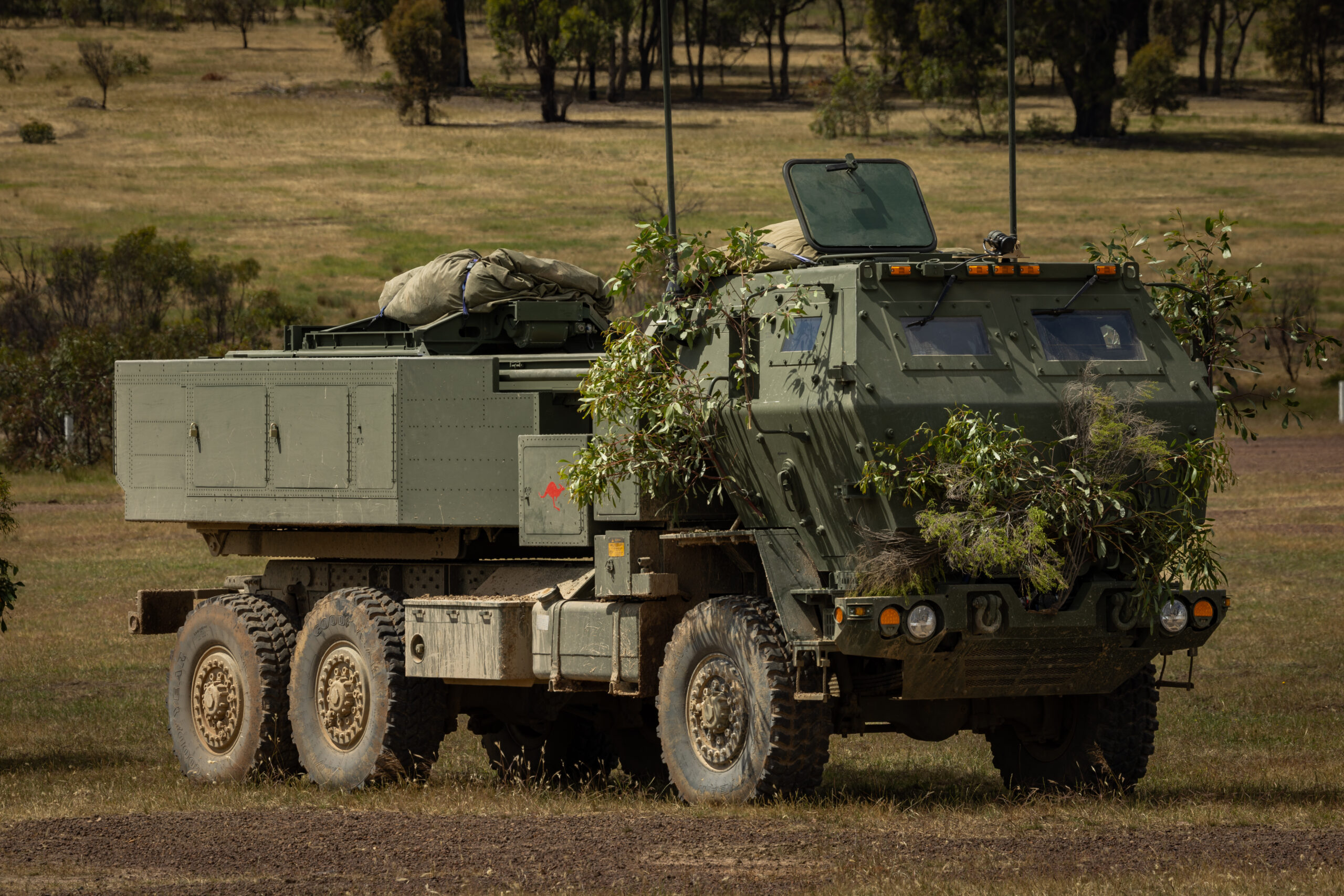
 In a major enhancement to the Australian Army’s long-range strike capability, the government has selected the High Mobility Artillery Rocket System (HIMARS) and the Precision Strike Missile (PrSM), investing A$2.3 billion over the decade and delivering a second long‑range fires regiment at the Edinburgh Defence Precinct in South Australia. This decision follows a comprehensive competitive evaluation process by Defence, the government said.
As the 2026 National Defence Strategy sets out, the Australian Defence Force (ADF) requires greater capacity for long-range strike to defend Australia. A second long‑range fires regiment will significantly enhance the ADF’s ability to engage targets at ranges of up to 500kms, transforming to more than 1,000kms with future increments of PrSM. This will increase our capacity to respond effectively to contingencies in our region and work with our allies and partners.
As set out in the recently released 2026 Integrated Investment Program, the Albanese Government is investing up to $37 billion over the next decade, including enabling data and systems, to develop and enhance the Royal Australian Navy, Army and the Royal Australian Air Force’s targeting and long-range strike capabilities.
HIMARS are already in service with the Australian Army as part of the first long-range fires regiment. These launchers were used at Exercise Talisman Sabre 25, firing a PrSM two years earlier than planned. The second regiment will complement Army’s existing HIMARS capability – delivering a proven, highly mobile and lethal strike system aligned with Australia’s strategic and operational requirements.
The government is establishing a sovereign missile manufacturing industry in Australia, including missiles fired from the HIMARS launcher. The first Australian-made Guided Multiple Launch Rocket System (GMLRS) missile was test-fired by an Australian HIMARS this month, and last year Australia and the United States established a cooperative program for PrSM to pave the way for future domestic production. Both missiles will have Australian industry participation in their supply chains, including for locally manufactured components and sub-components.
Deputy Prime Minister Richard Marles said: “This is a decisive investment in Australia’s long‑range strike capability that will bolster our Defence Force and help keep Australians safe. This capability delivers on the National Defence Strategy direction to accelerate and expand the acquisition of land-based long-range fires to provide the ADF with a deployable strike capability to protect Australia’s northern approaches and contribute to sea control and sea denial. This is another significant milestone as the Albanese Government continues to invest in an integrated, focused force that meets our strategic circumstances.”
Minister for Defence Industry Pat Conroy said: “To defend Australia, our Army needs a stronger long-range strike capability – and we’re delivering it. The Albanese Government is investing up to $37 billion over the next decade on targeting and long-range strike capabilities for the ADF. We’re already making missiles that can be fired from the HIMARS – and this decision will create even more demand for PrSM missiles within the Australian Army and deliver more opportunities for PrSM manufacture in Australia.”

For Editorial Inquiries Contact:
Editor Kym Bergmann at [email protected]
For Advertising Inquiries Contact:
Group Sales Director Simon Hadfield at [email protected]





So does this mean the Strikemaster is a non starter?
That’s my reading of it.
Hold up, I am probably reading too much into this, but it seems almost like their avoiding saying that it’s for the Coastal Maritime Strike system project. Is there even a chance that this is an extra to expand the army’s capabilities and not the CMS that’s been ongoing for what seems like ages. Or is this CMS?
It would be great if it is an extra, but I know there’s a 99.99% chance the only reply would be ‘Tell him he’s dream’n’.
And how many are they ordering. I remember a U.S. gov notice said there might be a sale for 42 launchers is that still right?
I think this is for CMS, so very unfortunately Strikemaster appears to have missed out. We are doubling down on an overloaded and unreliable US supply chain at precisely the wrong moment. As for numbers of missiles and launchers, I assume we will find out in the usual manner through the US Defense Cooperation Agency’s notification to Congress. We were always going to get PrSM – we have cofounder it to the tune of about $400 million – to go with HIMARS. For me, it would have made much more sense for Army to be getting it plus NSM.
It does appear at the moment to be a half announcement in that the specifics are held back.
While it would’ve been good to see a split between HIMARS and Strikemaster to give a high- lo solution, I can see why you’d want to only support one system vs two. While Strikemaster used the Copperhead vehicle and NSM, both of which have derivatives in service already, it still is a different/unique system that would require an additional training system etc.
Re the HIMARS solution, you’re getting a dual purpose capability that can do terrestrial and maritime strike (once Increment 2 is available of course), in greater numbers than if you were to have a split between systems. Given its dual capability, I wouldn’t just be tagging it as a CMS as it can do far more than that. If we had gone with Strikemaster, would we have used it as any more than a CMS despite NSM having a land strike capability.
On the supply chain side, isn’t the plan under GWEO to transition to a local manufacturing capability for both GMLRS and PrSM? I seem to recall that being the case. Once that kicks in, it will hopefully be independent of the US supply chain, and if anything help by lowering the burden on it for the US and other users.
End of the day I would’ve called either outcome a win.
I agree with most of that – but there’s a very good reason why the USN and USMC use NSM, not PrSM. Apart from standard inter-service rivalry, the seeker on NSM is far better at detecting targets in a crowded littoral environment. I would have preferred to see a mix of PrSM and NSM for Australia – even though, as you point out, it is a more complicated solution. More tools in the toolbox, as they say. I also have doubts about the ability of the US to deliver PrSM on time – as well as their sincerity about moving production to Australia. The local manufacture of NSM is already guaranteed.
At least we will still have NSM onboard our surface fleet. If we take a broader look at this, the ADF will have the ability to hold shipping at risk from the surface (NSM/ Tomahawk), sub surface (Mk48 / Harpoon), air (LRASM, JSM etc.) and now land (PrSM). I’ve probably forgotten a few systems there, but you get the idea.
Fair points.
Yes, I originally preferred HIMARS for its versatility, giving us two fully capable regiments means the ability to apply any one of them to any long fires task.
But after Trump started his carry On’s, I gained a much greater appreciation for the Strike masters sovereignty.
They should convert a reserves regiment to Strike master.
People are already questioning whether we’ll even be capable of making PrSM, if that fell over, we’d be, as you said, reliant on the overstretched American supply chains etc.
There was a DCA notice report in one of your stories in the last quarter of last year which I am fairly certain stated a request for 42 launchers.
On the bright side if all goes well with the gweo program then this will make local manufacture more viable
Of course having both Himars & Strikemasters would be great, but it’s unclear to me how this was ever considered a contest as NSM and ‘Long Range Strike’ have never belonged in the same sentence. Rejecting Prsm based on alleged USMC reservations about its potential in congested Littoral theatres ignores the PLAN’s recent circumnavigation of Australia.With ranges between 500 – 1,000km +, Prsm, Japan’s Type 12 or Korea’s Chunmoo 3.0 asbm appear to be the only semi credible land based short term plugs for the RAAF’s chronic gaps in maritime air cover.
I sincerely hope that the article was the standard Defence release from the DoD, it has so many implied ( our “already in Service is 2 or 3 units, the missiles were assembled not as implied manufactured in Australia) but not stated as well as total misdirection I would hate to think it was written by APDR. I’m still at a loss how Marles and Conroy believe we will get this new order ( assuming it IS a new order and not a rerelease of the old order ) will be delivered anytime soon, or that the U.S. will ever allow any Tech Transfer to happen . At least Thales was thrown a bone with the order of more Bushmaster.
Yes, it is word-for-word a government / DoD media release.