

 India–Bangladesh relations have entered their most critical phase since 1971, with political distrust and strategic realignment spilling over into trade, mobility, and regional security. GlobalData, an intelligence and productivity platform, notes that the deterioration in diplomatic confidence is unfolding against a sensitive macro backdrop in Bangladesh, where elevated inflation versus pre-2020 levels and sustained currency depreciation increase the economic cost of any disruption to trade predictability with India.
Ramnivas Mundada, Director of Economic Research and Companies at GlobalData, comments: “Bangladesh’s near-term outlook is increasingly exposed to confidence shocks and supply frictions. With growth moderating since 2022, any further deterioration in predictability, whether through visa restrictions, port congestion, or policy tightening, could weigh on demand and amplify downside risks to the broader outlook.”
Immediate flashpoints deepen a climate of mistrust
India–Bangladesh ties are deteriorating due to escalating political and diplomatic disputes. Tensions have sharpened over former Prime Minister Sheikh Hasina’s stay in India and Dhaka’s extradition request. Mobility has suffered as Bangladesh has restricted visa services for Indians in Kolkata, Mumbai, and Chennai, as of early January 2026, amid reciprocal visa suspensions since late 2025, disrupting travel, medical care, and education. India has also raised alarm over attacks on Bangladesh’s Hindu minority. Dhaka’s growing outreach to China and warming ties with Pakistan further heighten New Delhi’s security concerns.
Trade corridor stress: Industrial inputs under pressure as exports soften
GlobalData notes that the India trade corridor is vital for Bangladesh, supplying key intermediate goods and essentials that sustain factory production and household demand. India’s exports to Bangladesh are concentrated in cotton, fuels, machinery, and chemicals, but FY2025–26 year-to-date shipments have slowed broadly, reflecting heightened caution amid bilateral friction. Bangladesh’s exports to India, mainly textiles and apparel, have also dropped sharply, hurting garments, footwear, SMEs, and jobs. Constraints include India’s May 2025 curbs on 42% of imports, land-port congestion, and disputes over third-country goods.
Macro sensitivity raises the cost of disruption
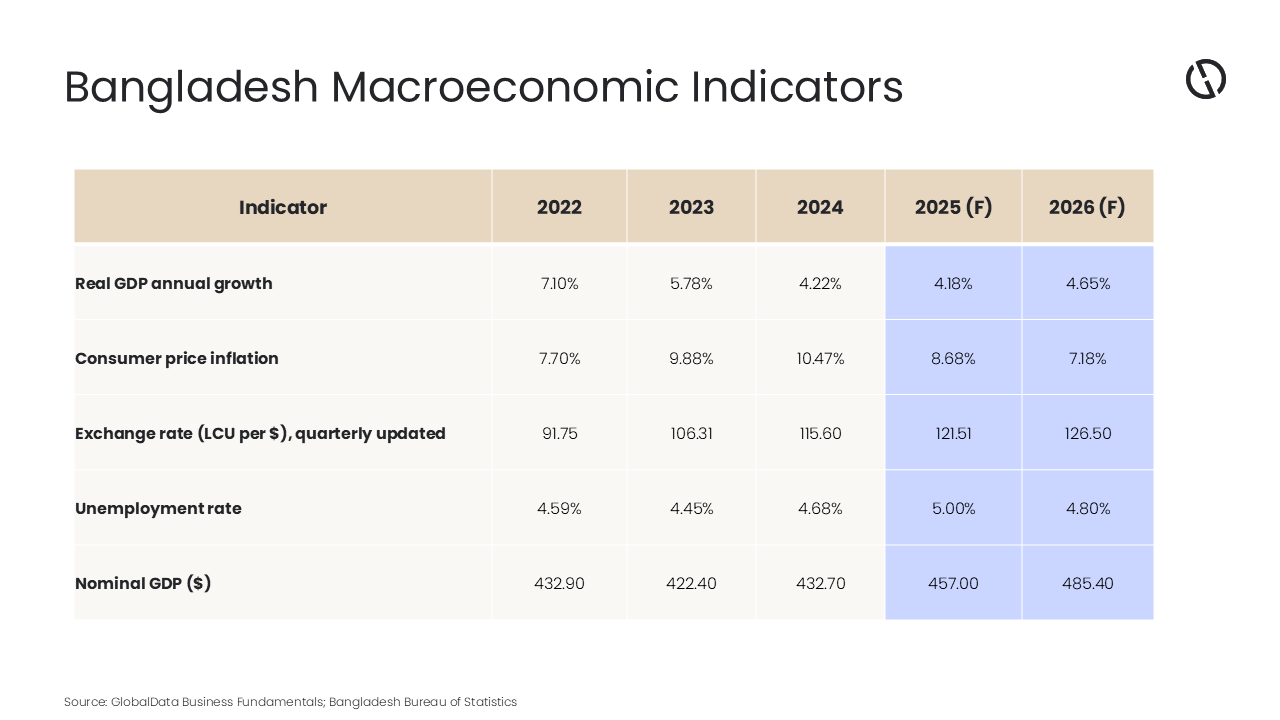
GlobalData highlights that Bangladesh’s macroeconomic conditions elevate the risks of trade disruption. While inflation has eased from its 2024 peak, it remains elevated relative to pre-2020 levels. Currency depreciation is a further stress multiplier: GlobalData’s quarterly-updated forecast for the exchange rate (LCU per USD) rises from approximately 91.7 (2022) to a projected 126.5 (2026), increasing the local-currency cost of imports, including essentials sourced through India.
Mundada continues: “As the taka weakens, even stable-dollar import bills translate into sharper local-currency pressures. That dynamic increases the economic cost of supply disruptions, delays, and sudden policy tightening in critical corridors.”
“2026 Treaty Clock” could reset the relationship
In 2026, several deadlines could reshape India–Bangladesh ties. The 30-year Ganga Water Sharing Treaty expires in December 2026; although joint water-level measurements began in early January 2026, renewal talks are strained by low trust and hostile rhetoric. Bangladesh’s Least Developed Country (LDC) graduation in November 2026 heightens trade risks: without an India–Bangladesh Free Trade Agreement (FTA), Dhaka could lose preferential access to Indian markets. Moreover, elections in February–March 2026, coinciding with state polls in West Bengal and Assam, may inflame migration and border politics.
Multi-sector impacts: Security risk, energy continuity, cultural rupture
Security cooperation is under strain as India fears a revival of insurgent activity in its Northeast if border coordination with Bangladesh weakens; the Siliguri Corridor (“Chicken’s Neck”) remains a key strategic vulnerability. Energy ties are comparatively stable: Bangladesh continues to import over 1,100 megawatts (MW) of electricity from India and depends on projects such as the Maitree power plant. Cultural and sporting links have deteriorated, with Bangladesh refusing to travel for the Twenty20 (T20) World Cup and banning Indian Premier League (IPL) telecasts.
Outlook: Elections as the near-term hinge
Mundada concludes: “Bangladesh’s 2026 elections could reshape its ties with India. Despite geographic proximity and economic interdependence encouraging cooperation, a growing war of narratives and Dhaka’s strategic diversification increase the risk of prolonged tensions. For India, the task is evolving from managing a consistently aligned neighbour to engaging a more assertive, multi-aligned Bangladesh, while safeguarding core interests in security, trade, and energy, especially amid regional political sensitivities and uncertainty.”

For Editorial Inquiries Contact:
Editor Kym Bergmann at [email protected]
For Advertising Inquiries Contact:
Group Sales Director Simon Hadfield at [email protected]