

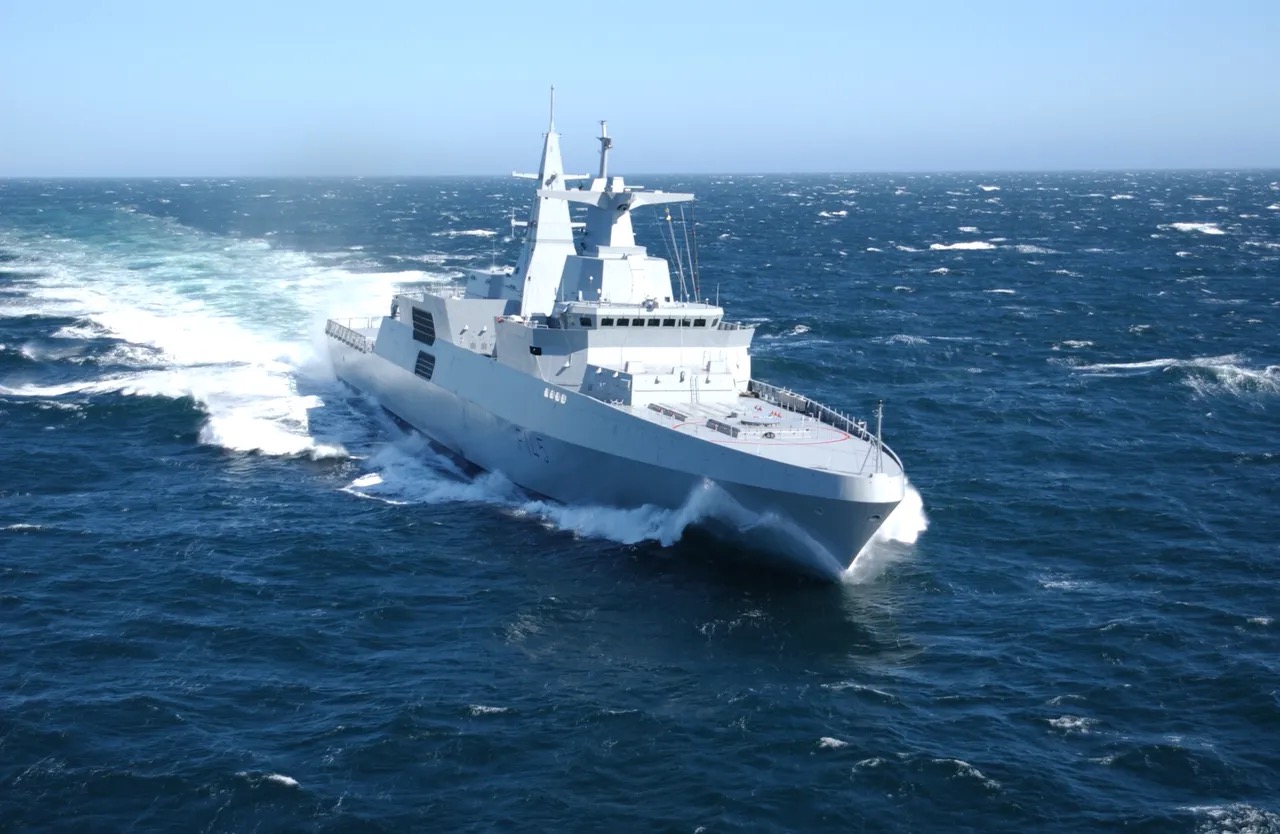
 Saab Australia and thyssenkrupp Marine Systems have signed a Memorandum of Understanding (MOU) to explore opportunities for collaboration on the MEKO A-200 frigate platform, with a focus on enhancing naval capabilities through joint innovation and integration.
The MOU was formalised at the Consulate-General of the Federal Republic of Germany in Sydney in the presence of Vice Admiral Carsten Stawitzki, Director-General for Armaments in the German Federal Ministry of Defense, who emphasised the strategic value of such partnerships. “Collaborations like this one show how international industry partnerships can strengthen national defence capabilities,” Stawitzki noted.
This partnership builds on a long-lasting working relationship between thyssenkrupp Marine Systems and Saab Australia, and reinforces both companies’ commitment to providing sovereign industrial capability in naval defence.
This collaboration will leverage Saab’s Australian Combat System (AusCMS) already in service across the Royal Australian Navy’s surface fleet. The AusCMS provides enterprise-level interoperability, training, sustainment, and operational benefits, contributing to the sovereign capability of Australia’s defence industry.
This initiative aligns with thyssenkrupp Marine Systems’ proven business model, which supports partner nations in building, maintaining, and upgrading naval vessels domestically. Having previously delivered the ANZAC frigates to the Royal Australian Navy and supported similar projects across 16 navies – including six NATO members – thyssenkrupp Marine Systems continues to demonstrate its commitment to sovereign shipbuilding partnerships.
“This MOU with Saab Australia reflects our proven approach to naval shipbuilding and long-term collaboration with trusted partners,” said Dr. Oliver Juckenhöfel, Executive Vice President of Operating Unit Surface Vessels at thyssenkrupp Marine Systems.

For Editorial Inquiries Contact:
Editor Kym Bergmann at [email protected]
For Advertising Inquiries Contact:
Group Sales Director Simon Hadfield at [email protected]







One would think that this is aimed at the rumoured 2nd bid option from TKMS for Sea 3000, especially with the restrictions on what can be made public.
On that note, it will be interesting, if we ever do find out, if the base TKMS A-200 option is as capable from an armament and sensor perspective as what an Anzac currently is.
An Australianised option would almost certainly include 9LV, CEAFAR, and Mk41 with at least ESSM blk2. However, how would the base option weigh up? How would a Seagiraffe and Mica NG combination compare to a current Anzac?
You would hope that we would aim to increase our capability, not reduce it.
It’s definitely aimed at SEA 3000 – but because of ridiculous, unjustified restrictions from Defence, none of the bidders are allowed to mention the project by name. I have rarely seen anything so completely stupid.
The TKMS display at IODS 2024 showed a Meko 200 model with a CEFAR 2 radar fitted. Given that TKMS’ Australian team already integrated the CEFAR 2 to the Anzac Class when they were upgraded, surely they could do the same in any new Meko 200 build in Australia now?
There are distinct differences between the two offerings for Sea 3000, but of course there are those “Political Alliences” / “Percieved Values” in this Egg Shell Region. I would imagine Japan will be”all guns blazing” (for lack of better terms) to prove that the Mogami would be as equally efficient as was the Anzac build of the 80s. This is the real reward in a confined production time line. Japan will have proof of its flexibility and willingness to get the job done on time and budget, something we havent placed enough emphasis on in the past.
IMO the good news is that both frigates (Meko and Mogami) are good options for the RAN. Both have advantages.
Mogami is very advanced, but is also crew-efficient and Japan is committed to fitting RAN weapons. Against that there is a lot of system integration to do, which implies a time risk. Meko is less advanced, but still state of the art sensors and is cheaper, less time risk and long range. It would suit the RAN and industry.
So if the government is most focused on capability and alliances they will pick Mogami. If the government is most focused on time, money and local industry they will pick Meko.