
 The Exercise Kakadu Fleet Review 2026 on Saturday 21 March featured an uncrewed surface vessel (USV), the Ocius Bluebottle, reflecting the growing role of autonomous systems for Australia’s maritime capability. This milestone reflects the first time the Royal Australian Navy has included a USV alongside crewed vessels in a formal Fleet Review.
The Bluebottle USV is the first uncrewed surface vessel to be designated as a Navy-registered vessel, and its inclusion in the Exercise Kakadu Fleet Review follows last week’s announcement of a landmark $176M Program of Record agreement with Ocius, representing one of the largest-ever global acquisition contracts for uncrewed surface vessels, adding 40 more Bluebottle USVs to the Royal Australian Navy’s existing fleet of 15.
Requiring no fuel, the Australian-designed Bluebottle is a step-change in uncrewed maritime capability. Powered by solar, wind and wave energy, it delivers months-long endurance while remaining acoustically quiet for high-fidelity underwater surveillance. Its fuel-free operation extends persistence and strengthens operational resilience. Bluebottle USVs work in a teamed environment with other undersea and surface assets, creating an interoperable suite of capabilities for an integrated force.
The Royal Australian Navy’s Bluebottle USV Fleet will significantly enhance Australia’s ability to monitor and protect its maritime borders, delivering a cost-effective, persistent and sovereign capability for a nation responsible for one of the world’s largest maritime areas.
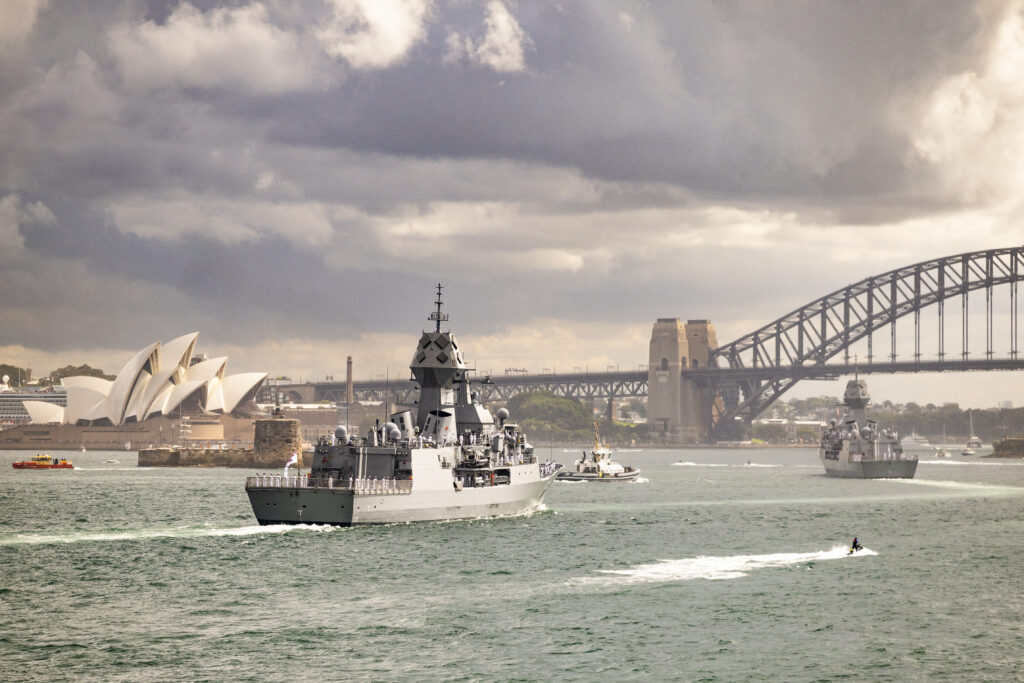
Exercise Kakadu is the Royal Australian Navy’s premier multinational maritime engagement activity in 2026. The Bluebottle USV will be featured alongside around 30 vessels from Australia and 18 other countries taking part in the Exercise Kakadu Fleet Review on Sydney Harbour to commemorate the 125th anniversary of the foundation of Australia’s Navy.
Robert Dane, Chief Executive Officer of Ocius Technology, said: “The Bluebottle USV is an operational capability already delivering persistent maritime surveillance for Australia. By participating in the Exercise Kakadu Fleet Review 2026, the Royal Australian Navy is making clear that uncrewed systems are an integral part of Australia’s advanced maritime capabilities. With Bluebottle USVs designed and manufactured right here in Australia, this important milestone also reflects the world-leading innovation of our maritime defence technology industry. Importantly, Bluebottle USVs are powered by renewable energy, utilising solar, wind and wave energy, meaning they require no fuel and are capable of long-endurance operations.”
Thirty-one ships from 19 nations conducted a ceremonial entry into Sydney Harbour for the 2026 Exercise Kakadu Fleet Review. Hosted by the Royal Australian Navy (RAN), the review is the largest gathering of foreign warships in Sydney Harbour in more than a decade and marks 125 years of the Australian Navy’s service to the nation.
A fleet review is a long-standing naval tradition in which a reviewing officer, embarked in a reviewing ship, inspects an assembled fleet. Historically, fleet reviews occurred when a battle fleet was mobilised for war. In the modern era, they have become important commemorative milestones that bring together partner navies to demonstrate shared commitment to maritime security and international cooperation.
The Fleet Review was being held in conjunction with Exercise Kakadu, the RAN’s premier multinational maritime exercise. This pairing transforms the occasion from a ceremonial event into a practical demonstration of regional partnership, readiness and interoperability.
Chief of Navy, Vice Admiral Mark Hammond, said: “The Fleet Review highlights the depth of our partnerships across the region, demonstrating the strength of the relationships and the importance of working together to ensure a secure maritime domain. For 125 years, Australia’s Navy has defended our nation, protected our maritime approaches, and supported regional stability but we have never done it alone. Our partners and allies have played a critical role in our 125-year history.”

For Editorial Inquiries Contact:
Editor Kym Bergmann at [email protected]
For Advertising Inquiries Contact:
Group Sales Director Simon Hadfield at [email protected]