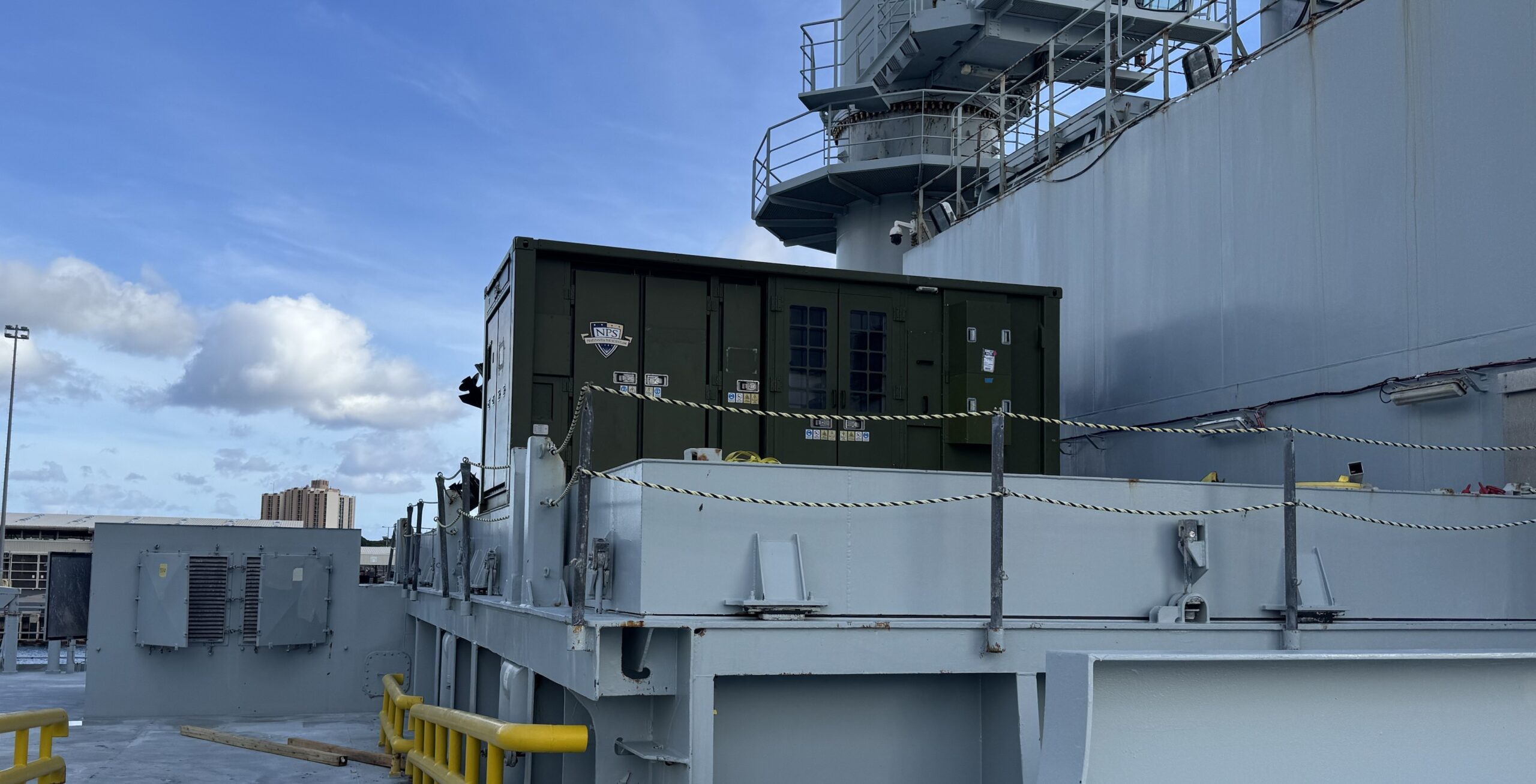
 In the first at-sea deployment of a SPEE3D system, a US joint-branch effort took cold spray metal manufacturing aboard Canadian partner vessel MV Asterix, producing mission-critical metal parts for participating forces across a distributed network reaching from ship to shore. At RIMPAC 2026, the Consortium for Advanced Manufacturing Research and Education (CAMRE) at the Naval Postgraduate School (NPS), with the US Army Combat Capability Development Command Army Research Laboratory (ARL) as its government lead, alongside the Tennessee Army National Guard and the University of Tennessee Knoxville (UTK) Defense Development and Applied Research Center (DARC), set out to close that gap: not from a depot, but from the deck of a ship at sea.
Working through a Partnership Intermediary Agreement with FLEETWERX, CAMRE deployed more than 50 advanced manufacturing technologies across the exercise, designed to deliver mission-critical readiness parts in days rather than months. As one of the technologies chosen, SPEE3D’s expeditionary capability, the Expeditionary Manufacturing Unit (EMU), operated aboard the MV Asterix while underway, putting production at the point of need rather than at the end of a supply chain.
During RIMPAC 2026, SPEE3D cold spray systems printed 32 mission-critical metal parts for participating forces through a distributed manufacturing network spanning ship and shore. Twenty-four were printed through the global reachback capability of the Knoxville Armory, and eight at sea aboard the MV Asterix using SPEE3D’s EMU system. Twenty-nine of the 32 were taken through to full completion, including heat treatment and machining.
“The ability to produce, post-process, and evaluate parts while operating at sea has direct implications for readiness and sustainment,” said Lt Col., USMC (Ret.) Chris Curran, Program Manager at CAMRE NPS. “This effort brings together government, academia, industry, and operational partners to test advanced manufacturing where it matters most, in the hands of the warfighter.”
SPEE3D’s capability runs on Cold Spray Manufacturing (CSM), which deposits metal powder at supersonic speed to build dense metal parts without melting, making it rugged and compact enough to work in the field and at sea. The EMU pairs the containerised XSPEE3D metal 3D printer with an integrated SPEE3Dcell post-processing and machining unit, so a part can go from print to finished component without leaving the ship.
The test was simple, and until recently would have been considered out of reach: prove that critical spares can be produced from metal powder, on-site and underway, keeping ships and forces operational when the supply chain cannot reach them.
“At RIMPAC 2026 we deployed our Expeditionary Manufacturing Unit at sea for the first time, printing mission-critical metal parts on an open deck in heavy seas aboard the MV Asterix, alongside the US Navy and the Royal Canadian Navy. That is what it means to bring production to the fight. Across our deployments, we have now proven Cold Spray Manufacturing in sub-zero, tropical, battle-damage and at-sea conditions, the proof that SPEE3D works where supply chains fail. We’re proud to have supported our partners in putting this to the test in one of the most demanding environments there is,” said Byron Kennedy, CEO of SPEE3D.
On the evidence of RIMPAC 2026, readiness no longer needs to be hostage to distance, and making a part on demand, wherever the mission takes you, moves closer to being a standard part of how the Joint Force and its allies operate.
“Producing parts at sea on NATO vessels using coalition equipment is an example of the flexibility and interoperability that are key to modern operations, ” said Morgan Bower, FLEETWERX Hub Director. “RIMPAC offers a unique opportunity to bring innovative advanced manufacturing capabilities out of the lab and test them in a realistic maritime environment.”
SPEE3D appoints Bryan O’Connor as global CEO
SPEE3D has appointed Bryan O’Connor as its Global Chief Executive Officer. He brings more than 30 years of senior executive experience across the aerospace, Defence and industrial automation sectors. The appointment comes as current SPEE3D CEO and Co-Founder Byron Kennedy relocates to the United States to build the company’s presence, partnerships and business across one of its most important markets. As Global CEO, O’Connor will lead SPEE3D worldwide while Kennedy focuses on driving growth in the United States.

O’Connor has held General Manager, Managing Director and other senior leadership roles with major multinational companies, including Moog and Apple, across Australia and Ireland. His experience in Defence, aerospace technologies, sovereign capability and international business development will support SPEE3D as the company enters its next phase of global growth.
As Moog’s General Manager, Asia-Pacific Defence, and Managing Director of Moog Australia, O’Connor grew the company’s regional Defence business and expanded its presence across the Indo-Pacific. He led the development of key markets and technologies while supporting major Defence programs and building strategic relationships across the region.
During his time in Australia, O’Connor oversaw the construction of new facilities in 2014 and a further major expansion in 2022, supporting Defence and aerospace programs across the region. He also played a key role in securing strategic opportunities across programs including ASCA, GCSP, F-35, GWEO and GMLRS, contributing to sovereign capability and Defence exports.
Adam Lewis, Chairman of SPEE3D, said: “Bryan’s experience building and growing Defence businesses across Australia and the Indo-Pacific makes him an exceptional fit to lead SPEE3D. His deep understanding of Defence markets, sovereign capability and advanced technologies will be a game changer as SPEE3D enters its next phase of growth.”
O’Connor said he was delighted to join SPEE3D at a critical time for Defence across the Indo-Pacific. “SPEE3D is developing game-changing technology with the potential to fundamentally change how Defence forces manufacture, repair and sustain critical capability in the field. The modern battlefield demands resilient logistics and the ability to sustain operations at Forward Operating Bases. It is increasingly a war of attrition, where speed, availability and resilience are critical. SPEE3D’s CriticalSPEE3D model has the potential to revolutionise Forward Operating Base logistics by enabling critical metal parts to be produced rapidly and close to where they are needed.”
Kennedy said: “SPEE3D has grown from an Australian start-up into a company shaping how Defence forces sustain capability around the world. Appointing Bryan as Global CEO is a key milestone in that journey, and it lets me focus on building our presence and partnerships in the United States. It is the right next step for our global expansion, ensuring we continue delivering cutting-edge, sovereign, and expeditionary manufacturing capabilities to our Defence partners and industrial customers.”

For Editorial Inquiries Contact:
Editor Kym Bergmann at [email protected]
For Advertising Inquiries Contact:
Group Sales Director Simon Hadfield at [email protected]