


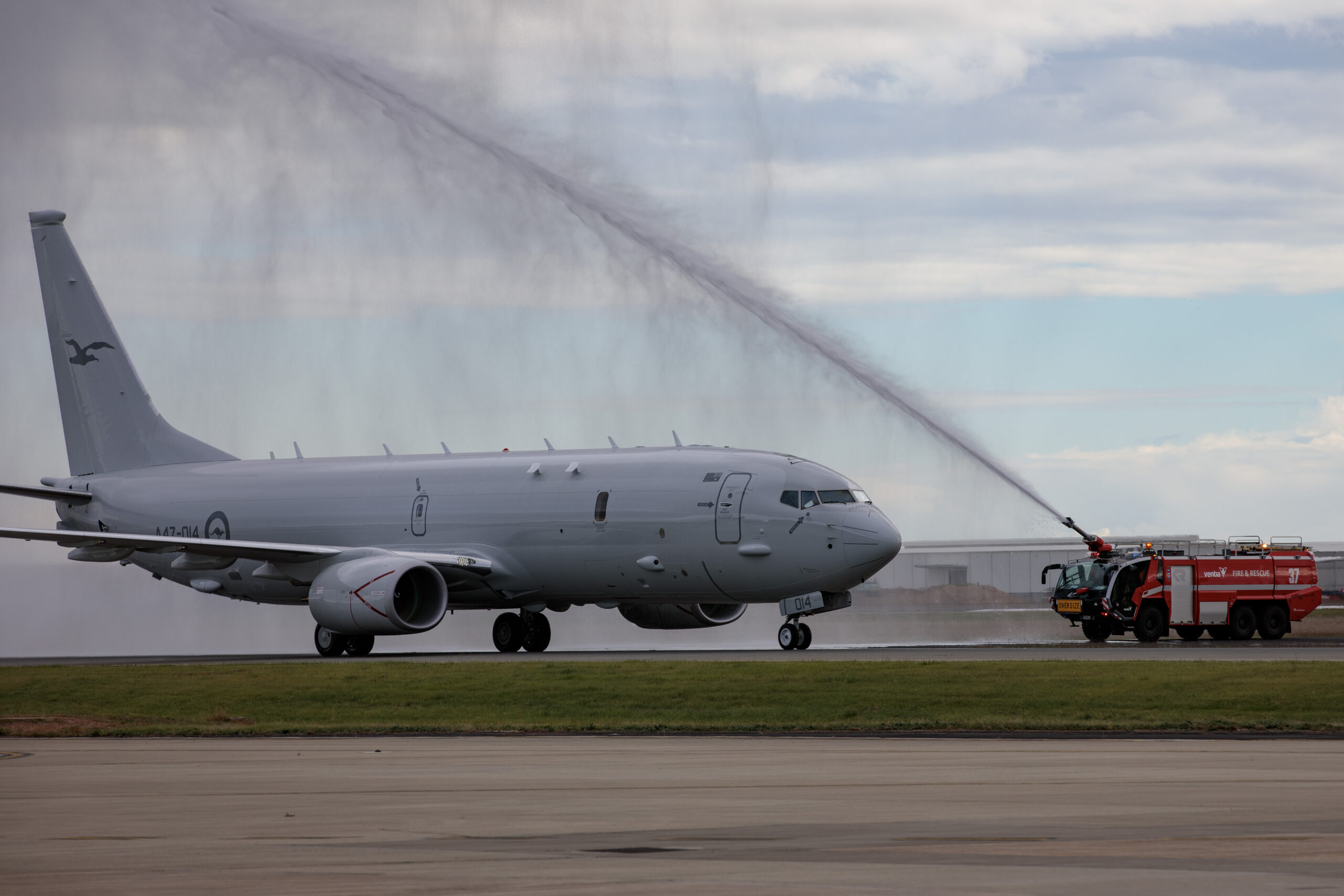
 The Royal Australian Air Force (RAAF) has taken delivery of its 14th and final P‑8A Poseidon aircraft, marking a significant milestone in strengthening Australia’s ability to conduct anti‑submarine warfare, maritime strike, and intelligence, surveillance and reconnaissance missions.
Chief of Air Force Air Marshal Stephen Chappell said the arrival of the final P‑8A Poseidon aircraft demonstrates Air Force’s commitment to delivering on the National Defence Strategy, strengthening Australia’s maritime surveillance and response capabilities to protect our nation and uphold regional security. “The P‑8A Poseidon fleet is a critical capability that underpins our ability to maintain awareness of our maritime domain, and enhances Australia’s capacity to detect, deter and respond to threats across its maritime approaches,” Air Marshal Chappell said. “By integrating advanced sensors, communications, and strike capabilities, the P-8A Poseidon plays a vital role in supporting Australia’s deterrence-by-denial strategy. As outlined in the 2026 National Defence Strategy, this is achieved by delivering persistent intelligence, surveillance, and reconnaissance across Australia’s primary area of military interest.”
The P‑8A Poseidon program reinforces Australia’s sovereign defence capability and supports jobs. It is underpinned by close collaboration with Australian defence industry, with Boeing Defence Australia and other local partners playing a crucial role in sustainment and future upgrades. This includes long-term maintenance and modification to enhance existing capabilities across the P-8A Poseidon fleet at the new Deep Maintenance and Modification Facility at RAAF Base Edinburgh.
Completion of the 14‑aircraft fleet enables higher availability, increased resilience and the ability to deliver sustained operations in support of Australia’s security and regional stability. To ensure the aircraft remains at the leading edge of maritime patrol and response operations, the capability will continue to evolve through planned future upgrades, including Increment Three Block Two modification, and deeper integration with allies and international partners. The aircraft will be operated by Number 11, 12 and 292 Squadrons out of RAAF Base Edinburgh, South Australia.

For Editorial Inquiries Contact:
Editor Kym Bergmann at [email protected]
For Advertising Inquiries Contact:
Group Sales Director Simon Hadfield at [email protected]



Acft #1 was delivered 27 September 2016. Acft #14 was delivered May 2026, a rate of capability growth best described as glacial.
Not a very clever comment, or trying to be too clever?
The 14 P-8A were approved/ordered in multiple batches.
Firstly, Eight + four options, those options later converted to orders.
The first airframe delivered in late 2016, the twelfth delivered 01/2020, that’s a period of approx 3 1/2 years.
Much later the 13th and 14th were ordered.
Not nearly as glacial as you’ve suggested.
I only notice these things because we have seen multiple negative articles on this website about the slow rate of introduction of UH-60M, where 22 will be delivered in under 3 years.
It’s an interesting comparison, considering the concerns about a capability gap for utility helicopters, when only 8 P-8s were ordered to replace two SQNs of P-3s, and only 4 P-8s were in service when the last of 24-ish maritime P-3s was retired in late 2017.
But I apologise if my characterisation of a 10 year journey to a 50% reduction in the maritime patrol fleet as glacial is unfair.
JB, You wrote:
“the last of 24-ish maritime P-3s was retired in late 2017” and “a 10 year journey to a 50% reduction in the maritime patrol fleet”
What the? 24-ish? 50% reduction? Seriously? Back to reality….
The fleet of 18 AP-3C were never planned to be replaced on a ‘one for one’ basis by P-8A, or in fact, by a single aircraft type, (three types eg, P-8A, MQ-4C and MC-55A).
Originally the fleet consisted of 20 P-3C, reduced to 19 after the loss of one airframe.
Of those 19 P-3C, 18 were upgraded to AP-3C standard, leaving one airframe unmodified (testing, trials, etc).
Further, two of the upgraded airframes were converted to AP-3C(EW) configuration, those two airframes remained in service until end 2023 (replaced by MC-55A).
This left 16 AP-3C airframes available for the ASW/Maritime Recon roles (excluding the two EW airframes).
So…..
The ordered/delivered airframes is as follows:
14 x P-8A – all delivered
4 x MQ-4C – three delivered
4 x MC-55A – two delivered
Net result is a planned (ordered/delivered) fleet of 22 airframes replacing 18 AP-3Cs.
Anyway….
It would appear the potential of a 15th P-8A, isn’t happening, the only other outstanding question is if the Government will eventually proceed with increasing the fleet of 4 (approved) MQ-4C to the proposed 6 or 7 airframes.
I thought there were 2 Sqns of 12 P-3s not 10. My mistake.
It’s good to see MQ4 and MC55 are now in service.