



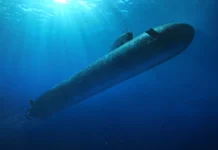
 The Australian Government held its fourth Product of Concern Summit in Canberra to support the sustainment of Australia’s Collins class submarines. Minister for Defence Industry Pat Conroy convened the summit alongside Minister for Finance Katy Gallagher and senior representatives from government and industry.
Since being listed as a Product of Concern in December 2024, Defence and the contractor, ASC Pty Ltd, have developed a remediation plan for the sustainment of the Collins class. This plan will ensure Collins class submarines remain among the most capable conventionally powered submarines in the world. Since the revitalisation of Defence’s Projects and Products of Concern process in 2022, the Albanese Government has strengthened the oversight and remediation of defence projects.
Remediation is being achieved through targeted workforce initiatives, process improvements and productivity reform. The Product of Concern framework continues to play a crucial role in driving cooperation, accountability and sustained action across government and industry.
This is the 12th Project of Concern Summit since May 2022.
Minister for Defence Industry, Pat Conroy said: “I was pleased to convene the fourth Product of Concern summit for the Collins class submarine fleet today. This process helps ensure Australia has a highly-capable conventional submarine fleet for many years to come, and as we transition to nuclear-powered submarines. By bringing Defence and industry together on a regular basis, we maintain oversight and transparency of the capabilities required by the Australian Defence Force to preserve peace and deter conflict. The Product of Concern framework, which was revitalised by the Albanese Government, provides a structured forum to collaborate and agree on remediation activities to support Collins class submarine sustainment outcomes.”

For Editorial Inquiries Contact:
Editor Kym Bergmann at [email protected]
For Advertising Inquiries Contact:
Group Sales Director Simon Hadfield at [email protected]





Conroy saying “This process helps ensure Australia has a highly-capable conventional submarine fleet for many years to come…” is a worry.
I haven’t seen enough mentions of the or a LOTE to be convinced heavy maintenance and upgrades will occur before the Collins timeout.
https://en.wikipedia.org/wiki/Collins-class_submarine#Submarines_in_class indicates the 6 subs launched about every 2 years between 1996 and 2001. Even a generous 35 years for each sub indicates Collins must retire in 2028 and Farncomb in 2030 etc.
As I estimate and Virginias and SSN AUKUSes will only be available in the mid 2040s, Australia will have a submarines gap.
I think you are correct about the looming submarine capability gap.
The fact that he appears to believe that yet another “summit” will achieve anything like he is describing tells you all you need to know.
My personal guess is that the Collins Class will be the last manned subs the RAN ever operates.
That’s a view I share. China already has XL-AUVs capable of laying mines outside all of the RAN’s bases. The situation 10 years from now will be far, far worse. Even Indonesia recently launched a torpedo from an XL-UAV.
I’m completely at a loss how any rational person can think that the Virginia Class Submarine is the right choice for the R.A.N.. Firstly, it has approximately twice the Crew ( the R.A.N. cant Crew what we have now) is around 30mts longer and uses HEU fuel which is almost impossible to store safely. The U.S. Ship Building is so far behind in its own commitment to the U.S.N. ( even with the Australian Hand outs it won’t improve in time ) It won’t even have enough for its own Fleet, let alone have some to sell ( even second hand ) . Secondly, While conceding that Range is of upmost importance, do we need a Boat that can Patrol the Sth China Sea and has a VLS, if it’s role is to be Defensive ? There is also the fact that the Brits ( who will design the AUKUS Boat ) haven’t exactly covered themselves in glory when it comes to building their own fleet. The old “tyranny of distance “ argument is a valid one ,to a point but that argument doesn’t hold up when the R.A.Ns role is supposedly one of Deterrent. I’m not opposed to moving to a Nuclear Powered Boat but am convinced that the Virginia Class is not the right option. Unless the end game is supporting the U.S.N. Offensive Capability.
I agree with your assessment – and you haven’t even mentioned the enormous cost of this undertaking. The only realistic hope Australia has is that XL-AUV technology will race ahead at such speed that by the 2030s crewed nuclear powered submarines will be largely irrelevant and the US will be giving them away for free.
You said it yourself: range is of the utmost importance.
The other aspect of utmost importance is speed: the faster a submarine is, the quicker uncertainty about its location grows. Non-nuclear submarines are relatively slow underwater, they essentially have to pick the right spot to wait to ambush a target, whereas nuclear submarines can chase a target down – even other nuclear submarines.
That’s mostly true about speed. Assuming a conventional submarine has a reasonable amount of charge in the battery pack they can also sprint quite quickly – but only for a short time. However, with improvements in battery technology, underwater performance will certainly improve for both speed and endurance. Nuclear reactors aren’t getting any better – it’s now a very mature technology – but with hundreds of billions of dollars being invested every year for EVs and storage systems, we can be sure that battery technology will keep improving and that will inevitably flow through to undersea systems. This inescapable trend seems to be well understood by navies such as those of South Korea, Japan and China, but unfortunately not by the RAN.
While SSNs can maintain high speeds, they have to stop – or dramatically slow down – at intervals for situational awareness because travelling quickly degrades sonar performance. When you lose situational awareness, it doesn’t matter how advanced your sub is, bad things can happen – as USS Connecticut found out the hard way in 2021: https://news.usni.org/2021/11/01/investigation-concludes-uss-connecticut-grounded-on-uncharted-sea-mount-in-south-china-sea