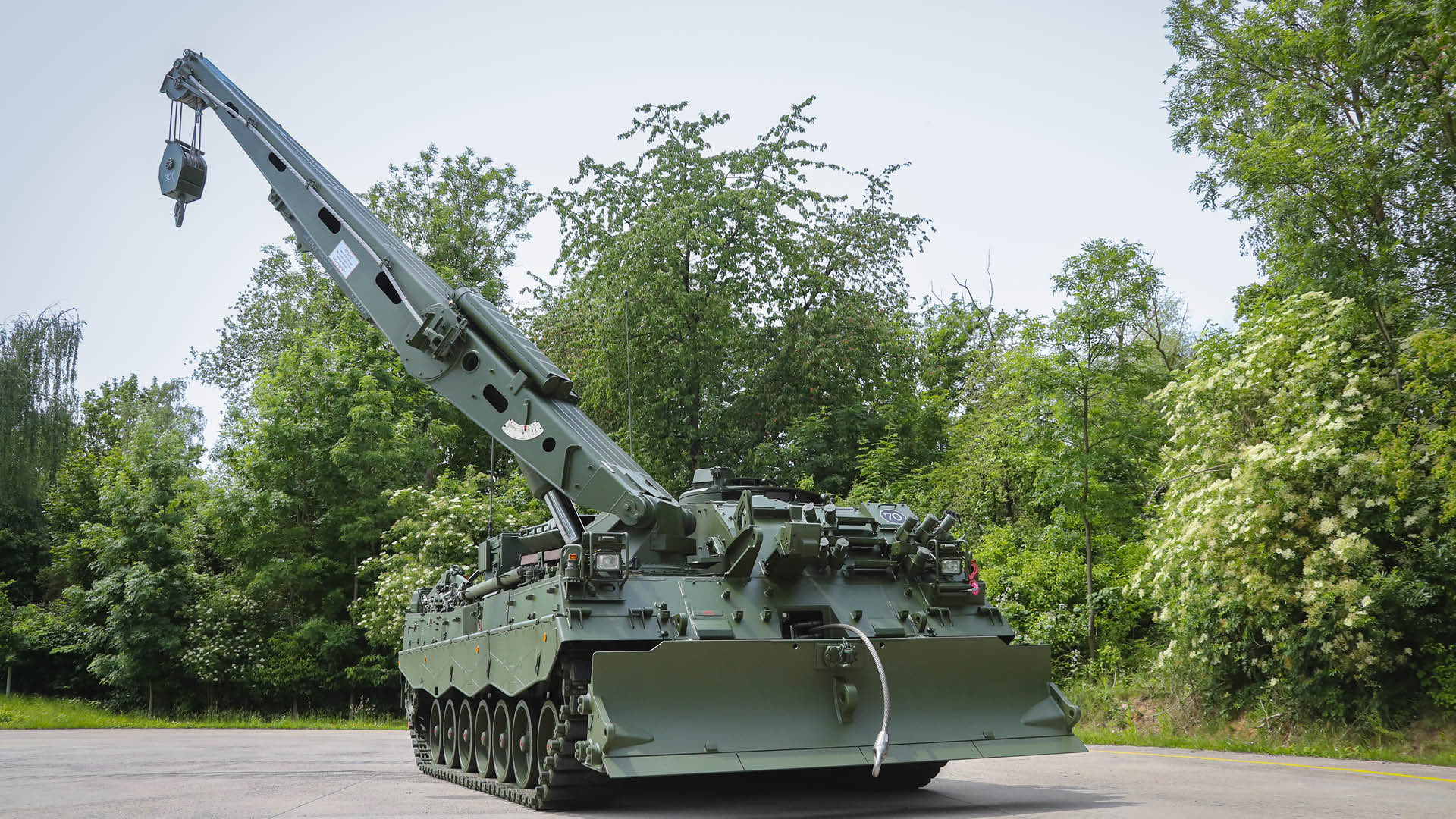
 Rheinmetall has received an order from the Bundeswehr for the replenishment of a total of 23 vehicles of the armoured recovery vehicle series, the so-called Bergepanzer 3 Büffel. This followed a corresponding budgetary decision by the Bundestag on 10 June 2026. The value of the replacement order amounts to a mid-three-digit million-euro range.
As part of Germany’s support for the Ukraine, 21 Bergepanzer 2 (BPz 2) and a further two Bergepanzer 3 (BPz 3) armoured recovery vehicles had previously been handed over to the Ukraine. The decision to issue a replacement order for 23 vehicles compensates for these transfers and strengthens the Bundeswehr’s capabilities in the field of armoured recovery and support vehicles. The first vehicle is scheduled for delivery as early as December 2027, just 18 months after the contract was signed. To enable this early delivery, the Group has pre-financed and commenced production in beforehand. The final vehicle is scheduled for delivery in June 2029.
The vehicles are a modernised, obsolescence-cleared version of the well-established Bergepanzer 3 and are known to the customer as the Bergepanzer 3 A2. The replacement order highlights the ongoing importance of the Bergepanzer 3 as a key support system for mechanised forces. This measure is not intended to develop new capabilities, but rather to ensure long-term operational readiness based on a proven, commercially available system manufactured using state-of-the-art processes.
This configuration reflects the current state of the art and offers potential for future upgrades. The Bergepanzer 3 therefore ensures vital long-term support for armoured forces and is designed for being in service for decades. Investing in a modernised, future-proof vehicle fleet lays the foundations for the long-term availability of this capability within the Bundeswehr.
Rheinmetall and General Atomics explore co-production of Vektrex artillery
Rheinmetall and General Atomics Electromagnetic Systems (GA-EMS) signed a Memorandum of Understanding (MoU) to explore cooperative production opportunities for Vektrex, a maneuvering 155 mm precision-guided munition. Vektrex extends the range and effectiveness of coalition artillery forces and addresses growing requirements for modernisation, long-range strike capability and munitions replenishment.
Driven by increasing international demand for industrial-scale manufacturing as governments rebuild depleted munition inventories, expand defence industrial capacity, and modernise artillery forces for high-intensity operations, the companies entered into the agreement to assess Vektrex as a cost-effective standoff capability. Vektrex integrates with fielded 39- and 52-calibre 155 mm artillery systems, enabling rapid integration across coalition force structures.
The MoU, signed by GA-EMS President Scott Forney and the CEO of Rheinmetall’s Weapon and Ammunition Division, Roman Köhne, builds on GA-EMS’ continued investment in precision-strike munition development and scalable manufacturing. Rheinmetall’s expertise in munitions and production, combined with its NATO-compliant infrastructure, positions Vektrex for large-scale series production to meet the requirements of Alliance and partner nations.
“Operational demand continues to outpace traditional guided-munition manufacturing output,” Forney said. “This collaboration helps allied industry expand long-range strike capability while leveraging artillery systems already deployed across coalition forces.”
Vektrex delivers manoeuvring strike capability in contested and GPS-degraded environments. Its glide-based aerodynamic design extends engagement range two to three times beyond conventional artillery projectiles while reducing integration risk for fielded artillery formations. The munition provides a lower cost-per-effect alternative to tactical missile systems for forces requiring survivable standoff fires.
“European and allied armed forces require long-range strike capabilities that integrate rapidly, scale efficiently, and remain sustainable through resilient multinational industrial networks,” Köhne said. “This MoU enables both companies to align advanced artillery technologies with established manufacturing infrastructure to support evolving operational requirements.”
The collaboration supports distributed co-production opportunities that can strengthen supply chains, accelerate fielding timelines, and expand industrial participation across allied defence sectors. As military requirements shift toward longer-range and higher-volume fires, Vektrex provides a scalable modernisation path for fielded artillery systems without requiring new launcher, propellant infrastructure, or logistics.

For Editorial Inquiries Contact:
Editor Kym Bergmann at [email protected]
For Advertising Inquiries Contact:
Group Sales Director Simon Hadfield at [email protected]